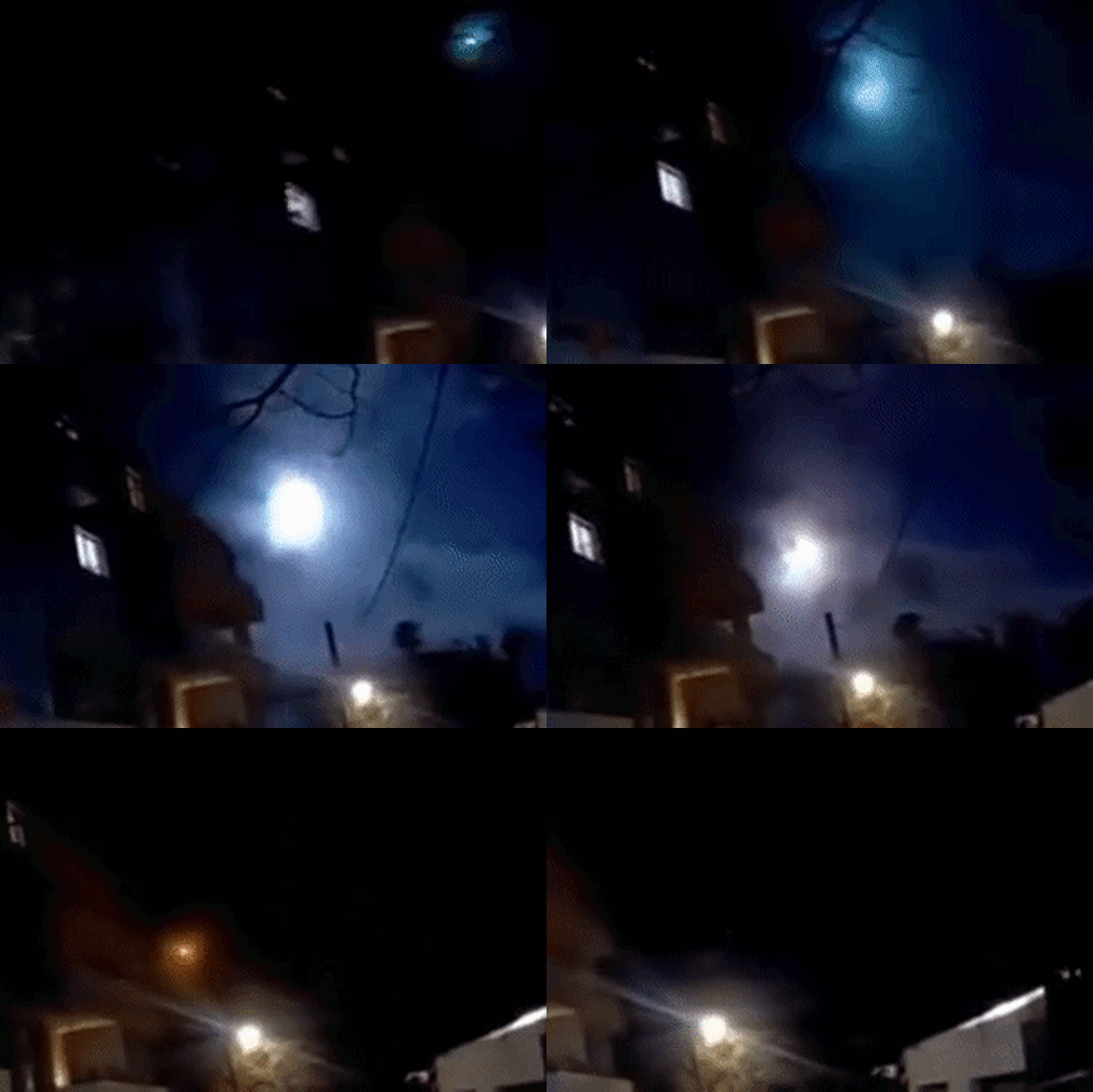

In an era when many stargazers are wasting their shooting-star wishes on falling space junk, what blazed across eastern Australian skies on Thursday night was a bona fide meteor – an exploding offcut of an asteroid or comet.
Early speculation has put the object at the size of a basketball, which rocketed to Earth on the faster end of a meteor’s speed range, between about 11 and 72 kilometres per second.
Experts are now analysing its trajectory to offer official estimates. The technical term for a meteor brighter than Venus is a “fireball”, said astronomer Professor Jonti Horner.
The meteor let off an explosive flash, which was captured from Bondi to regional NSW and Canberra.
“If we see one that has a very notable explosion then we call that a bolide. That’s just a technical term for ‘explodey meteor’,” Horner, from the University of Southern Queensland, said.
“If you’ve got an explosion, that means the thing has broken apart and has disintegrated, right?” Horner said.
The detonation indicates the meteor was probably rocky or icy in nature, as opposed to a rarer iron meteor.
“It looked to me to be a bit quicker than some of the other fireballs that we’ve seen. That suggests either that it’s coming in at a really steep angle, which is possible, or that it’s coming in at a high velocity, or a combination of both,” Horner said.
“A higher velocity probably means it’s moving on a more elongated orbit around the sun, so it might have the possibility of being cometary in origin rather than asteroidal.”
Comets are “dirty snowballs” of ice and dust that give off streaking tails as they pass the sun, just like the recent C/2025 R3 PanSTARRS comet. Asteroids, on the other hand, are hurtling space rocks.
When an object in space hits Earth’s atmosphere it becomes a meteor, and if it strikes Earth it’s called a meteorite.
It’s largely a myth you can tell what a meteor is made of depending on the colour of its glow, despite claims a greenish glow might indicate nickel, iron or magnesium.
“The green colour is going to come from the excitation of atmospheric oxygen because a lot of the light is from the superheated air, not from the thing itself burning up,” Horner said.
Rachel Kirby, lead geochemist for the Desert Fireball Network, agreed and said spectral cameras can detect what elements make up a meteor’s surface but the constellation of phones and dashcams that recorded the spectacle last night cannot.
“[About] 95 per cent or so of that light is from the surrounding atmosphere, not from the meteor itself,” she said.
Space junk travels much slower than a meteor, which is why it burns orange-red rather than blue-green.
Most meteors originate from the asteroid belt orbiting between Jupiter and Mars. Some are called carbonaceous chondrites, which are stony asteroid fragments.
“Chondrites are really valuable to scientists because they’re pieces that have gone relatively undisturbed since the formation of the solar system,” Horner said.
Other metallic meteorites may come from large asteroids 200 to 300 kilometres across, or protoplanets. These cosmic bodies are big enough to have heat build in their bellies and the beginnings of molten metallic cores.
“You get effectively an object with a core, a mantle and a crust, just like the Earth. Iron-nickel meteorites are fragments of the cores of these objects,” Horner said.
“There are also the ‘stony irons’, which can be really beautiful. They have metal interwoven between rock on that boundary between the core and the mantle, so you’ve got a bit of both mixed together.”
Thursday night’s meteor probably exploded over the ocean, taking its secrets with it, unlike the Perth Mother’s Day meteor that the Desert Fireball Network managed to track down for analysis.
But for people who suspect they’ve discovered a freshly fallen meteor chunk, Horner said there are some key rules to observe.
“What they should do is imagine it’s dog poo,” he said, and collect it with a bag so you avoid contamination.
Don’t test it with a magnet, either, to see if there’s metal – this can erase fossilised evidence of magnetic fields, which scientists can detect to see what kind of asteroid it may have come from.
Finally, stick it in the freezer, which will preserve precious evidence of space water.
Kirby said the vast majority of “meteors” people report are simply rocks but it’s worth adhering to these rules if you’re in the known “strewn field”, or landing zone, of a recent meteor.
Analyses of meteors and meteorites can reveal much about the cosmos.
“We use a mix of the trajectory analysis but also the chemistry to work out, did it come from Mars? Did it come from the moon or the asteroid belt?” Kirby said.
“These are samples that sometimes are as old as our solar system itself.”
The Examine newsletter explains and analyses science with a rigorous focus on the evidence. Sign up to get it each week.
 Angus Dalton is the science reporter for The Sydney Morning Herald.Connect via X or email.
From our partners
Disclaimer : This story is auto aggregated by a computer programme and has not been created or edited by DOWNTHENEWS. Publisher: www.smh.com.au