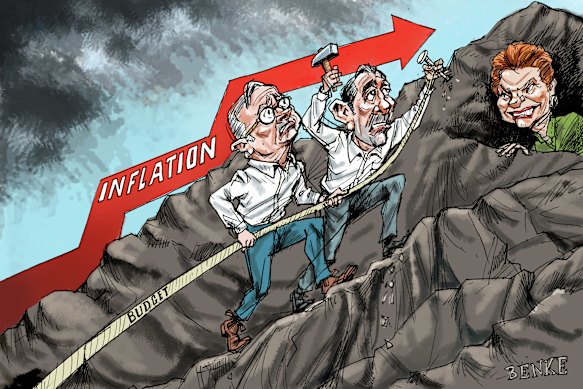
The Albanese government is confronting two uncomfortable facts. The first is clear: the political landscape has become incredibly rocky. But the second will cause it more concern: that landscape is about to become even rockier.
When the government delivers its next budget, in three weeks and a day, that is the environment in which it will be operating.
To get some sense of just how fraught things have become, cast back to January, when Labor began hinting at a reform budget. Soon, it seemed this meant changes to housing taxes. Inflation had begun rising in the preceding months, which meant that any talk of raising taxes could be difficult. Still, it was well beyond time for such changes: it seemed possible that voters would be receptive.
Then the US and Israel attacked Iran. A fuel crisis threatened. What did all this mean for the budget? Would the government retreat to safety, away from reform?
But then another twist: in the South Australian election, One Nation matched its polling success with actual success. This placed an argument on the other side of the scales: a government needing to appease angry voters could not afford to delay action on housing inequality further.
The war in Iran kept going. Events became more uncertain. And that is where they remain today.
If you were advising the government purely on the politics of the moment, what would you suggest? Carry on as planned with a budget of politically contentious tax reform? In a situation in which voters want you focused on one thing – and in which cutting through with reasoned arguments on any other topic might be tough? Or would you delay such changes until later – perhaps even delay the budget itself until after the Iran crisis had passed?
But what does that mean? When will the crisis have “passed” for Australia?
Three weeks ago, Anthony Albanese delivered an address to the nation. In some quarters, it was panned for not telling anyone anything they didn’t know. This missed the fact that Albanese’s most notable quality as prime minister has been the skill of reassurance. The absence of news offered exactly that.
And Albanese was offering reassurance of another sort, too. What he had to say about fuel use received the most attention. But in fact, his first lines were all about prices. First, a spike in fuel prices. Then the issue of “paying higher prices” in general – mentions of “the servo” and “the supermarket”. Those opening lines indicate that Labor understands what is likely to be the dominant political factor in coming months – and that Albanese wants to make sure voters know he knows.
Fuel rationing and recession – either global or local – are possible. But inflation is a certainty. That is the major context in which the budget will be delivered and – even more crucially – in which any budget measures will be legislated. The difficulty of delaying other reforms until “all this has faded away” is that “this” could come much, much later.
Labor has been here before, of course. In its first-term inflation crisis, the strategy that eventually worked for it had two parts. One: give money to voters. Two: don’t do anything to distract from No.1. That playbook is unlikely to work this time – for three reasons.
The first is obvious: like the government, voters have been here before. They will be more eager to blame anyone they suspect of making things worse. So simply handing out more money has become riskier.
The second reason is in the timing of the inflation peak. I’ve written before about research showing governments lose elections 40 per cent of the time – unless the election is within two years of an inflation spike, in which case they lose 80 per cent of the time. The 2025 election was outside that two-year danger zone. This time, inflation is likely to peak in the middle of 2026, meaning the 2028 poll will still be dangerous for Labor. Its majority is so large that losing is unlikely, but it might be more challenging than expected.
The third reason lies in a lesson from last term. For months and months, Labor’s polling numbers fell. The prime minister’s personal image suffered. Newspoll found he was seen as the least strong and decisive PM since that measure was introduced in 2008. Inflation seemed the major cause. But it is also true that the government’s softly-softly approach meant it had not defined itself in voters’ minds. The result was that a crisis – about which it could only do so much – ended up playing a disproportionate role in defining it.
This is the danger for Labor of not doing something large on housing soon. Avoiding reform may encourage voters to believe the government is laser-focused on inflation, at the cost of compounding the other risk. Labor could end up looking weak, both because inflation makes every government look weak and because it has not taken other chances to define itself. If, by then, Andrew Hastie – who says he is open to action on housing taxes – is Liberal leader, Labor could even end up gazumped by the Coalition.
The question of just how much to do is also a tricky one. Labor’s instinct is usually to take the most minimal option: here, that would be some grandfathered, severely restricted change. Perhaps, because the area of housing taxes has been taboo for so long, this will cut through. But it is also possible that it ends up feeling similar to Labor’s recent gambling changes: surprisingly small for something that has taken so long. Something that fails to convince voters it is really committed to fixing the problem.
There is another lesson from Labor’s first term – one only now making itself felt. At the time, with inflation rampant, it seemed like a difficult period in which to attempt large reforms. How much simpler those times seem in retrospect. Pauline Hanson, Iran and inflation’s return are a reminder: in politics there is never any guarantee that things will become easier later.
Sean Kelly is an author, a regular columnist and a former adviser to Julia Gillard and Kevin Rudd.
 Sean Kelly is author of The Game: A Portrait of Scott Morrison, a regular columnist and a former adviser to Julia Gillard and Kevin Rudd.Connect via X.
From our partners
Disclaimer : This story is auto aggregated by a computer programme and has not been created or edited by DOWNTHENEWS. Publisher: www.smh.com.au