
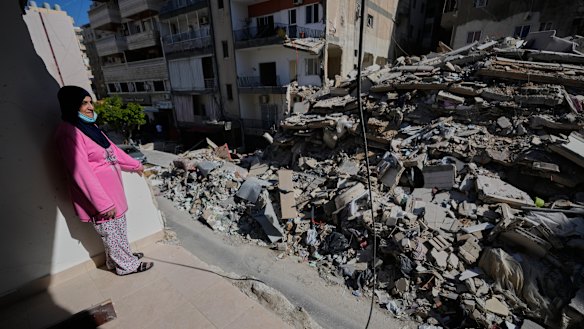

London: The casualties are mounting after almost two months of deadly attacks in Lebanon, despite a ceasefire that is supposed to pause the fighting.
Israeli forces are bombarding towns in southern Lebanon and sending bulldozers into villages to demolish buildings, while Hezbollah fighters are firing rockets into civilian areas of northern Israel.
The airstrikes killed nine people on Thursday alone – including two children – when Israeli forces targeted communities in the south, according to the Lebanese Health Ministry.
For the agencies trying to help civilians, the crisis is worsening, even when the headlines hold out the promise of a peace deal.
“What we are seeing on the ground goes beyond a humanitarian crisis to being a protection and health crisis,” says Anandita Philipose, a United Nations official who leads the work in Lebanon to help women and girls.
“We are deeply concerned about the attacks on health care. Women and girls are in a deeply, deeply troubling situation on the ground.”
Philipose is the representative in Lebanon for the UN Population Fund, or UNFPA, an agency that is backed by 144 countries to help with maternal health worldwide.
She estimates that 620,000 women and girls are among those displaced by the war in Lebanon – and that 13,500 pregnant women are among them.
While there is a nominal ceasefire in place, and Lebanese President Joseph Aoun says he wants to negotiate a peace deal with Israel, there are few signs of progress. US President Donald Trump announced the ceasefire on April 16, saying it would last for 10 days, and later extended it by three weeks. This suggests it could end by May 17 unless a deal is struck.
There are suggestions that Israeli Prime Minister Benjamin Netanyahu could fly to Washington in the week ahead for talks with Trump, but the most important message from Israel comes from its military. Netanyahu wants to crush Hezbollah, and Trump pays more attention to the Strait of Hormuz.
Meanwhile, the UNFPA and other agencies report growing pressure on civilians.
“We are asking for protection of civilians, but also protection of healthcare workers that have come under direct attacks, as well as protection for frontline humanitarian responders,” Philipose tells this masthead.
“Many of these women have left their homes in a hurry. They barely had enough time to put clothes on their back, let alone planning ahead for their children.”
The UN agency has set up mobile clinics to offer health support, and has supplied women and girls with “dignity kits” including sanitary napkins, deodorant, towels and other basic supplies for those living in shelters or on the streets.
The kits also include guidance about where to get more help. Philipose says sexual assault and rape are among the dangers.
“In any crisis where women have come under huge pressure and stress, there is a sharp rise in gender-based violence, and Lebanon is no exception,” she says.
“We don’t share data around the cases we’re seeing because they’re highly sensitive, but what we know is that the risks are extremely high.”
Funding is a challenge, as with any agency in a crisis. The UNFPA is running a “flash appeal” to raise $US12 million (about $17 million) for services in Lebanon, but it has only received a fraction of that sum so far.
“We’ll be able to deploy more midwives,” says Philipose of the purpose of the funding appeal.
“We currently deploy around 40, but we’ll be able to deploy more, and as you know, midwives are often the backbone of the maternal health system.
“We’ll be able to deploy more social workers. All of this is contingent on what funding is coming through the pipe.”
About 1.2 million people are living with high levels of acute food insecurity in Lebanon, according to a new alert from the Integrated Food Security Phase Classification group, a peak entity backed by the UN.
In southern Lebanon, this means that 55 to 65 per cent of the population faces acute food shortages.
Attacks continue on both sides despite the ceasefire, with the Israel Defence Forces saying a contractor was killed on Tuesday while operating a bulldozer in southern Lebanon.
While the IDF says the bulldozers are used to clear infrastructure built by Hezbollah, the militia backed by Iran, Lebanese authorities blame Israel for destroying civilian property in villages close to the border.
The IDF also said an Israeli soldier was killed, and six others were wounded on Sunday when they were targeted by a Hezbollah drone in southern Lebanon.
The Lebanese Ministry of Public Health says the death toll from the fighting since March 2, when Hezbollah launched attacks on Israel, has reached 2586. Another 8020 have been wounded.
The Lebanese president has rebuked Hezbollah leaders for questioning his decision to hold direct talks with Israel in the hope of securing an armistice.
The comments from Aoun earlier this week highlighted the tension in Lebanon over Hezbollah’s decision on March 2 to support Iran by launching rocket attacks on civilian communities in northern Israel, bringing weeks of deadly retaliation with airstrikes on Lebanese communities.
“My goal is to reach an end to the state of war with Israel, along the lines of an armistice agreement,” Aoun said on Monday during an event at the presidential palace in Beirut.
He did not name Hezbollah, but he appeared to respond to Hezbollah leader Naim Qassem, who had issued a statement hours earlier saying there should be no direct talks with Israel.
“What we are doing is not betrayal,” Aoun said, according to Beirut newspaper L’Orient Le Jour and other media.
“Betrayal is committed by those who drag their country into war to serve external interests. Some criticise us for deciding to go to negotiations on the grounds that there is no national consensus. I ask: When you chose war, did you have national consensus first?”
A key criticism of Hezbollah is that it brought danger to Lebanese civilians by launching its attacks on Israeli communities when there was no consultation or consensus on its decision to side with the Iranian regime. And the Lebanese Army lacks the military power to keep the Islamist militia group in check.
Israel insists it is right to continue its attacks because it is destroying Hezbollah’s bases and infrastructure. Under the terms of the ceasefire, Israel has the right to use force against “planned, imminent or ongoing” attacks.
Aoun, a former army general from a Maronite Christian family, calls the Israeli attacks a blatant violation of the agreement.
The Israeli demolitions in southern Lebanon are preventing people from returning to more than 50 villages. “We can’t go back. It’s been bulldozed – basically there’s nothing to go back to,” said Ibrahim Hamza, the mayor of the coastal town of Naqura, to Agence France-Presse.
On Thursday, Israeli forces issued another series of evacuation warnings for villages around Nabatiyeh, a town in the south where many people began leaving weeks ago. Nabatiyeh had two hospitals operating under severe pressure when this masthead visited in March.
An Israeli attack in the Nabatiyeh district on Thursday destroyed a home in Jibchit, according to Lebanon’s National News Agency, killing four members of one family. A strike nearby, in the village of Toul, left one victim dead. The victim was a child.
Get a note directly from our foreign correspondents on what’s making headlines around the world. Sign up for our weekly What in the World newsletter.
 David Crowe is Europe correspondent for The Sydney Morning Herald and The Age.Connect via X or email.
From our partners
Disclaimer : This story is auto aggregated by a computer programme and has not been created or edited by DOWNTHENEWS. Publisher: www.smh.com.au


