There’s a welcome familiarity to Sally Field that emanates through the screen as you watch “Remarkably Bright Creatures,” a charmingly sweet adaptation of Shelby Van Pelt’s hit 2022 novel of the same name. The actor, 79, has been a part of viewers’ lives for decades, from TV shows like “The Flying Nun” and “The Girl With Something Extra” to films like “Norma Rae,” “Places in the Heart” and “Mrs. Doubtfire.” She’s maintained a thriving career on screen and on stage since, with “Remarkably Bright Creatures,” directed and co-written by Olivia Newman, as her most recent endeavor.
The Netflix film, which begins streaming Friday, has actually been in the works long before Van Pelt’s book spent more than 64 weeks on the New York Times bestseller list.
“It came to me very early in galleys of the book,” Field says, speaking over video call from her home in Los Angeles. “I read a few chapters and said, ‘Yeah, let’s find a way to set this up and get it made.’ But it was a long haul to get it to where it is and to get the screenplay right because it’s a wonderful and complicated little book and all of the pieces had to be in place. You can’t lose the magic.”
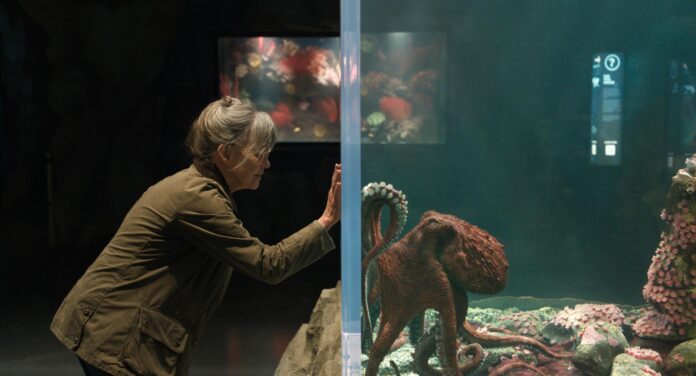
Field plays Tova, a lonely widow living in a fictional coastal town in Washington. She spends her nights cleaning the local aquarium, where she befriends a Pacific octopus named Marcellus. It’s Marcellus who narrates both the novel and the film — he’s voiced by Alfred Molina — and it’s Marcellus who helps to form a connection between Tova and down-on-his-luck newcomer Cameron (Lewis Pullman). For Field, the relationship between nature and humanity is what elevates the film.
Sally Field as Tova and Marcellus the octopus in Netflix’s “Remarkably Bright Creatures.”
(Netflix)
“It’s an homage to ocean creatures and to creatures altogether,” she says. “Human beings have an extraordinary connection to creatures. I always choose things because they somehow affect me. In a lot of ways, [the film] is about the planet and losing these creatures and losing the sea life. These marvelous, magical creatures that live in the ocean.
“We’re ruining our oceans. We’re ruining the planet,” she continues. “We’re killing each other. Is anything good happening? I don’t know. But in this little movie, there are some good things happening and that’s nice to do in the midst of everything.”
Here, in a conversation edited for length and clarity, Field discusses making “Remarkably Bright Creatures,” her transition from TV to film and why she can’t help but keep continuing to perform.
How would you describe the connections you’ve experienced with creatures?
I didn’t until the pandemic. I always had dogs, but they were my son’s dogs. Big old goldens. They would wait at the door. They could have cared less about me. I had no real connection with them. And then right before we even knew there was a pandemic, for some strange reason, I got this little puppy. He was 8 weeks and weighed 6 pounds, and I brought him home thinking, “What have I done? What am I doing?” And three weeks later, we were in shutdown. He was my contact. He was my everything. His name is Dashiell Hammett — I call him Dash. And so the story of Marcellus and Tova and how important Marcellus is to Tova resonated in me.
Did you immediately understand Tova?
No, I had to find her. I had to find a place where she and I met. We met in the middle. Tova’s crabbiness certainly fits with mine right now. And her age. I’m old, she’s old. And it’s very hard to find films about older people — women most especially. There are lots of movies about older men with great characters. And I don’t really like the movies about older women just looking for a date. Is that what we’re looking for? Still? I don’t think so. So this one was about some of the things that older women are facing: aloneness and loneliness and friendship and loss and family and healing.
What sort of work did you have to do to meet in the middle with the character?
I’ve been doing this for 62 years. I studied for a long time. Not every actor works like I do, but I studied with Lee Strasberg, so I work very much from my interior. Breaking down who the character is, her history and trying to find a way that the pieces of me can link with the pieces of the character. I think what it is about Tova that people identify with is her loneliness. You see her at work at night where she lights up when she’s talking to things that can’t talk back, but she feels that they do. The first time you meet Tova you see her react to these creatures and then go home to her isolation.
Did you film in a real aquarium?
We shot in magnificent Canada. I underline that — magnificent Canada — because I’d like to be an honorary citizen. There is an aquarium in Vancouver and we shot there for one great night to get the shark tank and the bigger tanks. The other tanks, for Marcellus and the seahorses and the wolf eels, were on a stage.

“I think what it is about Tova that people identify with is her loneliness,” Field says. “The first time you meet Tova you see her react to these creatures and then go home to her isolation.”
(Christina House / Los Angeles Times)
How was Marcellus created?
I won’t say. It’s extraordinary what these guys did, but I won’t say so much because it spoils the magic.
Did you know Lewis Pullman before working with him in this film?
No, I had worked with his dad [Bill Pullman] in the U.K. There’s a reason why Lewis is such a diamond. Bill is such a wonderful actor and man to stand across from the stage. I couldn’t have asked for a better human being to be at the Old Vic. That was a glorious time. Lewis said he did come to see the play, but I never met him.
How did you and Lewis explore the relationship between Tova and Cameron?
We had to explore what was on the page and what we knew from the book just by playing the scenes. But also I knew early on that he was absolutely the right person to do this because we’d had a brief meeting where he and I began to improv. A lot of what you see between the two of them is just improv. It’s me being Tova and him being Cameron.
The film is uplifting, but it’s also about grief and isolation. What sort of headspace were you in while making it?
I was in Vancouver for two and a half months. I always just think of it as work. You put yourself where you need to be and you live that life. That’s what the job is. It’s relentless all day long and then you go back and eat something and you get ready for the next day.

Field with Lewis Pullman, who plays Cameron in “Remarkably Bright Creatures.”
(Netflix)
Has the experience of the job changed for you over the years?
The jobs change. The locations change. The characters change. The requirements therefore change. And I’ve changed. So nothing ever stays the same, as they say.
What is it that keeps you wanting to act?
I found the stage when I was 12. And then I never left the stage. Once I found the stage, it was something I couldn’t not do because I was a little girl raised in the ‘50s and I [grew up] in the ‘60s. I had no contact with my voice, my own. I couldn’t hear myself because I was taught not to. I thought you weren’t supposed to do this and you couldn’t say that. You had to sit like this and you had to wear that. If I had any emotion, anger or pride, my grandmother would say, “Don’t be ugly.”
Then I found the stage and I found my voice and instead of clamping it down, I could let it out, whatever it was, wherever it came from. Things I didn’t know I felt would just come out. On the stage, you weren’t a bad person for being angry. It took a long time for me, eventually, to get to a place where I could study and learn how to harness it, learn how to use it, to manipulate it. So why have I done this all this time? Because I can’t not do it. And I’m fortunate enough to be able to do it.
How many projects do you typically work on in a given year?
Because I’m female, even in my prime, I’ve never done more than maybe a film or a project every year, or year and a half. Unless I was doing a series, which is really hard. You work 24 hours a day, eight months out of the year.
What do you consider as the prime of your career?
When I finally started in film. It was hard for me to get out of television because I started in television in 1964. And in 1964, if you were doing situation comedy television and you didn’t get out of there, especially if you were a woman, you never got out. You lived and died right there. I couldn’t get on a list for an audition because they identified me with situation comedy television. And in those days, television and film did not mix. So it took a real rigor for me to know that if I wasn’t where I needed to be, I had to get better.
One very important moment was around 1972 or 1973 when I auditioned for something and I knew no one even wanted me there. I came into the room with some directors and writers and people sitting around. I had to take that rage and harness it. And then they began to listen. It was for a project called “Sybil.” I did get it because they couldn’t not give it to me. “Sybil” eventually led to the film that really began my film career, which was “Norma Rae.”

Why does Field continue acting? “Because I can’t not do it. And I’m fortunate enough to be able to do it,” she says.
(Christina House / Los Angeles Times)
Your 1985 Oscars speech for “Places in the Heart” is quoted a lot. Do you ever reflect back on that moment?
First of all, it is misquoted. Finally, I won my second Oscar. That whole year — I won my first Oscar, [it] had been so jaw-dropping I hardly felt it so. But the time I won the second Oscar, I said, “I need to allow myself to feel this. I have to recognize how hard it has been for me to get here, and finally, I am here. And for this one moment in time, I have to allow myself to hear that you like me.” It’s not that I just stood up there and said that. To be honest, I’m getting tired of being asked this question. Look it up and see what I really said.
Have you always had a balanced relationship with the stage, film and television?
I wish I had more time to explore the stage. I was so locked in to being in L.A. most of my life that I couldn’t get to the stage until way later. I was always raising kids, so I couldn’t just go off and be in New York for six months to do a play. Eventually, they were grown and I could get to the stage. That’s a medium I wish I knew more about. I have so much to learn because that is by far the hardest. It takes a lot of miles in that saddle to be able to navigate it easily without letting it kill you. As an actor, I keep changing. Every decade, I’m 10 years older and that’s a whole different world to explore.
Do you have any other upcoming projects?
I’m months away from being 80, so it’s very hard to find anything. It’s very hard to find stories that are worth telling. There are more and more roles now for women, but are they better roles? I don’t know. How many of them are really complicated, interesting characters or highly entertaining movies? I’m thinking my next project is on stage, but I’m waiting to see what happens with that.
Is there something in particular you hope resonates with people when they see “Remarkably Bright Creatures”?
Whatever they want. You can’t think about that. You have to do the work and let the pieces fall where they may.
More to Read
Disclaimer : This story is auto aggregated by a computer programme and has not been created or edited by DOWNTHENEWS. Publisher: latimes.com