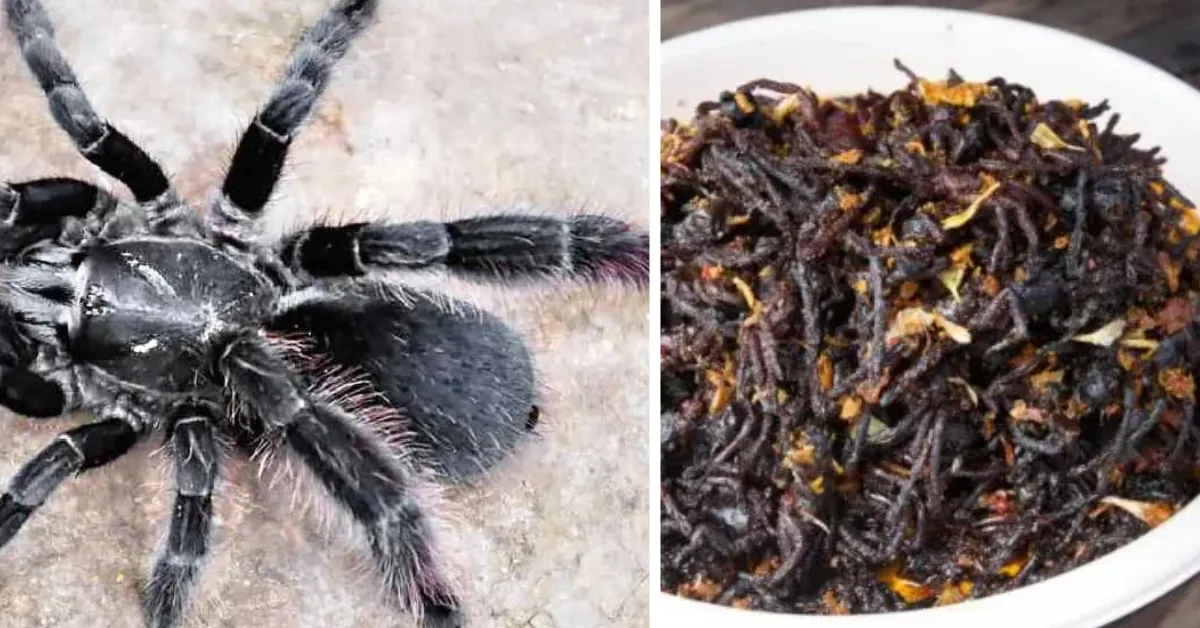
For Bhupen Rabha, a village elder in Assam, eating spiders is a food tradition he grew up with.
He remembers how his parents and grandparents collected large, hairy spiders from the nearby forests, brought them home and prepared them as a seasonal delicacy.
The spider, locally known as Bhaluk Makara, is the Indian Black Earth Tiger Spider (Lyrognathus crotalus), a species of tarantula native to Northeast India.
Every year, between April and June, members of the Indigenous Rabha community in Assam’s Kamrup (Rural) district collect these spiders from underground burrows along the edges of sal forests.
Back home, they wash the spiders, soak them in hot water and fry them in mustard oil with salt and garlic powder. The dish is traditionally enjoyed with locally prepared rice beer.
But why do they eat spiders?
For the Rabha families who follow this practice, the answer lies in generations of food knowledge, the seasonal availability of the spiders and their close relationship with the surrounding forests.
In August 2026, a study published in the Proceedings of the Zoological Society documented the community’s consumption of this particular spider species for the first time in scientific literature.
The research offers a closer look at how this food tradition has survived across generations, while raising important questions about the conservation of the species.
How are these forest spiders collected and cooked?
Around 65 kilometres southeast of Guwahati lies Mouman village, where members of the Rabha community live close to forests dominated by sal trees.
Here, Bhaluk Makara lives in underground burrows.
Its local name comes from its appearance. Bhaluk means bear, referring to the spider’s large, black body covered in dense hair, while Makara means spider.
To understand the community’s relationship with the species, researchers Jyotiprakash Boro, Kuldeep Bora, Chandramita Boro and Samir Terdalkar conducted fieldwork between April and June 2025.
They interviewed 34 Rabha community members, including village elders and experienced collectors, to understand when the spiders are gathered, how they are prepared and how the practice has been passed down.
According to the villagers, the spiders are particularly abundant during April and May, making these the preferred months for collection.
Collectors typically venture into the forests for three or four days a month during the peak season. Depending on availability, a single outing can yield around 20 to 30 spiders.
Finding them requires familiarity with the forest.
Collectors identify burrows along the forest fringes and either carefully dig into the ground or insert a wooden stick to encourage the spider to emerge.
Once collected, the spiders are brought home, washed and repeatedly soaked in hot water for several minutes.
They are then fried in mustard oil for approximately seven to 10 minutes until browned, with salt and garlic powder added for flavour.
For families who have followed this practice for generations, collecting Bhaluk Makara involves knowledge of the spider’s habitat, seasonal availability and preparation methods learnt from their elders.
Why has the Rabha community been eating spiders for generations?
For the Rabha community, Bhaluk Makara is part of a wider food culture closely connected to the surrounding forests.
Agriculture is an important livelihood, while fishing, livestock rearing, weaving and gathering forest resources are also part of community life.
Rice is a staple food, accompanied by fish, meat, vegetables and locally collected edible plants.
Bhaluk Makara belongs to this tradition of preparing foods available in the local environment.
The practice has been passed down through generations, with older family members teaching younger ones where to find the spiders and how to prepare them.
Bhupen Rabha told Mongabay India that the tradition had been passed down orally within the community.
“The spider was regularly collected and eaten by our parents and grandparents as a seasonal delicacy,” he recalled.
And the tradition continues among younger community members.
Ashok Rabha, a spider collector in his early 20s, described gathering spiders as an enjoyable shared experience and “a kind of rite of passage”.
For him, searching for burrows, collecting the spiders and eating them together is also a way of participating in a practice learnt from earlier generations.
Rohini Kumar Nongbag, another experienced collector, told Mongabay India that younger people continue to collect the spiders during the pre-monsoon months.
These accounts show that the practice remains part of community life, rather than something remembered only by older generations.
However, researchers point out that the tradition may be limited to particular Rabha villages and households, rather than being followed by the entire community.
Similar food practices have also been documented elsewhere in Northeast India.
In March 2026, a study published in Frontiers in Sustainable Food Systems recorded the consumption of two species of orb-weaver spiders among Indigenous communities in Nagaland.
Known locally as siyankyü in the Lotha Naga language, these spiders are prepared using ingredients such as ginger, chillies and bamboo shoots.
Researchers interviewed 33 people and found that knowledge of collecting and cooking the spiders was similarly passed down through generations.
Although the species and recipes differ, both studies show how traditional food practices are connected to local biodiversity and the knowledge communities have developed over time.

Can this food tradition continue while protecting the spiders?
While the August 2026 study has documented an established food tradition, it has also highlighted how much remains unknown about the species.
Within the Rabha community, Bhaluk Makara is regarded as a nutritious seasonal food. However, its nutritional composition has yet to be established through laboratory testing.
The researchers also found no reported medicinal use of the spider among the community members interviewed.
Another important question concerns the spider’s population.
Some collectors believe the species remains as abundant as it was years ago.
Manoj Rabha, who has been collecting spiders for around 12 years, told Mongabay India that he has observed no noticeable decline. According to him, experienced collectors can still gather as many as 30 spiders during an outing.
But these observations have yet to be supported by scientific population surveys.
Jyotiprakash Boro, a wildlife biologist and research scholar at Fergusson College, Pune, explained to Mongabay India that the researchers had not independently assessed the spider’s population or abundance.
Scientists still need to understand how many spiders inhabit these forests, how quickly they reproduce and whether repeated collection affects their numbers.
This is particularly relevant because some tarantula species grow slowly and take years to reach maturity, potentially making them vulnerable to excessive collection.
Importantly, the study does not establish that the Rabha community’s existing harvesting practices are harming the spider population.
Instead, the researchers have called for further studies into the species’ ecology, population dynamics, nutritional composition and conservation status before drawing conclusions about sustainability.
For Bhupen and other members of the Rabha community, Bhaluk Makara remains a familiar seasonal food, connected to the forests around their villages and the knowledge they have inherited.
The new research brings that knowledge into the scientific record, while opening up opportunities to better understand the spider and its habitat.
It also highlights the importance of documenting Indigenous food traditions through the experiences of the people who practise them, so that both their cultural knowledge and the biodiversity connected to it can be better understood and protected.
Sources:
‘First Record on the Traditional Consumption of the Indian Black Earth Tiger Spider (Lyrognathus crotalus Pocock, 1895) Among the Rabha Tribe from Northeast India’: By Jyotiprakash Boro, Kuldeep Bora, Chandramita Boro and Samir Terdalkar, Published on 18 August 2026
‘Edible spiders: an unconventional source of nutrition and therapeutic agents’: By Lobeno Mozhui, Kekhesino Sale, L. N. Kakati, Published on 9 March 2026
‘For the Rabhas of Assam, this giant spider is a seasonal delicacy’: By Roopak Goswami, Published on 24 August 2026
Disclaimer : This story is auto aggregated by a computer programme and has not been created or edited by DOWNTHENEWS. Publisher: thebetterindia.com