GAZA CITY — The question came from a little boy who had barely learned to walk before an Israeli airstrike changed his life.
“Where is my leg?” asked Malik Oweida, who was just 2 years old when he lost pat of his left leg. He wanted to put on his boots. He wanted to go outside and play.
But Malik was confronting something far beyond his understanding. His mother was dead. So was his baby brother, Anas, who had been alive for only 19 days. His father had lost both legs.
His family struggled to explain what had happened to his body. Eventually, his grandmother found a word he could understand. She began calling his artificial leg a “potato.” The nickname stuck.
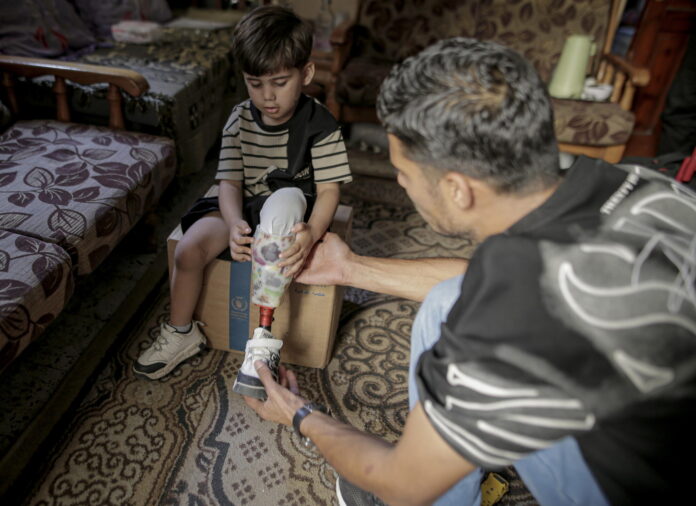
Fayez Oweida, 35, helps his nephew Malik put on his prosthetic leg at their home in Gaza City.
When Malik encountered other people with amputations, he sometimes pointed out that they, too, had a “potato.”
Today, Malik, now 3, can walk and, with assistance, climb stairs. But he can still lose his balance, experience pain or struggle when he tries to move too quickly. His prosthesis is relatively basic and does not adequately accommodate the movements of an active child.
Malik’s journey reflects a growing challenge across Gaza: Surviving a devastating injury is only the beginning of a long and uncertain recovery.
At the Gaza Artificial Limbs and Polio Center, where specialists are helping patients relearn movements that once came naturally, the shortage of even the most basic materials has created painful dilemmas.
Technicians have resorted to recycling plaster molds, manufacturing components from locally available materials and, at times, prioritizing patients whose prosthetic limbs require fewer supplies.
The shortage of materials that makes some artificial limbs harder to manufacture can also influence who receives them first — and who must continue waiting.
Night of the airstrike
At approximately 3 a.m. on Oct. 29, 2025, an Israeli airstrike hit the Oweida family’s home in Gaza City, according to the family’s account. Along with Malik’s mother, Fathiya Salman Oweida, and his newborn brother, several relatives were killed, including his eldest uncle, Fathi Oweida, 38, a clothing trader, and his son Abdulaziz.

People attend a funeral at Al Ahli Arab Hospital for Palestinians who were killed in an Israeli attack on Gaza City on Oct. 29, 2025.
(Khames Alrefi / Anadolu / Getty Images)
Malik was thrown or fell from the fourth floor, suffering severe injuries to his face, lower back and right hand, along with the loss of his left leg below the knee.
His father, Fawaz Oweida, born in 1995, also suffered catastrophic injuries. Both of his legs were amputated at a high level, near the pelvis.
After two months at Al Ahli Arab Hospital, also known as the Baptist Hospital, Malik returned to his family.
But another problem developed. The bone at the end of his amputated leg continued growing, creating inflammation and complications that would interfere with the fitting of an artificial limb. Doctors determined that he needed another operation.
Through Gaza’s prosthetic services, Malik was eventually referred to Palestinian Red Crescent facilities in Khan Yunis. During an approximately 15-day stay, surgeons removed about 4 centimeters of bone, according to the family.
Even after the operation, Malik was not ready to receive a prosthesis. His muscles were weak. He was underweight and suffering from malnutrition. Months of injury, hospitalization and restricted movement had taken a toll on a body still in its earliest years of development.
Before he could learn to walk again, he first had to become strong enough to support his own weight.

As he’s grown more accustomed to his artificial leg, Malik, second from right, has been playing more with other children.
(Saeed Jaras / For The Times)
A rehabilitation team began working to improve his muscle strength, balance and mobility, and he eventually received his first artificial leg this year.
But the device felt heavy and unfamiliar, and there was another, less visible obstacle: Malik had to accept that the artificial limb was now part of his life. His father recalled the boy asking to put on his boots and go out to play.
For the family, his questions were reminders of how difficult it was to explain permanent physical loss to a child who was still learning to understand the world around him. But little by little, Malik grew accustomed to the prosthesis. He began walking again and interacting with other children. But the family’s account of his recovery has no simple, triumphant ending.
His current prosthesis has had a significant height discrepancy compared with his natural leg, reportedly measuring about 4 centimeters longer before adjustments. Specialists have modified his footwear and added compensating insoles to improve his balance. He still needs supervision when walking, especially on uneven ground or when he becomes impatient and tries to move faster.
And as he grows, he will need further adjustments and replacement prostheses, a process that will follow him through childhood.
Thousands of patients
Malik is among a rapidly growing number of Palestinians whose injuries have placed extraordinary demands on Gaza’s strained rehabilitation services.
Since Hamas insurgents attacked Israel on Oct. 7, 2023, killing about 1,200 people and kidnapping some 250 others, the Israel military has devastated Gaza, leaving an estimated 74,000 dead and twice that number injured, according to Gaza health authorities.
The Gaza Artificial Limbs and Polio Center, established in 1976, is the territory’s principal local specialized center for manufacturing prosthetic limbs and providing related rehabilitation services. It has treated people injured in earlier conflicts, road accidents and other circumstances, as well as patients whose chronic illnesses led to amputations. Now its staff is confronting needs on a different scale.
Niveen al-Ghussein, 58, the center’s acting director, said its records include approximately 2,500 people with amputations who require prosthetic services. An additional 1,500 to 1,700 patients have spinal cord or brain injuries.
Al-Ghussein, who has worked at the center for about 32 years, said that approximately 30 to 50 patients seek amputation-related services there each day. The center receives 20 to 25 referrals for assessments each week.

A prosthetics specialist cuts and sews materials at the Gaza Artificial Limbs and Polio Center, which receives 20 to 25 new referrals for assessments each week.
The center has received support from the International Committee of the Red Cross, a partner since 2007, particularly for lower-limb prosthetic components. But Al-Ghussein said supplies can’t keep up with demand, while supplies for upper-limb prostheses, specialized children’s devices and other rehabilitation equipment are critically limited.
Moreover, some materials that were once routine supplies are now among the center’s greatest needs. One of them is plaster.
Dwindling supplies
A bag of plaster may seem an unremarkable item, but without it, prosthetic technicians can struggle to complete one of the earliest and most important stages of making an artificial limb.
Faris Saleha, 35, a prosthetic and assistive-device specialist at the Gaza center, explained that the process of manufacturing a prosthesis begins with a careful assessment of the patient’s injury and remaining limb.
Technicians take measurements and create a plaster mold, which is then modified to produce the socket — the customized component that fits around the residual limb. The socket must distribute pressure correctly and minimize friction. An improperly fitted device can cause pain, wounds and difficulty walking.
Al-Ghussein said attempts to bring plaster into Gaza through humanitarian organizations, including the Red Cross and the World Health Organization, had been unsuccessful. She attributed the problem to Israeli restrictions on the entry of the material.
With supplies running low, workers have begun recycling used plaster molds and improvised new manufacturing techniques.
These adaptations have allowed some work to continue, but they are not necessarily equivalent to the original parts in durability, comfort or performance. The shortage has also forced the center to confront a difficult question: When supplies cannot meet everyone’s needs, who should receive an artificial limb first?

Malik stands on a concrete slab amid the rubble of his destroyed family home in the Al-Zeitoun neighborhood of Gaza City.
(Saeed Jaras / For The Times)
The painful calculation of who gets to walk can depend on how many materials a patient needs. A person who has lost a leg below the knee generally requires a less complicated prosthesis than someone whose leg has been amputated above the knee.
Patients who have lost both legs require still more resources.
A landscape of rubble
Inside the rehabilitation center, a patient can learn to stand between parallel bars, shift weight onto an artificial limb and take a series of careful steps on a relatively predictable surface. Outside, Gaza presents a very different challenge.
Many are returning to damaged neighborhoods, crowded shelters or tent encampments, where movement requires navigating sand, rubble, broken concrete, muddy ground, damaged roads and uneven pathways.
For a person using an artificial leg, even a modest slope or an unexpected obstacle can become a serious challenge. Omar Hamad al-Dahdouh, 41, a physiotherapist at the center, said the rehabilitation program includes exercises designed to simulate these conditions. Patients practice walking on sand, navigating slopes and stairs and balancing on uneven surfaces.
The final stages of training may take place outdoors, where patients attempt to apply what they have learned in the unpredictable conditions of the street.
But not every barrier to rehabilitation can be measured in muscle strength, balance or mechanical function. For many patients, the most difficult obstacles are psychological.
When survival becomes its own burden, Taghreed Qasem, 27, a psychologist at the Gaza Artificial Limbs and Polio Center, has encountered patients struggling with profound grief, fear, anger and uncertainty after losing a limb. Some are frightened of receiving a prosthesis. Others have difficulty accepting changes to their bodies or imagining how they will resume ordinary activities.
The psychological effects can be especially severe among people who lost relatives in the same attacks that left them injured. One statement, Qasem said, recurs in her conversations with deeply distressed patients: “I wish I had been killed instead of being left with this injury.”
Qasem said psychological recovery does not necessarily progress steadily. A person who initially appears to be adjusting may later experience renewed grief, anxiety or fear.
The center offers individual counseling, group sessions and family support to help patients cope with their injuries and rebuild confidence.
Seeing someone with a similar injury walk, work or take part in daily activities can make the prospect of recovery feel more attainable. For children, the approach must be different. Qasem and her colleagues use therapeutic play to help young patients express emotions they may not yet have the language to describe.
Caregivers also receive guidance on supporting children outside the center. Some young patients have lost one or both parents, leaving grandparents, aunts, uncles or other relatives to help them navigate both physical rehabilitation and psychological trauma.
For those children, the center can become what Qasem described it as a second home — a place where patients can return for support, reassurance and a sense of belonging.
Rebuilding a childhood
For Malik Oweida, the wider Gaza crisis is reflected in a more immediate problem: His artificial leg isn’t good enough for the childhood his family wants him to have.
His relatives remain close when he walks, ready to steady him if he loses his balance. They continue encouraging him to interact with other children and hoping that a more suitable prosthesis will eventually become available.
His father describes Malik as brave and patient, but as he grows taller and heavier, his prosthesis will need to be adjusted or replaced.
His recovery is therefore not a finished story. It will be a continuing series of medical, physical and psychological challenges. For Gaza’s rehabilitation specialists, children like Malik represent both the possibilities and the limitations of what their work can accomplish.
At 3 years old, he is still adjusting to his “potato,” working to move without fear of falling. His grandmother’s nickname for his prosthesis helped him make sense of a world that had suddenly become unfamiliar.
But the family’s hope is much simpler than finding the right words to explain what he has lost. They want Malik to be able to put on his boots, go outside and play.
Shbair is a special correspondent.
More to Read
Disclaimer : This story is auto aggregated by a computer programme and has not been created or edited by DOWNTHENEWS. Publisher: latimes.com