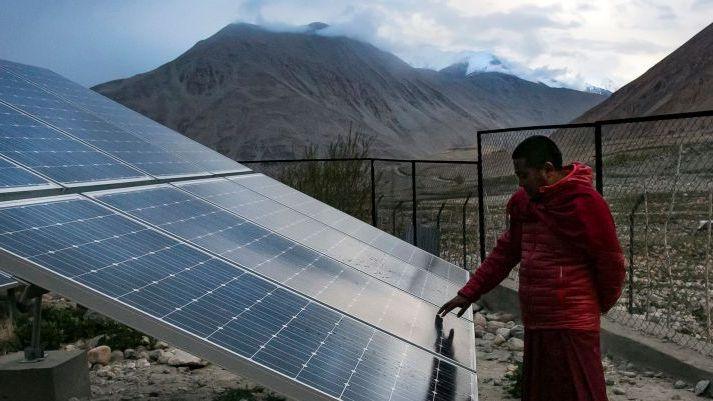
India is producing more green energy – but wasting a lot of it
-
Published
On a hot July afternoon this year, electricity generated from renewable energy briefly met over half of India’s peak power demand – only the second time this happened. The first instance was around the same period a year ago.
While it was only briefly that power generated from solar, wind, hydro and nuclear sources collectively outstripped coal-based output, it was a milestone moment reflecting the astonishing growth of non-fossil fuels to the country’s electricity mix over the last decade.
“It showed that renewable energy is no longer a marginal source sitting at the edge of the power system,” Sumant Sinha, CEO of ReNew Power, one of India’s largest Nasdaq-listed clean energy companies, told the BBC.
To be sure, coal-based power plants still continue to generate 70% of India’s electricity on average because they run on a higher load factor, or for more hours than solar or wind. Yet, the country’s push for clean energy appears to have reached a crucial inflection point.
A decade ago India’s installed renewable energy capacity was barely 4GW. It now makes up 300GW or 54% of its total 552GW installed capacity, external – a target that’s been achieved five years ahead of schedule.
For a nation long seen as the poster child for dirty coal dependence, this rapid transition points to a remarkable achievement in decarbonising its grid.
Yet, the gains are tempered by some serious challenges.
 Image source, AFP via Getty Images
Foremost among them is a shortage of grid capacity. The renewables’ build out has significantly outpaced transmission infrastructure, a point of major concern for policymakers.
“In the first quarter of 2026, transmission constraints accounted for nearly two-thirds of all renewable energy curtailment at 300 gigawatt-hours (GWh),” according to Ember, a global energy think-tank.
Put simply, that means a bulk of the clean energy that was produced in India was wasted because the country’s transmission lines have been dogged by missed targets, with one out of four inter-state projects facing delays of over a year.
The difficulty lies in matching the speed of generation projects with the grid build-out, says Sinha.
“Generation projects can be constructed in 18-24 months… Transmission can take much longer because they involve right-of-way, land acquisition, approvals and coordination across many agencies. It is an execution issue that becomes more important as the system gets larger,” he adds.
Vibhuti Garg of the Institute for Energy Economics and Financial Analysis also blames “poor planning” for the problem.
The grid was able to absorb new capacity as long as India was generating 10-15GW annually, she told the BBC. But that pace has dramatically increased, reaching a record 51GW last year, and the infrastructure is no longer able to cope.
The concentration of renewables projects in the north-western states of Gujarat and Rajasthan has also compounded the challenge of evacuating power in the face of such grid shortages.
Analysts at Ember now believe this growing mismatch between fast-moving generation projects and slower-moving transmission infrastructure, is the “most critical operational risk to the country’s 2030 target of 500 gigawatts (GW) of non-fossil electricity”.
A quick solution to addressing this gap would have been to build battery storage systems at renewable pooling stations to integrate the power into the grid.
“Had that been the case, India could have stored the energy and used it during evening hours rather than wasting it,” says Garg.
But storage capacity has not grown because of a huge jump in the price of batteries, raw material shortages due to the war in the Middle East and a fall in the value of the Indian currency which has jacked up financing costs for Indian companies.
“Many storage projects that were meant to come up fell through as a result,” Garg adds.
 Image source, AFP via Getty Images
Yet, finance isn’t a constraint merely for storage projects but an industry wide problem.
While ample global capital is available for green transition across the developed world, getting access to it remains a persistent struggle for Indian clean energy companies, despite the strides that the country has made in its renewables commitments.
Estimates suggest the country will require $400-$500bn to meet its 500GW renewables target by 2030, external. But currently, around 83% of India’s finance for climate mitigation is sourced domestically, according to the government’s economic survey. While the Paris Agreement clearly mandated developed countries to provide financial resources to the tune of $100bn annually up to 2025 to developing countries for their climate action, that money has been hard to get.
“Emerging and developing economies outside China receive only around 15% of global clean-energy investment, despite accounting for roughly two-thirds of the world’s population,” says Sinha.
According to him, while India does not necessarily need developed countries to finance its entire transition, help is needed in the form of cheaper loans, guarantees and protection against currency losses so that private investors are encouraged to put in more money into the space.
Plugging these critical gaps in finance, transmission infrastructure and storage will be critical given this transition is under way at a pivotal moment, say experts.
 Image source, NurPhoto via Getty Images
India is the world’s third largest emitter of greenhouse gases and facing a sharp rise in electricity demand, which has grown at a compounded rate of over 7% every year. It is expected to further accelerate with the expansion of industries like data centres and chip manufacturing.
The International Energy Agency, external predicts India’s electricity demand will increase by 80% by 2035, the sharpest jump among emerging economies. It also credits the country’s robust expansion of its renewables as a major contributor for slowing emissions in the developed world this year, even as energy related CO2 emissions rose more strongly in advanced economies for the first time since the 1990s.
How successful India is in achieving its targets on time will thus have an outsized impact on the world’s ability to meet its climate goals.
Follow BBC News India on Instagram, external, YouTube,, external X, external and Facebook, external.
Disclaimer : This story is auto aggregated by a computer programme and has not been created or edited by DOWNTHENEWS. Publisher: newsrss.bbc.co.uk