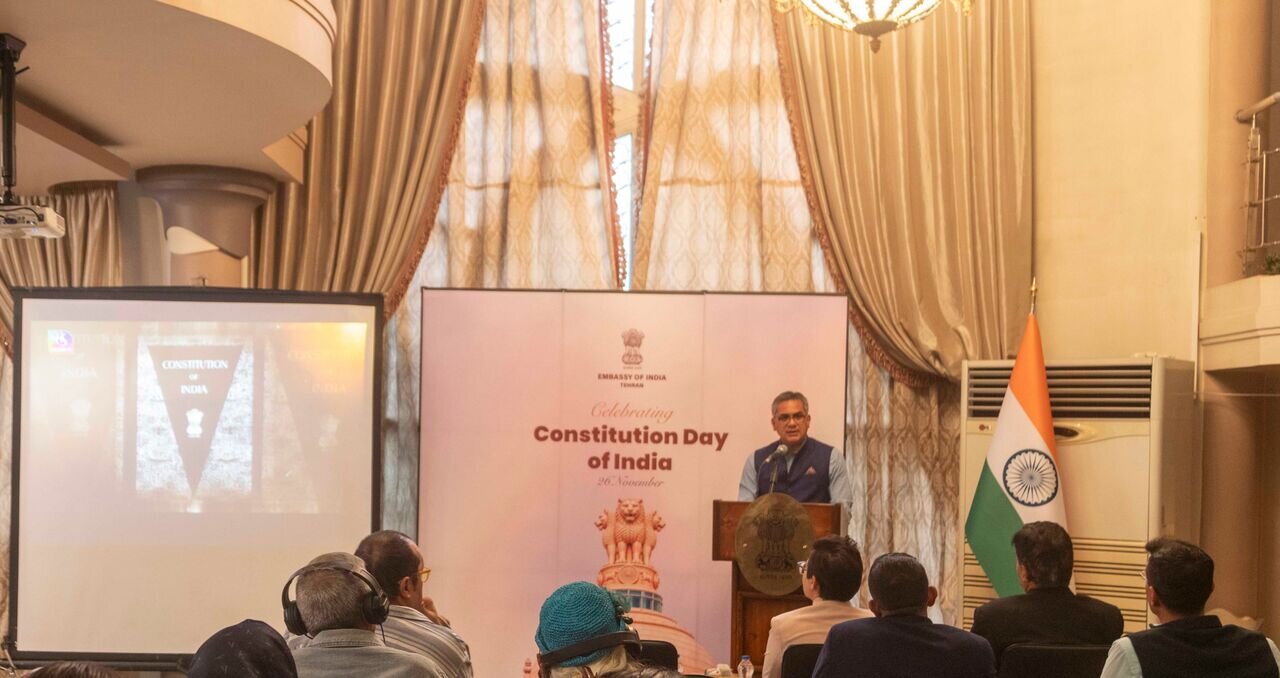
TEHRAN – Vishwesh Negi, the Indian ambassador to Tehran, said on Thursday that the two “ancient civilizations” of India and Iran “continue to walk together in mutual understanding and shared prosperity,” and reaffirmed his country’s “warm friendship with the people of Iran.”
Ambassador Negi made the remarks in a ceremony in the Indian embassy marking Constitution Day.
The diplomat also said the Indian Constitution “is both a legal charter and a work of art.”
The following is the text of his speech:
Let me on behalf of the embassy of India in Tehran express our deep gratitude to the esteemed and honorable guests who have taken time out to participate in this event today on a holiday.
My special appreciation goes to our two learned guest speakers Dr Maziar Falarti and Dr Hanifeh Rigi who will share their respective perspectives on this special day which we call as the Constitution Day in India.
Today, on 26 November in 1949, the Constituent Assembly of India adopted the Constitution that would come into force on 26 January 1950, and transforming India into a sovereign democratic republic. I thought it fitting to share with you, our Iranian friends, a few thoughts about this document—not as a technical lecture, but as a reflection on how a newly independent nation chose to organize itself as a free, plural and united country.
The Constitution of India is the longest written national constitution in the world. Yet what is more remarkable than its length is the spirit in which it was created. It was drafted by Indians, for Indians, after a long freedom struggle. Dr. B.R. Ambedkar, the Chairman of the Drafting Committee, and his colleagues drew inspiration from many sources—the parliamentary system of UK, the fundamental rights from America, the directive principles from Ireland—but they adapted every idea to the unique conditions of India. It is often called a “bag of borrowings,” yet the final product is evidently Indian.
One of its most beautiful features is that the original document was entirely handwritten. Artists from Shantiniketan explained the pages with illustrations drawn from India’s long history—from the Indus Valley to the freedom movement. In this sense, the Constitution of India is both a legal charter and a work of art.
Just to highlight some of its features:
At its heart, the Constitution declares India to be a Sovereign, Socialist, Secular, Democratic Republic. It guarantees fundamental rights to every citizen—equality before the law, freedom of speech, religion and expression. It also lays down Directive Principles that guide the State towards social and economic justice. From the very beginning, it granted universal adult franchise—every adult Indian, regardless of caste, gender, religion, wealth or education, earned the right to vote. This was a bold choice in a country of vast diversity.
India is home to dozens of languages, multiple religions, and countless regional cultures. The Constitution does not try to erase this diversity; it seeks to hold it together. It establishes a federal structure with a strong center, recognizes official languages, protects minority rights, and provides for local self-government. In a way, it is an ongoing experiment in living together—an experiment that continues to evolve through amendments. The Constitution has been amended more than a hundred times, yet its basic structure remains protected. We call it a “living document” precisely because it has the capacity to grow with the aspirations of the people while remaining faithful to its foundational values.
For Iranians, many of these ideas may sound familiar in spirit. Both our civilizations have long valued justice, the dignity of the individual, and theغ primacy of law. Both have known the challenge of governing vast and diverse lands. India’s Constitution is our particular answer to that challenge: a framework that places the people as the ultimate source of power, and that tries to balance liberty with equality, diversity with unity, and rights with responsibilities.
As India and Iran continue to deepen their bilateral partnership, I believe our shared commitment to dialogue, mutual respect and the peaceful resolution of differences remains the strongest foundation. In sharing a few of its ideas with you today, my hope is only that it offers a small window into how India understands itself as a democratic nation.
Therefore, on this Constitution Day, I take the opportunity to reaffirm India’s warm friendship with the people of Iran. May our two ancient civilizations continue to walk together in mutual understanding and shared prosperity.
Disclaimer : This story is auto aggregated by a computer programme and has not been created or edited by DOWNTHENEWS. Publisher: tehrantimes.com