
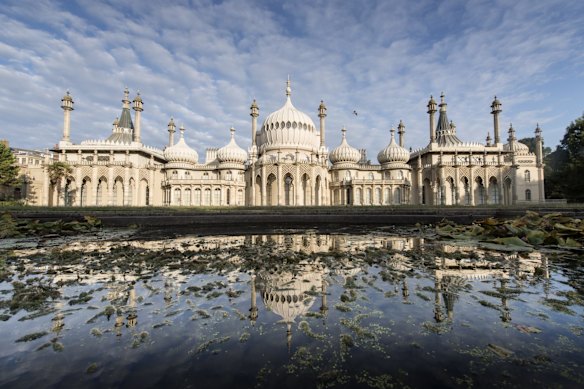

The Royal Pavilion, with its bulging domes and soaring minarets, is a grand, Mughal-style slice of Eastern fantasy. It belongs – with the Taj Mahal, Agra Fort and Badshahi Mosque – in the pantheon of lavish architecture from the Indian subcontinent.
Well, it would do if it wasn’t on the south coast of England. Designed by John Nash of Buckingham Palace fame, this monument to decadent whimsy is probably the silliest building in Britain.
That’s particularly the case when you head inside, and everything’s suddenly Chinese rather than Indian. The future King George IV, for whom this pleasure palace was built, clearly wasn’t all that bothered by consistency and authenticity.
The first room entered, the Long Gallery, is done up like a temple. It is lined with figures of Chinese court officials, while beech wood is painted to look like bamboo. And things only get more ridiculous from here.
George, then the Prince of Wales, started visiting Brighton in 1783. It was ostensibly because the sea air would be good for his gout, but realistically because it was somewhere he could carry out romantic trysts in secret and have a thoroughly good time.
Sign up for the Traveller Deals newsletter
Get exclusive travel deals delivered straight to your inbox. Sign up now.
The Royal Pavilion, built out from an old farmhouse between 1787 and 1823, is like its patron – utterly in thrall to the spirit of excess.
Nowhere is this more apparent than the Banqueting Room, where George would regularly host indulgent, shamelessly gluttonous feasts that lasted hours. The room – which seats up to 90 people – is lavished in red and gold, the prominent colours of the Chinese Imperial Court, and dotted with images and carvings of dragons.
One of those dragons is particularly hard to miss. It’s carved from wood and guards the top of the 9.1-metre-long, 15,000-crystal chandelier hanging above the centre of the dining table. It once held oil lamps inside its glass lotus flowers.
The neighbouring kitchen, aside from its support pillars made to look like palm trees, seems slightly less extravagant. But it is enormous, and could churn out more than 100 different dishes during one of George’s grand banquets.
George was arguably more proud of his state-of-the-art kitchen than any of the Royal Pavilion’s dazzlingly ostentatious public rooms. He insisted it was next to the Banqueting Rooms – something unusual for the time – so that food never went cold. He also led guests on tours, showing off the innovative steam heating and the smokejack – a massive rotary-powered mechanical spit for roasting meats.
The journey through the giddily furnished rooms keeps throwing out surprises. The more handsome a footman was, the higher price he fetched; George would sometimes arrange it so that he appeared in a puff of smoke to greet guests; he knew every member of the band by name and would often insist on playing with them.
A strange air of melancholy pervades this most deliriously flamboyant of buildings, however. It’s notable, for example, that the king’s apartments are downstairs. George indulged himself to the point where he struggled with stairs and had a mechanical apparatus to get him out of bed.
Upstairs, the Royal Pavilion is more of a museum that looks into what came after George died in 1830. He was succeeded by his younger brother William IV, then shortly afterwards, his niece Victoria.
It’s fair to say Queen Victoria didn’t like Brighton much. She felt harassed by the public there, and decided to sell the Royal Pavilion to the townspeople in 1850. It was left in a sorry state, stripped of its artwork and furnishing. The present glory comes from 175 years of restoration and repurchasing.
The biggest surprise, however, doesn’t come from any ornamental dragon or artfully concealed door – it comes from a photograph. In it, turbaned soldiers lie in a line of beds under the scallop shell and chandelier decoration of the music room. They’re some of the 4306 Indian soldiers who were treated here in World War I, when the Royal Pavilion was reincarnated as a military hospital.
Finally, the out-of-place Mughal architecture found its purpose – the Royal Pavilion was chosen in the hope it would help the wounded Indian soldiers feel at home.
The hospital food probably didn’t match up to Prince George’s banquets, however.
THE DETAILS
Visit
The Royal Pavilion is in central Brighton. Brightonmuseums.org.uk
Fly
Emirates flies via Dubai from Sydney and Melbourne to Gatwick Airport, a half-hour train journey from Brighton. See emirates.com
Stay
The Leonardo Royal Hotel Brighton Waterfront has rooms from £80 ($150). See leonardohotels.co.uk
 David Whitley is a writer based in Sheffield, England, who has made it his mission to cover as much of Australia as possible. He has a taste for unusual experiences and oddities with a great story behind them. As far as David’s concerned, happiness is nosily ambling around a history-packed city or driving punishing distances through the middle of nowhere on a big road trip. He is also probably the only person to have been to Liechtenstein and the Cook Islands in the same week.
From our partners
Disclaimer : This story is auto aggregated by a computer programme and has not been created or edited by DOWNTHENEWS. Publisher: www.smh.com.au





