
From hard‑won labour rights to glittering Eurovision spectacle and a light‑hearted political football showdown, here’s what we’re talking about at The Local Germany this week.
The three 8s
The week began with news that Labour Minister Bärbel Bas of the centre‑left Social Democrats (SPD) will present a draft bill in June to modernise the country’s Working Time Act, shifting the focus from a fixed eight‑hour day to a more flexible and ‘modern’ 40‑hour week.
What may sound like a modest administrative adjustment struck a surprisingly deep nerve.
To understand why, it helps to go back to what Germans often call the “three 8s”. Long before it was written into law, the eight‑hour day was a central demand of the 19th‑century labour movement: eight hours of work, eight hours of sleep and eight hours of leisure.
The slogan captured a vision of how life should be organised, with clear boundaries between labour and rest.
Germany was not the first country to embrace the idea, but its adoption in November 1918, amid revolution and the collapse of the German Empire, marked a turning point.
The new government introduced the eight‑hour day in part to steady a fragile society and head off more radical unrest. Despite the upheavals that followed, the principle endured – through war, crisis and, eventually, as a pillar of post‑war reconstruction and the economic miracle.
READ ALSO: Will Germany scrap the eight-hour working day?
Today, for many people, the eight‑hour day is about protecting the sacred concept of Feierabend – that distinctly German idea of a clean break between work and private life.
As the reform moves forward, the chances are it will become one of the defining labour battles of the year.
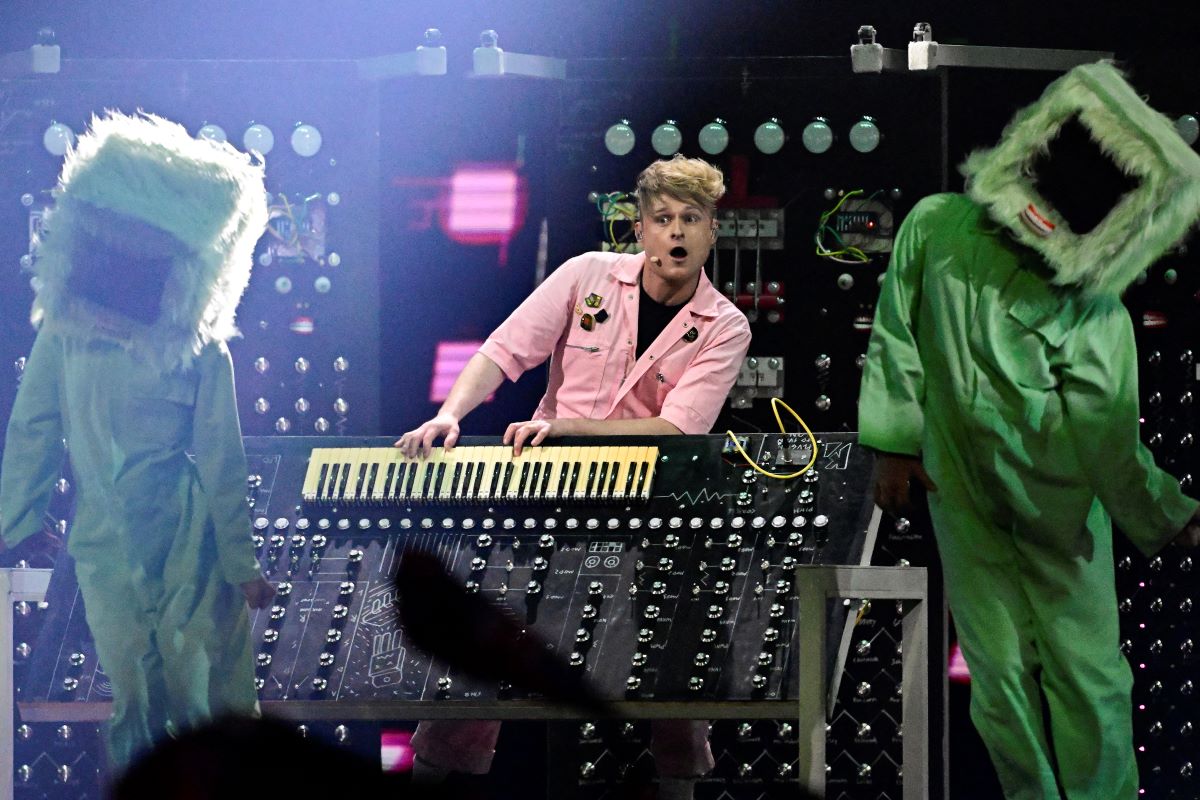
Photo of the day: Do you recognise this man?
English musician Sam Battle, aka Look Mum No Computer is representing Great Britain with the song ‘Eins, Zwei, Drei’ at the Eurovision Song Contest. Photo by Tobias SCHWARZ / AFP
If the debate over working hours is about protecting life beyond the office, then arguably the Eurovision Song Contest is about exploring the outer limits of what that might involve.
The 70th edition is taking place in Vienna, with the grand final scheduled for Saturday evening at the Wiener Stadthalle.
The build‑up to this year’s competition has been anything but harmonious. Several countries, including Spain, Ireland and the Netherlands, have withdrawn or boycotted the event over Israel’s participation.
READ ALSO: Austria vs Germany – Where is it easier to find an English-speaking job?
Will Germany catch fire in Vienna
Germany’s entrant is Sarah Engels, a popular German singer and television personality who first rose to fame as a runner-up on talent show Deutschland sucht den Superstar 15 year ago.
She is singing a song about self-empowerment (naturally) called “Fire” – but expectations for her success remain muted. The bookies have her somewhere in the middle of the field and most afficionados in the country would probably be satisfied with any improvement on the recent run of poor results.
READ ALSO: The ultimate guide to Germany’s open-air parties in 2026
The smart money appears to be on Finland. Greece and honorary European nation Australia are also expected to challenge strongly.
The UK entry, meanwhile, is the very left-field “Eins, Zwei, Drei” by LOOK MUM NO COMPUTER.
In Germany, the final will be broadcast live on ARD, with streaming options available online.
A Finnish ‘doppelpack’?
A Doppelpack in German is a double win – two goals for a single player in a football match or two successes in quick succession, often in sport.
It’s a feat which Finland are hoping to achieve this weekend. Because while Finnish performers top the Eurovision odds, Finnish politicians are also dominating on the football pitch.
While it doesn’t receive quite the same levels of coverage as other events, Germany is hosting the European Parliamentary Football Championship in Lübeck this weekend, with teams of ferociously competitive MPs battling for sporting glory.
READ ALSO: Germany backtracks on cuts to integration courses for foreigners
The home side, FC Bundestag, heads into the tournament with realistic ambitions. Led by captain Fritz Güntzler, the squad trains regularly during parliamentary sessions and has even brought in former Bundesliga trainer Felix Magath to work on tactics and fitness.
But unfortunately for Güntzler and his team, the squad from Finland – which includes former professional player turned politician Timo Furuholm – has already secured three consecutive titles and looks well set to dominate once more.
Mercifully, there are no plans to televise the event.
Disclaimer : This story is auto aggregated by a computer programme and has not been created or edited by DOWNTHENEWS. Publisher: thelocal.de



