Whether it’s just over the border in Denmark or the other side of the world in your home country, for non-Germans getting married is often easier literally anywhere but Germany, writes The Local editor Paul Krantz.
This week I’m freshly back at my desk after a couple weeks off during which I flew around 8,500 kilometres to be wed.
The decision to fly across eight time zones for a wedding may sound like an overindulgent choice. In fact when my (now) wife and I initially discussed our plans, we agreed we wanted to avoid the headache and the cost of anything too big and complicated.
But, my beat being the challenges of living in Germany as a foreigner, I knew before we even began that getting married in this country was basically a dead-end for us.
So – for all the other internationals in Germany who are thinking about tying the knot – here’s why it was easier for me to fly halfway around the world than get married at my local registry office.
What it takes for foreigners to get married in Germany
A couple of years ago I interviewed a Canadian national about the process he navigated to be married to his French wife in Berlin.
In the end the couple did marry successfully, but the process involved months of gathering documents and translations, and spamming every registry office (Standesamt) in Berlin for an appointment.
It was described to me as “the final boss” of German bureaucracy.
READ ALSO: ‘Clunky process’ – The steps you need to take to get married in Germany
Language skills
The first barrier to getting married in Germany for many foreigners is the language requirement. All official civil weddings in Germany are conducted in German.
Navigating all of the proceedings, speech, questions and paperwork requires a pretty solid command of the language.
I’m not shy to admit that my own German is less than perfect and my wife’s is even more of a work in progress. So had we tried to go through with the German ceremony, we would have needed to hire an official interpreter (Dolmetscher) to attend, and translate for us.
It’s worth noting that if you have a witness at your wedding in Germany, which is optional, they too are on the hook for understanding everything that’s being said.
A funny detail in the story linked above was that the wedding itself was nearly derailed when the groom’s witness asked a simple clarifying question in English. The officiant suddenly turned quite serious, and said they would have to end the ceremony if the witness couldn’t respond in German (because this would show they had not understood the proceedings).
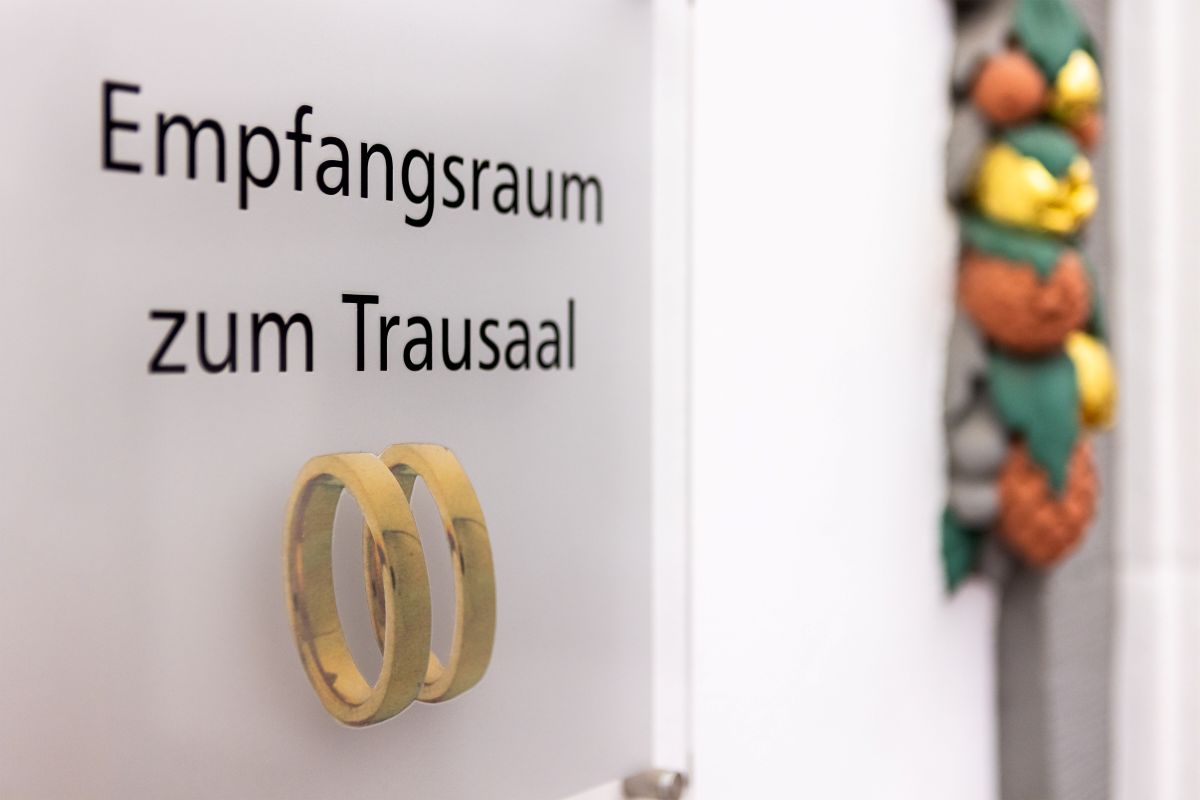
Sign at the entrance to the reception room to the wedding hall in the town hall of the city of Kassel. Photo: picture alliance/dpa | Christian Lademann
Papers and translations
The next hurdle, in typically German bureaucratic fashion, is gathering all the paperwork, and – for most foreigners – also official translations. In most cases these include:
- Birth certificates
- Valid passports or IDs
- A registration certificate for your current address (Erweiterte Meldebescheinigung), which is not more than 14 days old.
- A certificate of no impediment to marriage (Ehefähigkeitszeugnis), or an exemption if your country does not issue them.
Collecting each of these documents is usually easy enough, but getting each of them and their translations all within a tight time window is the trick.
The person I spoke to described needing to request a birth certificate from Canada, waiting for it in the mail, and then sending it back to the same authority to have the translation notarised.
Luck with getting an appointment
Finally, if you manage to clear all the preliminary hurdles, the final challenge can be getting an appointment to be married.
A tricky bottleneck here is that you first need an appointment to file your intent to marry (Anmeldung der Eheschließung) where you turn in the paperwork. Then you have a six month window during which the ceremony can take place.
Getting an appointment for a ceremony in that time is not always easy, depending on where in Germany you live – and especially if you’re aiming for a particular location like Berlin’s Rotes Rathaus, for example.
Your initial application needs to be submitted to the registry office in the district where you or your spouse lives. But when that’s approved, you can request that your file is transferred so that you can have the ceremony elsewhere. This means that if you live in a big city with overloaded registry offices, the easiest option could be to have your wedding at a smaller town or rural location.
Or just go abroad
If all of that sounds like a bit much, then you can just do what I did and get married literally anywhere else.
Among the easiest places to do so is Denmark – there the entire process can be sorted in just a couple of weeks. And because it’s just next door to Germany many foreigners, and even some Germans, opt for having the legally binding portion of their ceremony done there.
Another bonus is that you can get your certificate in German, which saves you an extra translation when you register your marriage in the Bundesrepublik.
READ ALSO:
I have a particular aversion to paperwork and bureaucracy, so for me the choice was obvious. And since my wife and I did ultimately decide that we wanted family to be there, the choice was simply my country or hers.
Now that I’m back in Germany, however, I will need to brave at least one (please let it be only one!) trip to the registry office to have our foreign marriage recognised here.
Disclaimer : This story is auto aggregated by a computer programme and has not been created or edited by DOWNTHENEWS. Publisher: thelocal.de