
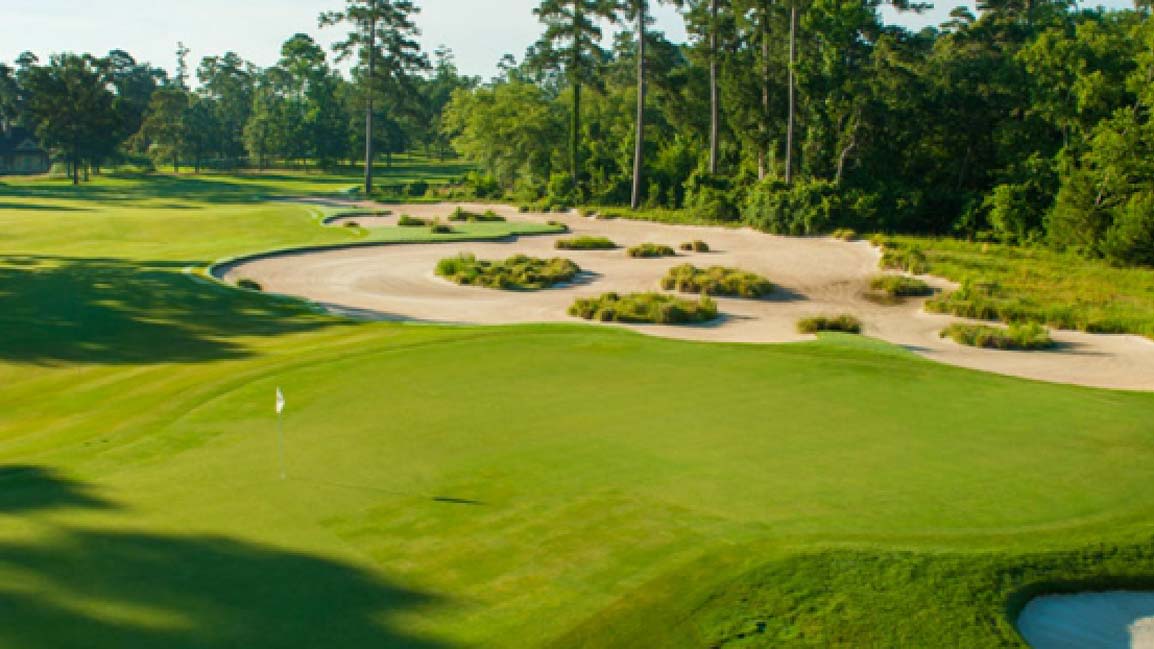
A touch of Tobacco Road with hints of an English heathland course, cut through corridors of Carolina pines.
If you’ve been keeping count, you know that the cradle of American golf has welcomed yet another newborn. Pinehurst No. 11 is its name. How to describe it is another matter.
The architect Bill Coore, who designed No. 11 with Ben Crenshaw and their lead associate, Ryan Farrow, was at Pinehurst Resort earlier this week as a gaggle of golf junkies got a sneak peek of the course, which will open to the public in March 2027. Coore calls the layout “weirdly wonderful,” an apt phrase that has been making the rounds in the media. But what are those endearing eccentricities?
Start with the setting. No. 11 joins No. 10, completed in 2024, at Pinehurst Sand Mines, a satellite campus 4 miles from the mothership at Pinehurst No. 2 that has its own pro shop and restaurant, with accommodations in the works. Portions of both courses sit on a former sand mine, where industry left behind an otherworldly landscape of spoil piles and ridges. Though the two layouts are contiguous in places, they make for a compelling study in contrasts. Where No. 10 is expansive and brawny, with sprawling fairways and tousled greens, No. 11 is more intimate, its putting surfaces calmer even as the land around them goes gloriously wild.
Coore is a friendly man, but he doesn’t always extend a friendly handshake. The par-4 opening hole demands crisp shotmaking right out of the gate, tumbling from a tee on a sandy ridge to a fairway guarded by sand wastes and mounds, then climbing to an elevated green.
The par-4 2nd makes a different sort of statement. Mining ridges flank the fairway on the right, blinding your approach if you block or bleed your drive. In its aesthetics and strategic demands, the hole calls to mind Tobacco Road, Mike Strantz’s fantastical creation a short drive away, where landforms and sightlines conspire to keep you guessing.
Pine trees sprout from many of the mining heaps, creating a subtly surreal effect, as if you’ve stumbled upon a hidden corner of the planet where nature kept about its business long after human beings cleared out. Purple-tinged centipede grass garnishes the grounds, lending the property a heathland look. The conifers that frame many fairways add a layer of visual deception, making shots seem tighter than they actually are.
An entire round amid wild mining formations might have amounted to sensory overload. Coore was mindful of that, and so he weaved the routing in and out of the most humpy, bumpy terrain. By the 7th, a short par-4 with a horseshoe-shaped green backed, infinity-like against a lake, you’ve been in more familiar Sandhills country for several holes. That doesn’t last. Before long, you’re back among the ridges and spoil piles, which make compelling cameos as your round draws to a close.
Coore is famously allergic to self-promotion. A minimalist through and through, he’s inclined toward understated quotes. When he says that No. 11 turned out “pretty darned good,” take that as his version of a gushing review.
He recognizes, though, that No. 11’s quirks might not be for everyone. “I’m not sure you’d want to build this as the first course at a resort,” he says. “But the good news is, it’s the 11th. If some people find that this one’s not to their taste, they’ve got 10 others here to choose from.”
3 Things I’m Thinking
Bargain pines: It’s hard to keep up with golf development in the Carolinas. On my recent swing through the region, I also spent time at Whispering Pines, which now belongs to the same ownership group as Mid Pines, Pine Needles and Southern Pines. Those are all Ross courses. Whispering Pines was built by Ross’s disciple, Ellis Maples, and like the others before it, it has been renovated by Kyle Franz, who made the most of a modest budget. Working from Maples’s design, Franz rebuilt greens with new hole locations and compelling runoffs, added and refreshed bunkers, sharpened sightlines and ramped up the strategy. The work is impressive. And so is the price. Green fees at Whispering Pines are $75 to $150, depending on the season, an amazing value for a design that is on par with much of the area’s best.
Candyroot sweetens the Charlotte area: My other stop was the just-opened first course at Candyroot, a resort-in-the-making that aims to high-quality public golf to a Charlotte market that has long been hungering for exactly that. Designer Mike Koprowski, who designed Broomsedge with Kyle Franz, wasn’t bent on building dumbed-down retail golf, and he didn’t. He went with the kind of course that delights him: U.K.-style, raw and rugged on land suited naturally for the game. He and his team didn’t shape a single fairway and refrained from framing holes, a trait that Koprowski thinks of as American invention. The result is a compelling challenge that asks you to contemplate all kinds of angles off the tee, the better to take on smallish greens with all kinds of complexities. It’s a firm, fast test, but not the type that makes you want to give up in frustration. It’s the kind, as Koprowski puts it, that makes you think, Man, I think I could do better next time. I can’t wait to take it on again.
Coul Links is dead. Long live Coul Links? You might have read the obituaries for Coul Links in the Scottish Highlands. The long-in-the-making project near Royal Dornoch was recently denied by the Scottish government, and headlines have declared it finished. But there may be life to this story still. One plan is dead. But landowner Edward Abel told me in a text that an alternate might still be in play, one that steers clear of the environmental issues that kept the project in a holding pattern for a decade plus. I’ll keep tracking this one as it evolves.
Disclaimer : This story is auto aggregated by a computer programme and has not been created or edited by DOWNTHENEWS. Publisher: golf.com




