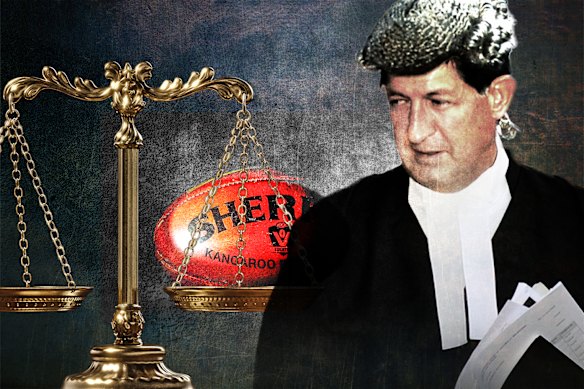
The independence of the AFL’s tribunal system has been called into question. As the league prepares to review it, we investigate its history, controversies, processes and future. This is part one of a two-part series.
Kings Counsel Will Houghton was dealing with the precarious future of a young Indigenous footballer who had been banned for uttering a homophobic slur when the AFL appeals board met on a balmy Thursday night in April.
It wasn’t long before Houghton’s own future was being called into question, sacked two days later by the AFL after his controversial judgment in the case. But the fallout did not end with Houghton’s dismissal, which has caused alarm in the legal profession about the independence of a judiciary system that is itself under fire after a succession of contentious verdicts.
A senior industry source, not willing to comment publicly, said the AFL acted at least in part because they were worried about a potential backlash from sponsors. But the league reiterated that Houghton’s judgment – in which he claimed homophobic, racist and sexist abuse could be “commonplace” in the hard game of elite football – was out of step with the league’s values and community expectations.
“At the time, the AFL strongly rejected the language used by appeals board chair, with the AFL CEO condemning the views via a public statement, and the next day the AFL relieving the chair of his duties,” the AFL said in a statement to this masthead.
“Respect and inclusion are not optional in our game – they are fundamental, and no other factors had any bearing on our statement or decision.”
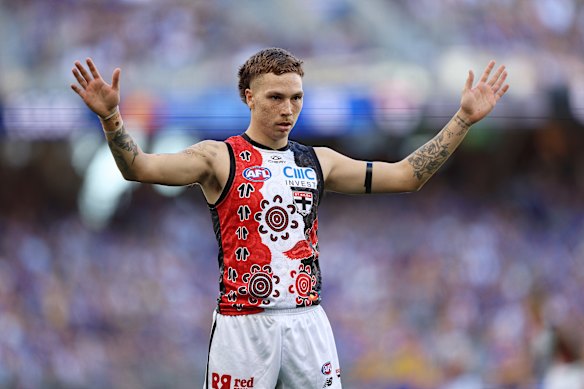
Houghton’s appeals board also cut young Saint Lance Collard’s ban from nine weeks (with two suspended) to four weeks (with two suspended) after he was found guilty of saying “f—ing f—-t” to an opposition player in the VFL. Collard claimed he said “maggot”.
AFL boss Andrew Dillon was not happy, nor were past and present AFL players, who felt their workplace had been unfairly tarnished. Dillon’s reaction was swift. Houghton was sacked, his remarks rejected, and the reduced penalty condemned.
But now, as the AFL prepares to conduct a review of its tribunal operations – a process that normally takes place at the end of each year – some fear the tribunal system itself has been tarnished.
The Age spoke to a range of football insiders and legal experts about how the system evolved, the controversies that shaped it, and whether it’s fit for purpose.
Former Collingwood president Jeff Browne, who acted as a lawyer for the AFL for two decades until the turn of the century, said the Houghton sacking “affects the very independence of the system”.
“What the AFL has done is destroy that perception by sacking someone whose decision they don’t like,” Browne said. “He wasn’t offered procedural fairness.
“That is very dangerous conduct on behalf of the AFL that is blurring the lines between independence and quasi-control.”
But former AFL chief executive and former North Melbourne player Andrew Demetriou took an opposing view.
“They were absolutely correct [to dismiss the appeal chair] because I don’t think the chair’s views were a reflection of what the AFL and the AFL family and industry are aligned to,” Demetriou said.
Houghton declined to comment.
While Houghton’s successor was expected to be named this week, some feared there would be a reluctance to accept the role, and that even then, the new appointment would feel restricted, or “nervous” about making decisions that upset the AFL.
“They [the AFL] keep calling it the independent tribunal. There’s nothing independent about them,” said one legal expert, speaking anonymously to speak freely.
“They’re paid by the AFL. They’re handpicked by the AFL. And as we saw with Will Houghton, they are sacked as soon as they make a decision or a comment the AFL doesn’t like.
“It doesn’t have to be independent, but don’t pretend that they’re independent.”
The dogs are barking
When Adrian Anderson was football operations boss and overhauled the AFL tribunal system in 2005, he could not have envisaged a fortnight of hijinks more than 20 years later that would throw the system into a tailspin.
Back then, there was no scope for a panel member to dial into a hearing while driving to an open house inspection in his car, nor was there the likelihood of an interstate player’s legal counsel muting his laptop microphone to quieten his barking dogs.

But technology changed everything.
The iPhone was released in 2007, social media pile-ons followed, and the COVID-19 lockdowns turned in-person hearings into Zoom events.
But one thing Anderson did know for sure was that he was letting the lawyers in.
Sure, he created the match review panel, later to become the match review officer, so that football people could judge football actions and expedite the process.
This level of sanctioning has played a large part in changing player behaviour, practically wiping out high bumps and sling tackles.
But Anderson also established a higher-tiered tribunal that mirrored a mini-court of law – a legally qualified chair and three industry-associated jury members to hear difficult cases or MRO appeals.
There was too much at stake to continue to leave judgments up to “bush lawyers”.
Anderson, a lawyer himself, needed to strike a balance to ensure there was enough natural justice and quasi-legal protections, including an “independent” appeals board, to dissuade footballers and football clubs from going off to the Supreme Court.
But, has it gone too far? Demetriou thinks so.
“I think it frustrates people because [of] the length and the arguments that are raised, and the debating over legalistic terminology,” he said. “And it should be pretty straightforward, I would have thought.”
Former Carlton football manager Brad Lloyd agreed.
“It has become very legal, the whole process. You go in there as a football person, and you are often not even arguing about the game,” he said. “For the football people it is hard to keep up with what they are arguing about.”
Browne said tension over the tribunal being overly legalistic had always existed.
“Players are playing for a lot of money,” he pointed out.
“If you are going to interfere with their rights to earn money then you have to do that according to the law.
“Unfortunately, you are not going to get rid of lawyers. The AFL should be pretty happy that players are not testing the rules outside the AFL system.”
But the events of recent weeks suggest that system is far from perfect. One legal expert involved in the process said it had become too remote.
It is difficult, he said, to prosecute cases when the parties are interstate – as happened in the Zak Butters case.
The Port Adelaide star contested a charge of abusing umpire Nick Foote. He gave evidence over a video link.
“Without people being in the same room, I think it loses its integrity,” the legal expert said.
‘A complete nonsense’
Premierships and Brownlow Medals have been won and lost at the AFL tribunal.
During the first year of Anderson’s new system, Sydney forward Barry Hall was flown to Melbourne in a sponsor’s $20 million Learjet on a Monday night to front the AFL judiciary on a charge of striking the Saints’ Matt Maguire.
Hall’s defence advocate, Terry Forrest, QC, was able to convince the tribunal – chaired by retired County Court judge David Jones and panel members Richard Loveridge, Emmett Dunne and Wayne Schimmelbusch – that the conduct was “reckless” rather than “intentional” and was “in play” rather than “behind play”, even though the ball was 30 metres away.
Houghton was counsel for the AFL during this celebrated case.
Five days later a premiership medal was draped around Hall’s neck after Sydney beat West Coast by four points. Hall kicked two goals.
Penalties for misconduct have long been part of the football industry. St Kilda were the first club fined in 1897 when they arrived 20 minutes late on a horse-drawn cart for their maiden VFL match against Collingwood.
The AFL tribunal was established 1929 after the league’s committee, its governing body, was accused of bias and inconsistent rulings.
After that, a cycle of controversial decisions, outcries and rule amendments followed.

In 1996, Sydney defender Andrew Dunkley played in a losing grand final against North Melbourne after winning a Supreme Court injunction to have his hearing delayed. His strike against James Hird left the Essendon player with a gash under his eye that needed three stitches.
In 2004, Jonathan Brown beat a rough play charge after putting a player in a headlock and wrestling with him. Lawyers pointed out this happened after the siren, so rough play couldn’t be happening as no one was actually playing. The rules were changed.
Carlton champion Patrick Cripps won his first Brownlow in 2022 after a two-match ban for a high bump on the Brisbane Lions’ Callum Ah Chee was overturned by the AFL appeals board on an “error of law”.
Cripps’ legal counsel, Christopher Townshend, KC, convinced the appeals board – chaired by former Supreme Court judge Murray Kellam with jurors Richard Loveridge and Stephen Jurica – that a guilty verdict was “unreasonable and did not comply with the requirements of procedural fairness” because Cripps had reasonably contested the ball.
That legal loophole was closed five months later as part of an annual review.

The appeal hinged on legal technicalities, including an argument that Cripps had not been given the chance to explain to the AFL tribunal whether he had intended to bump Ah Chee or not.
Townshend argued that AFL tribunal chairman Jeff Gleeson, KC, had created confusion by stating Cripps’ action was a “bump” and had not properly directed the tribunal panel before they retired to consider a verdict.
League boss Gillon McLachlan was clearly unhappy with the outcome and said at the time it was “frustrating to have a legal view about due process or procedural fairness – a complete nonsense – really affect a clear mandate to protect the head”.
But Townshend remains a fan of the process because, he said, there was not an obvious alternative.
“No system will deliver the right answer every time and no system will make all supporters happy in every case,” Townshend said.
“The better approach is for all concerned, including the AFL, to respect the system, the umpire’s decision if you like, and move on.
“By and large, most reports don’t get to the tribunal, and when the trickier ones do, on most Tuesday nights the tribunal does a competent job.”
Browne says the system has come a long way since the “bad old days” of the 1980s when, he recalls, a tribunal official was heard asking a VFL person “what [penalty] would you like tonight?”
“We have come a long way since those days and thank goodness,” Browne said.
“When they sack the chair of the appeals board then I start to think about the bad old days and think, ‘What have we learnt?’ ”
A lawyers’ picnic
Lawyers are footy fans, too, and having a legal eagle support your club or sit on your board is a huge plus.
St Kilda board member Michael Borsky, KC, represented Collard in his recent case pro bono, while former Saints board member Jack Rush, KC, has served as chair of the AFL grievance tribunal, provided legal advice to the AFL and still acts as a player advocate.
Townshend joined the Carlton board less than three years after the Cripps’ case.
Also among the legal fraternity to appear as player advocates are Myles Tehan, who helped Collingwood champion Scott Pendlebury escape suspension in March this year as well as being instrumental in having Hawthorn’s Mabior Chol cleared for his part in Cat Tom Stewart’s concussion late last year, while Sam Tovey often acts for Richmond players, North Melbourne leans on Justin Graham, KC, and sports lawyer Ben Ihle, KC, has appeared in recent cases for Essendon and Geelong.
At the top of the AFL tribunal sits league-appointed chair Gleeson – a “magnificent human”, according to one legal colleague.
“He takes it seriously, loves his sport and is thorough. I don’t think he is overly legalistic at all,” the colleague said.
A lawyer for 37 years, Gleeson acted for the AFL during the Essendon drug saga and told the Court of Arbitration for Sport appeal that Stephen Dank had acted like an “unhinged backyard scientist” when injecting Essendon players.
The AFL tribunal deputy chair Renee Enbom, KC, has acted for clients as diverse as Rebel Wilson, the chief commissioner of police, the Victorian government and The Age.
She regularly champions junior female lawyers; those engaged by her for internships or work experience are informally known as the “Bom Squad”.
The AFL also has a collection of handpicked lawyers to prosecute their cases: Nick Pane, KC, Andrew Woods, KC, Sally Flynn, KC, Albert Dinelli, KC, Sam Bird and Amara Hughes.
But tribunal cases are heard by a jury of football people.
A panel of three is picked from the following pool – ex-umpire Jordan Bannister, Michelle Dench (Melbourne Uni), Darren Gaspar (Richmond), Jason Johnson (Essendon premiership player), Shannon McFerran (VWFL), David Neitz (Melbourne), Talia Radan (Adelaide/West Coast), Scott Stevens (Sydney/Adelaide), Shane Wakelin (Port/St Kilda/Collingwood) and Paul Williams (Sydney/Collingwood).
While the AFL appeals board is chaired by a legal expert, the two-member panel is picked from Georgina Coghlan, KC, or ex-players Jurica, Wayne Henwood and Loveridge.
‘Not an agenda of change’
The AFL took action even before it started its review.
First, it made it clear to tribunal members they needed to be in a quiet place without interruption during hearings – in other words, stay out of the car and keep the dogs quiet.
Next, they sacked Houghton.
But there are other tweaks they will consider: Is the process too long, too legalistic, too intimidating for footballers and too detached from the game?
They will also consider bringing hearings back into one room, and making greater use of the Peek Rule which involves a more private conciliation process to handle cases involving racism, sexism and homophobic vilification.

The review will be overseen by the AFL’s legal department, headed by general counsel Stephen Mead, and the AFL’s football department, headed by football operations boss Greg Swann.
Changes will be introduced by the season’s end.
Swann said last week there was potential to have less legal input. But one AFL source said they were “not going in with an agenda of change”.
Demetriou has been around long enough to know that it is always darkest before the dawn.
“I’m a pragmatist, I can tell you that by round six or seven, every year, the umpiring was the worst it’s ever been. That’s always been the case,” he said,
“And by about round 12 or 13, everyone settles down. By the finals, that’s the best umpiring we’ve ever seen, and the tribunal doesn’t get a look in.”
Keep up to date with the best AFL coverage in the country. Sign up for the Real Footy newsletter.
Disclaimer : This story is auto aggregated by a computer programme and has not been created or edited by DOWNTHENEWS. Publisher: www.smh.com.au