We’re getting some extraordinary reporting on what it has been like inside Nvidia during Huang’s last days. Before his forced resignation, Huang had given up, Bloomberg says, and was heard saying things like “whatever,” “I don’t care,” and referring to himself as a “piece of sh–.”
That, of course, was in stark contrast to how Huang historically ran the company. Huang had “imperial control,” and ran it like a “feudal system,” according to the FT. “I can’t tell you what a cult this place is,” a source told the paper. General counsel Tim Teter wore a leather jacket just like Huang’s, the source said: “Jensen is a god, and that’s how he’s worshipped.”
Noteworthy: In addition to having no board chair, the company also did not have a compliance officer, the FT says.
Interim CEO Colette Kress and whoever replaces her as permanent CEO will have messy office politics to deal with, according to the FT. Huang’s daughter Madison Huang is a senior director of marketing at the company, but she acts like her father’s de facto chief of staff, the FT says. Nvidia also employs her husband Nico Caprez and Huang’s son Spencer.
Kress, meanwhile, sometimes did not get Huang’s respect, the WSJ reported. He once called her “a deer in the headlights” and a “reporting CFO” (as opposed to a strategic leader) during a meeting in which they were discussing Nvidia’s agreements “to provide billions of dollars of guarantees to companies that couldn’t afford its chips,” the WSJ said.
Kress struggled to rein in Caprez, who had made multiple offers of financing to cloud providers and data-center builders in return for shares of revenue.
Lenders relied on the Huang family’s backing for AI financing when structuring deals with AI providers. Without Huang at the top, “that Nvidia guarantee is not worth what it was worth a week ago, that puts those neocloud businesses at risk,” Joe Kaiser of Switchyard Partners, an AI financing company, told Fortune’s Catherina Gioino.
Congressional probe begins into Huang, Lutnick, and national security risk posed by Nvidia’s relationships
Ex-Nvidia CEO Jensen Huang and commerce secretary Howard Lutnick have been called by Sen. Tim Scott (R-South Carolina) to testify in front of the Senate Banking Committee, the NYT reports. The hearing will be conducted next month. “Recent reports raise serious concerns about our national security and the protection of sensitive U.S. technology,” Scott said.
That’s a reference to Huang’s relationship with a suspected Chinese spy who ran a company that bought Nvidia chips and is suspected of smuggling them into China in violation of U.S. export controls.
As for Lutnick, Republicans are furious at what they perceive was the special treatment he gave Nvidia in terms of its access to the Chinese market and in his foot-dragging on the enforcement of export bans to China, the FT says.
Lutnick shielded Nvidia from the White House’s attempts to restrict export of the U.S.’s best technology to China, the NYT reported.
All matters related to Nvidia were routed through a deputy to Lutnick, Jeff Kessler, who rarely took action without Lutnick’s approval, the NYT said.
Inside the White House, senior Trump administration figures largely blame Lutnick for being asleep at the wheel in terms of the threat Nvidia posed to national security, given its ties to Chinese importers, the WSJ reported.
Alice Huang: Those concerns will get extra momentum on the news that Jensen Huang’s affair partner, suspected spy Alice Huang (no relation) of Megaspeed, had a relationship with Huawei, China’s biggest competitor in China, according to CNBC.
Alice Huang allegedly ran a complicated network of companies to do deals with Nvidia that resulted in its chips ending up at Chinese companies, per Bloomberg.
MORE FROM FORTUNE
How Novig became the third-biggest prediction market site despite launching only months ago – Camila Grigera Naón
Before Megaspeed, there was Supermicro: The other Nvidia partner tied to China chip smuggling—and to Jensen Huang – Amanda Gerut
‘The plot twist’: A study of 73,000 adults found America’s richest still die sooner than most Europeans – Lena Borrelli
Standard Chartered profit jumps 46% as CEO bets on a fragmenting global economy: ‘An advantage for us’ – Michaela Herbst
Anthropic’s blockbuster IPO just got harder after Jensen Huang’s dramatic exit as Nvidia CEO – Beatrice Nolan and Allie Garfinkle
Andrew Cuomo: Wall Street is ready. Congress needs to catch up – Andrew M. Cuomo
CFOs face a tough choice on AI spending as borrowing costs rise, expert warns – Sheryl Estrada
THE MARKETS
Nvidia is dragging down the market for tech stocks
Nvidia shares fell 4.34% yesterday but gained 1.84% overnight as some traders bet on the dip. S&P 500 futures were flat this morning after the index fell yesterday. It’s looking like another difficult day for stock investors, as the price of oil ticked up and markets largely fell across Asia and Europe.
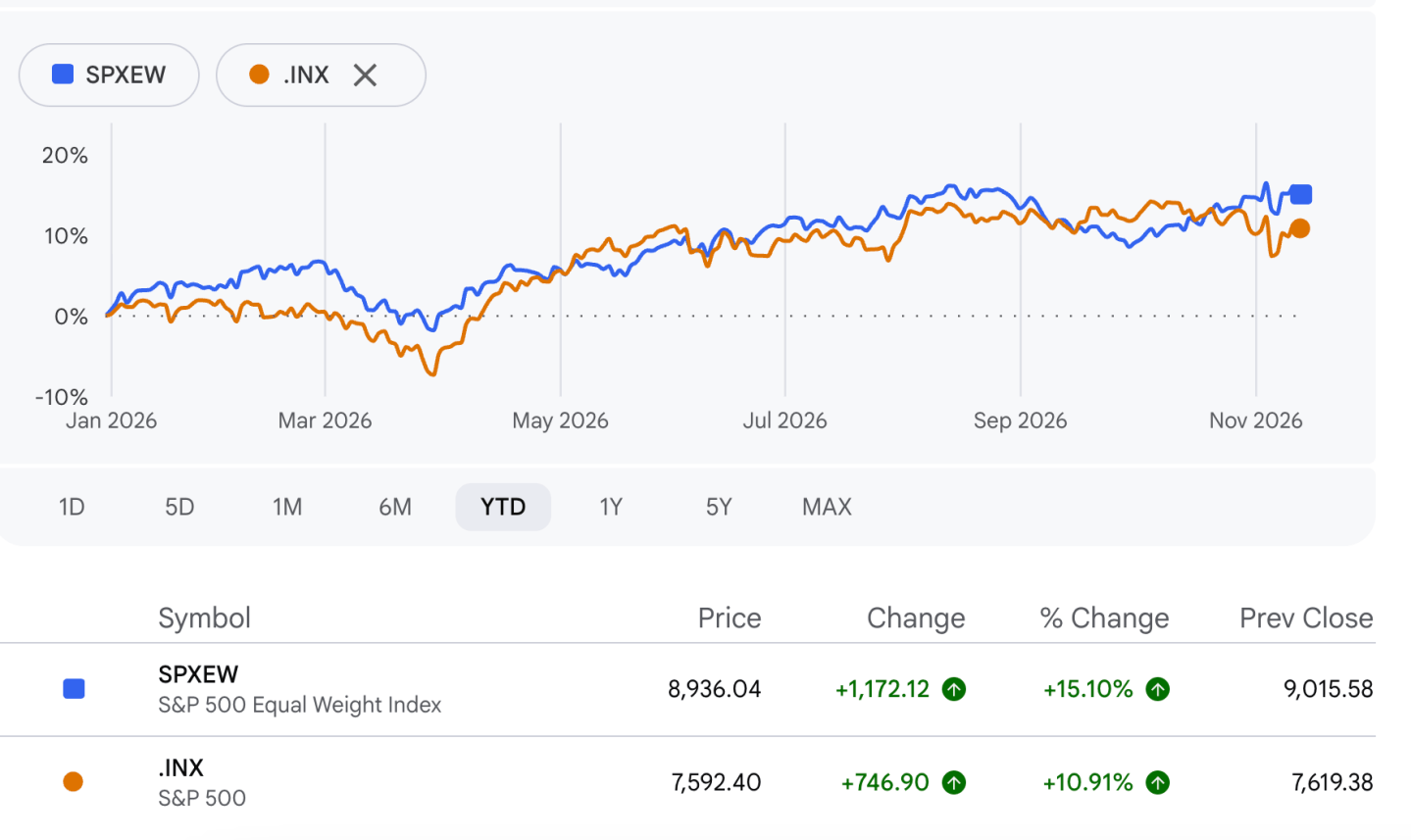
This chart shows how traders are rotating out of tech stocks into non-tech companies. The S&P 500 “equal weight” index (which nominally tracks each stock as if it were valued equally) is up 15% this year. By contrast, the real S&P 500—heavily skewed by the massive market caps of tech companies—is up only 11%.
- S&P 500 futures were flat this morning. The index fell 0.35% yesterday.
- In Europe, the Stoxx 600 rose 0.11% in early trading, and the U.K.’s FTSE 100 rose by 0.22% before lunch.
- Asia: South Korea’s KOSPI was down 0.98%. Japan’s Nikkei 225 was up 0.53%. India’s Nifty 50 was down 0.61%. China’s CSI 300 was down 0.68%.
- Brent crude rose to $95 per barrel.
- Bitcoin declined to $68,976.
Retail traders love tech stocks, hate everything else
This chart visualizes what stocks retail traders—meaning individual investors, not institutions—are buying and selling on a month-by-month basis in the S&P 500. Arun Jain and his colleagues at JPMorgan broke it out into Magnificent Seven tech stocks, an “AI 30” set of stocks linked to AI, and the S&P 470—all the non-tech companies.
Perhaps the most interesting trend is that retail traders clearly lost interest in non-tech stocks somewhere in 2022.
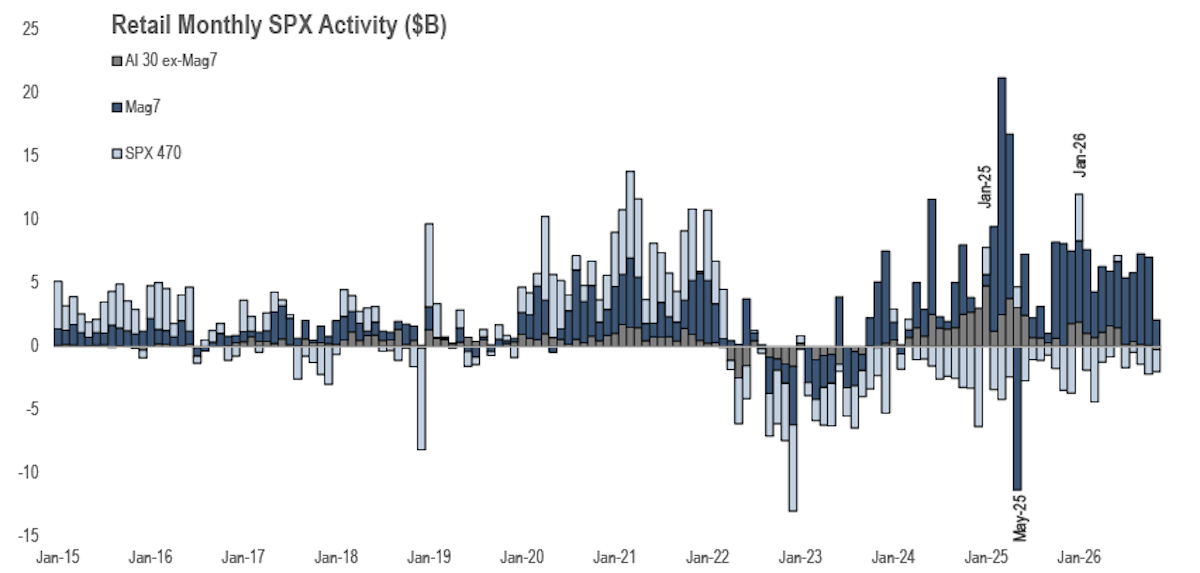
CHART OF THE DAY
Why AI revenues are going up even though token prices are going down
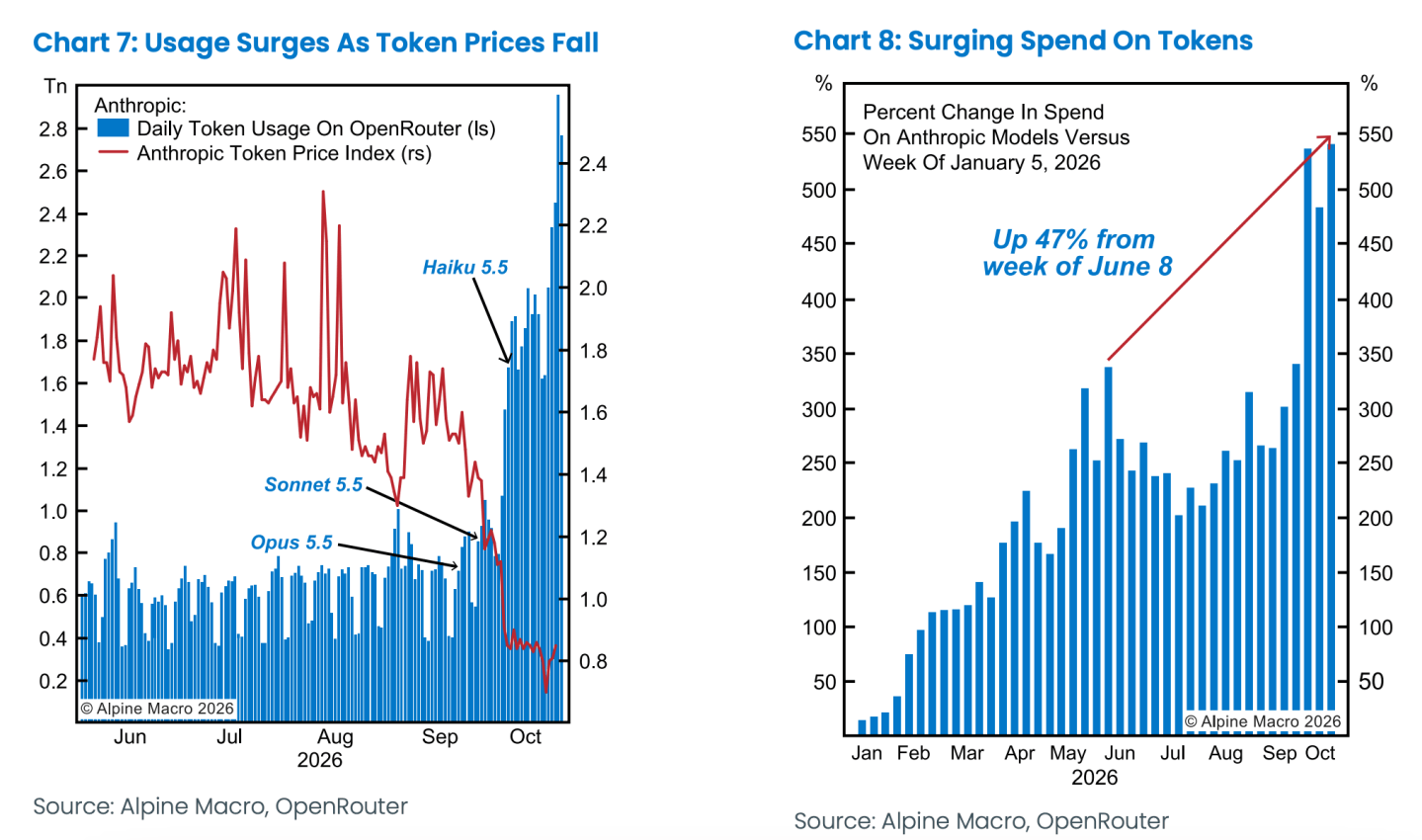
One central question about the Anthropic IPO is: how can this company grow revenue if its product prices—as measured via tokens—are in a race to the bottom? Turns out that piling it high and selling it cheap works in AI the same way it works in groceries, as these charts from Alpine Macro’s Noah Ramos show.
“While token prices have declined dramatically, overall customer spending continues to scale. This reflects both users extracting more intelligence per unit of compute and inference optimizations that make it economically viable to consume substantially more tokens. Lower token prices are expanding consumption rather than reducing spending,” he said in a note.
QUOTE OF THE DAY
“What seemed impossible a week ago is now a reality.”
—Dan Ives of Yorkville Ives, expressing the head-spinning pace at which Jensen Huang went from indispensable founder to excess baggage at his own company, Nvidia. “The old Jensen, the black leather jacket, the Godfather of AI, the rock star viewed as the face of the AI boom, is over and in the past; his value to the company pre and post this week is dramatically different, and the board did what we said it needed to do, which is rip off the band-aid and take Nvidia into its next chapter without him after this dark moment for Jensen and Nvidia.”
Ives also has an eyebrow-raising suggestion for who could replace Huang as CEO: Apple’s Tim Cook. He could be “a dark horse candidate in our view given the global importance of Nvidia to the overall U.S. tech industry.” The proposal makes sense given that Cook just retired as CEO of Apple, and although he is now its chairman, he does, in theory, have time on his hands. And frankly, who knows more than Cook about stewarding the most important tech company of its day to further success following the loss of an “irreplaceable” founder?
It goes without saying that the stakes are high. Remember what happened at HP and Intel, warn Wedbush’s Matt Bryson and Tuo Ma: “Both [HP’s] Mark Hurd and [Intel’s] Brian Krzanich departed their posts relatively abruptly following affairs with no clear successors in place. And for both Intel and HP, we believe these transitions played some role in disastrous periods that saw the companies lose their respective leadership positions in technology, with HP eventually breaking apart and Intel still struggling to prove it can regain the fab and chip design expertise it seemingly lost during its failed 10nm transition.” Ouch!
THE FRONT PAGES TODAY
Nscale warns it needs more cash ahead of $35bn IPO – FT
Widespread Microsoft outage takes down Outlook and other 365 services – CNBC
Zelensky says Musk-owned satellite system throttled again, Space X denies it – Axios
Iran’s New Cyber Playbook: Create Real-World Havoc – WSJ
Anthropic’s IPO Is About Six Times Oversubscribed – Bloomberg
Van Hollen Says He Will Challenge Schumer for Senate Majority Leader – NYT
Fanatics CEO Michael Rubin engaged to model girlfriend Camille Fishel after 10 years of dating – NY Post
ONE MORE THING
The latest status symbol of the 1% is a third child. ‘It has become rarer for everyone else,’ says an economist
For decades, the markers of extreme wealth were easy to spot: the second home, the fancy cars, the Ivy League education. New analysis of Federal Reserve data points to a subtler one: a third child.
Mike Konczal, vice president of policy and research at the Economic Security Project and a former White House economist, studied households headed by 45- to 64-year-olds in his analysis of the Fed’s Survey of Consumer Finances, pooling five surveys from 2013 through 2025. He found that 49% of top-1% earners have three or more children, compared with about 40% of the rest of the top 10%.
Families with four or more kids are about as common in both groups, so the gap comes down to the third child: 34% of the 1% stop at exactly three, versus 24% of the merely affluent.
- ➡️ Would you like to sponsor this newsletter? Contact advertising@fortune.com for details.
- ➡️ If you would like to receive this information in your inbox every morning before the markets open in New York, sign up here.
Disclaimer : This story is auto aggregated by a computer programme and has not been created or edited by DOWNTHENEWS. Publisher: fortune.com