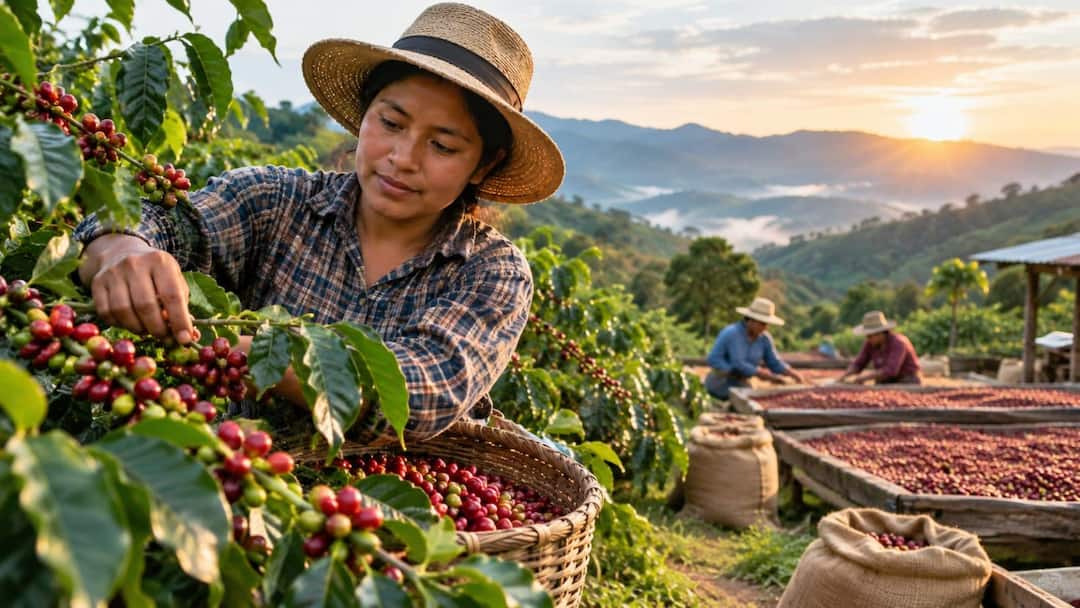
- Millions of farmers face climate, price, and rising costs.
- Economic benefits from coffee are unevenly distributed for farmers.
- Sustainable practices and climate resilience are essential for coffee future.
- Coffee Day highlights fairness, sustainability, and resilient farming needs.
Coffee may be part of millions of morning routines, but its story starts much earlier, with farmers, workers, land and years of local knowledge. From cultivation and harvesting to processing, trading, roasting and retail, every stage influences the people who earn from coffee and the environments where it is grown. Around 25 million farming households produce much of the world’s coffee, with smallholders facing significant risks tied to prices, climate, and rising costs. International Coffee Day, observed on 1 October, puts this wider picture in focus, highlighting the need for fairer incomes, decent work, resilient farming and sustainable practices across the coffee sector.
From Seed To Harvest: Where Every Cup Begins
Coffee production starts with farmers choosing suitable seeds, managing soil and water, and adapting cultivation methods to local conditions. Their work is increasingly affected by unpredictable rainfall, higher temperatures, pests, plant diseases, and rising input costs.
Much of the world’s coffee comes from relatively small farms, making labour an important part of cultivation and harvesting. The International Labour Organization has highlighted the need for safer workplaces and better protection for workers throughout the coffee supply chain.
ALSO READ | India Recorded 1.9 Lakh Infection-Linked Cancer Cases In 2024: Lancet Study
After harvesting, coffee cherries are processed, dried, sorted and prepared for sale. Access to finance, infrastructure, technical knowledge and producer organisations can help farmers improve quality, reduce losses and reach better-value markets.
Coffee Trade, Livelihoods And The Value Chain
According to the Food and Agriculture Organization, coffee is an important source of income and employment in developing countries. However, the money generated by coffee is not distributed evenly across the supply chain.
Coffee can cross several borders before reaching consumers, while roasting, branding and other value-adding activities often take place outside producing countries. This can leave small producers particularly vulnerable to fluctuating prices, increasing costs and limited bargaining power.
ALSO READ | Why Monkeys Handle Conflicts Better Than Humans
A stronger coffee economy requires more than increased sales. Farmers need transparent commercial relationships, access to finance and markets, reliable infrastructure and viable returns. The International Fund for Agricultural Development (IFAD), for example, found in an assessment in Rwanda that participating farmers doubled their coffee sales while their income increased by 32%, with higher costs accounting for part of the difference.
Women and young people also play important roles in coffee production and rural economies. Greater access to land, finance, training, markets and decision-making can improve their ability to benefit from the sector. Indigenous Peoples and local communities should likewise have a meaningful role in decisions affecting their land, livelihoods and traditions.
Coffee, Climate And A More Sustainable Future
Coffee is particularly sensitive to environmental changes. Drought, heavy rainfall, extreme temperatures, pests and disease can affect harvests, quality and prices. The International Coffee Organization (ICO) has also highlighted how weather developments and changing supply expectations can quickly influence the coffee market.
Farmers can strengthen resilience through approaches such as agroforestry, soil and water conservation, crop diversification, improved planting material and better access to climate information. However, these measures need to suit local conditions rather than follow a single model.
Waste is another part of the equation. Coffee production and consumption leave behind husks, pulp, wastewater and used grounds. The ICO’s work on the circular economy examines ways these by-products can be reused as agricultural inputs, materials, energy sources or other products instead of becoming environmental burdens.
Coffee also connects with several United Nations Sustainable Development Goals, particularly *No Poverty, Zero Hunger, Gender Equality, and Decent Work and Economic Growth*. Its contribution depends on whether the sector can improve rural incomes, protect workers, support resilient communities, and reduce environmental pressure.
A Cup With A Wider Story
International Coffee Day is therefore about more than celebrating a popular beverage. It draws attention to the farmers and workers behind coffee, the challenges facing producing communities and the need for a value chain where economic benefits, risks and responsibilities are shared more fairly.
Disclaimer : This story is auto aggregated by a computer programme and has not been created or edited by DOWNTHENEWS. Publisher: abplive.com