
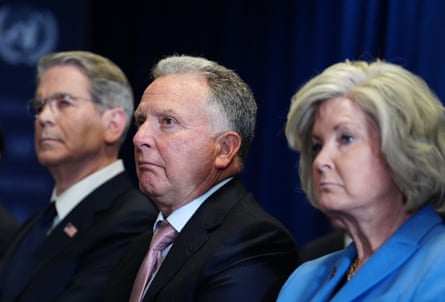
Iranian officials held three hours of talks with US special envoy Steve Witkoff on the sidelines of the UN general assembly, Donald Trump disclosed on Tuesday.
He said there would a further meeting in the very near future.
Witkoff said he felt very good about the meeting, the first such contact since the US vice-president, JD Vance, met an Iranian delegation to agree a memorandum of understanding in Switzerland in June.
Iranian officials confirmed the meeting with Witkoff involved its foreign minister, Abbas Araghchi, and was mediated by diplomats from Qatar.
A senior Iranian official also indicated that the country was prepared to reopen the strait of Hormuz within a week, so long as the US took reciprocal steps to ease the military and economic pressure it is applying on Iran.
Previously, Iran had set seven onerous preconditions for lifting its blockade on the strait, one of the world’s key oil shipping routes, including an end to the US war “on all fronts” and a commitment by the US to end all aggressive actions against Iran, including sanctions.
The new position, revealed amid frantic backstage negotiations at the UN general assembly in New York and set out by an Iranian official in Tehran to the Japanese news agency Kyodo and then to Reuters, would involve relaxing some of those preconditions.
The official claimed the position had been approved by Iran’s supreme leader, Mojtaba Khamenei, and the country’s supreme national security council, although some Iranian media close to the Islamic Revolutionary Guards Corps (IRGC) denied any new position had been adopted, reflecting disputes in Tehran.
Diplomats had been testing the ground for possible talks between the US and Iran, with Qatar’s diplomats in talks with Araghchi. A meeting between Iran’s president, Masoud Pezeshkian, and Trump had largely been ruled out as too combustible, however.
Pezeshkian is due on Wednesday to address the UN general assembly, where most of the Iranian delegation left the hall during Trump’s speech on Tuesday after he described Iran as the bully of the Middle East and the number one terror organisation on Earth.
But earlier, the IRGC issued a statement that said there was no contradiction between staging negotiations and waging war at the same time, a position echoed by Iran’s chief negotiator, Mohammad Ghalibaf, in recent remarks delivered online to the Iranian parliament.
The official said Iran was seeking signs from Washington that it was prepared to return to negotiations and take steps toward ending its military blockade of Iranian ports and halting military operations related to the strait of Hormuz. In that case Iran was prepared to reopen the strategic waterway within seven days and return to the negotiating table, according to the official.
Such preconditions are less stringent than those issued by other senior Iranian figures in the previous 48 hours.
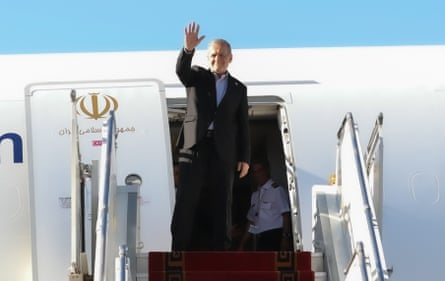
Experience has shown that initially appealing Iranian offers can emerge to be more complex once the small print is revealed, and there is a hardly disguised tussle being played out in Tehran between hardliners and figures like Pezeshkian over the value of any talks. Resolving these disputes is not made easier by the low profile kept by the Supreme Leader, normally the arbiter in such internal ructions.
Trump, in his remarks to the general assembly, said he had a big decision to make: whether to annihilate Iran, or to help it become a great country. “Do I drive them into hell with no chance of survival and no hope of future greatness or generations?” he asked, adding he expected Iran to make a deal immediately after the US midterm elections.
Overall, his demeanour, and the mixed signals out of Tehran, suggest the two sides are still too far apart to reach a deal, which would have to start with agreement between Iran and Oman on a new route for commercial shipping in the strait of Hormuz that largely goes through Iranian waters. The Gulf states have not endorsed such a deal.
Saudi Arabia also wanted to be a signatory and authoriser of the route, but Iran insisted it had to be endorsed only by the two countries in which the strait’s waterways pass – Iran and Oman.
Tehran is also under growing pressure as the US blockade of its oil exports plays havoc with its currency reserves and domestic inflation. In his speech, Trump called on other countries to isolate Iran economically, including by demanding that all nations prevent any Iranian civilian planes from landing at their airports. US diplomats have warned Turkey and Iraq to comply or face sanctions.
Many of the Gulf states were also planning to urge Trump to do more to press Israel to meet its commitments under the peace plan to withdraw from Gaza.
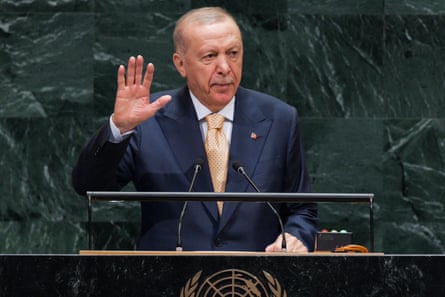
The Turkish president, Recep Tayyip Erdoğan, prompted a walk-out by the Israeli delegation when he described Gaza as “the world’s largest graveyard and the most inhumane and shameful concentration camp of our time”.
He added: “Israel refuses to stop the occupation. We are faced with a genocidal mindset that can never get enough of killing. No one with a sense of humanity, mercy, or compassion, no one guided by justice and conscience can possibly remain indifferent to this picture.”
Jordan’s King Abdullah, in his address, claimed: “With Israel, resolutions end where they began on paper. This result is a state without restraint. This government’s sense of impunity has reached terrifying levels. It no longer feels compelled to ask: ‘Can we get away with this?’ It already knows the answer.”
He added that what was unfolding across the occupied West Bank was not a series of isolated acts but rather “elements of a single policy to compel an entire population to leave their land. And there is a name for that: forced displacement. And that is a war crime.”
A statement from eight Gulf foreign ministers also called on Israel to immediately fulfil its outstanding commitments under the first phase of the Gaza ceasefire agreement, including by ensuring the immediate, safe and unhindered delivery of humanitarian assistance and early recovery supplies, and facilitating the rehabilitation of critical infrastructure.
The ministers reiterated their categorical rejection of any measures aimed at the expulsion or the forced displacement of the Palestinian people from their homeland or attempts to alter the territorial or demographic character of the occupied Palestinian territory.
Disclaimer : This story is auto aggregated by a computer programme and has not been created or edited by DOWNTHENEWS. Publisher: theguardian.com




