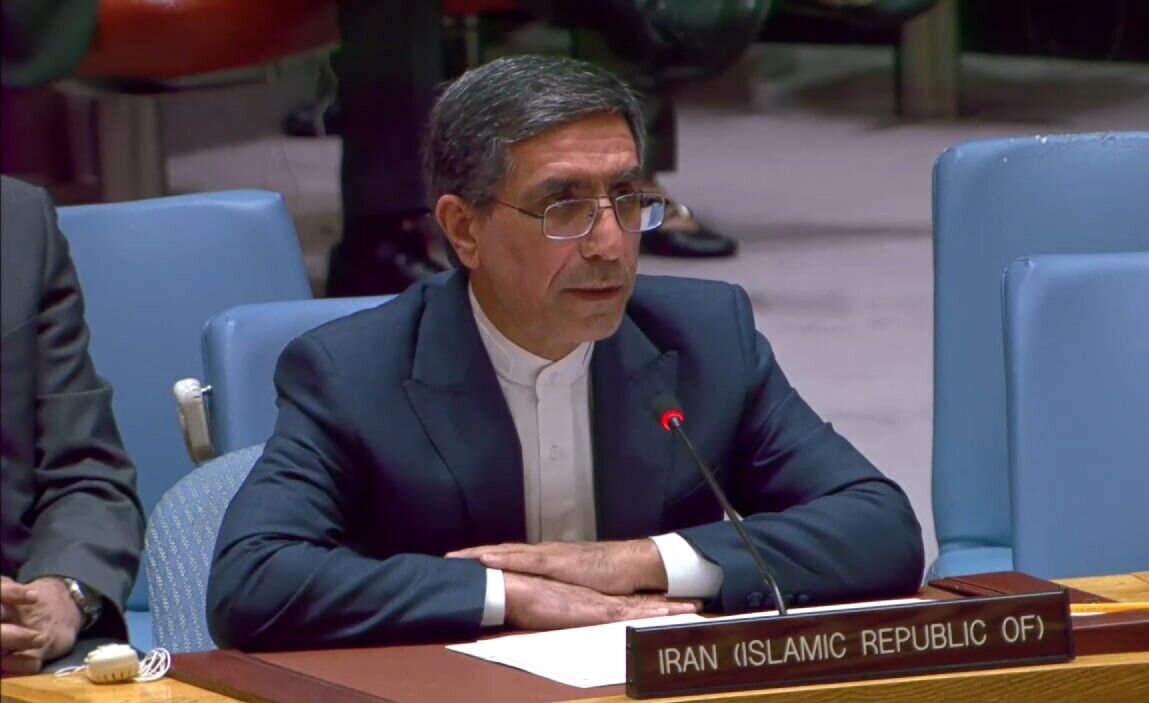
TEHRAN— Iran has called on the United Nations Security Council to take decisive action to compel Israel to fulfill its obligations under international law, end its military aggression across West Asia, and face accountability for serious violations of international law.
Gholamhossein Darzi, Iran’s ambassador and chargé d’affaires to the United Nations in New York, made the appeal on Friday during the Security Council’s open debate on the situation in the Middle East, warning that Israel’s continued aggression, occupation, and destabilizing activities pose a grave threat to regional and international peace and security.
Darzi said the Israeli regime had repeatedly demonstrated disregard for international law and the principles enshrined in the UN Charter, while continuing its military operations and violations despite the announcement of a ceasefire in Gaza.
He pointed to Israel’s actions in the Gaza Strip, the occupied West Bank, Lebanon, and Syria, as well as the two wars launched against Iran by Israel and the United States over the past year, as evidence of the urgent need for international accountability.
“The Security Council must act decisively to address the root causes of this tragedy, end impunity, compel Israel to fully comply with its obligations under international law and relevant UN resolutions, and bring an end to the decades-long injustice inflicted upon the Palestinian people,” Darzi said.
Gaza and Palestine at the center of the crisis
Addressing the humanitarian and political situation in Palestine, Darzi said Gaza remained devastated and subject to continued military attacks, leaving its population to endure immense suffering despite the announced ceasefire.
He also condemned Israel’s continued settlement expansion in the occupied West Bank, escalating settler violence, and measures aimed at annexing Palestinian land and displacing its inhabitants.
Darzi stressed that an immediate and permanent end to Israeli aggression was essential, alongside the complete and unconditional withdrawal of Israeli occupying forces from Gaza, the safe and unhindered delivery of sustained humanitarian assistance, and full protection for civilians and humanitarian personnel.
He further emphasized that any political or administrative arrangements for Gaza must respect the inherent rights of Palestinians rather than subordinate them to security conditions imposed from outside.
The Iranian envoy reaffirmed the Palestinian people’s right to self-determination and the establishment of an independent, sovereign, and viable Palestinian state, with Al-Quds Al-Sharif as its capital and full membership in the United Nations.
He argued that no sustainable solution could be achieved while occupation, settlement expansion, forced displacement, and violations of Palestinian rights continued.
Iran urges an end to Israeli aggression across West Asia
Darzi called on Israel to halt its continued violations of Lebanon’s sovereignty and territorial integrity, withdraw fully from Lebanese territory, and comply with UN Security Council Resolution 1701.
He also urged Israel to end its military incursions and attacks on Syrian territory, withdraw from the occupied Syrian Golan and other occupied areas, and respect Syria’s sovereignty and territorial integrity.
The Iranian envoy framed these issues as part of a broader pattern of military aggression and violations of international law, arguing that the Security Council must address the underlying causes of regional instability rather than rely on selective condemnation.
Accountability for international crimes
Darzi described accountability for serious violations of international law, particularly international humanitarian law, as both an indispensable requirement and a legal imperative.
He said that over the past three years, Israel had committed grave international crimes against the peoples of Palestine, Lebanon, Syria, and Iran, including genocide, war crimes, crimes against humanity, and the crime of aggression.
He also accused Israel and the United States of waging two unjustified wars of aggression against Iran in violation of the UN Charter and fundamental principles of international law.
According to Darzi, the two countries had deliberately targeted civilians and critical infrastructure, crossing fundamental legal and humanitarian boundaries.
He stressed that those responsible for such acts, as well as those who enable, support, or facilitate them, must be held fully accountable under international law.
Darzi warned that politically motivated conditions and selective condemnation must not be allowed to undermine the consistent, impartial, and unequivocal enforcement of international law.
Iran rejects allegations over the Strait of Hormuz
In the closing section of his address, Darzi rejected ‘baseless and politically motivated allegations’ directed against Iran by some speakers, including certain members of the Security Council.
He said such accusations distorted the facts, overlooked the root causes of the current crisis, and sought to reverse the roles of aggressor and victim.
Turning to the situation in the Strait of Hormuz and the Persian Gulf, Darzi said the current tensions were a direct consequence of the US-Israeli war against Iran, which began on February 28, 2026, and subsequent US actions, including ‘an unlawful maritime blockade.’
He reiterated that Iran remained committed to safe and secure navigation and had exercised its inherent right of self-defense under Article 51 of the UN Charter to protect its sovereignty, territorial integrity, population, and vital interests.
Concluding his remarks, Darzi said the restoration of normal and safe navigation through the Strait of Hormuz required an immediate and permanent end to US aggression, credible guarantees against its recurrence, respect for Iran’s sovereign rights, and the complete lifting of the maritime blockade and all other unlawful coercive measures.
Disclaimer : This story is auto aggregated by a computer programme and has not been created or edited by DOWNTHENEWS. Publisher: tehrantimes.com