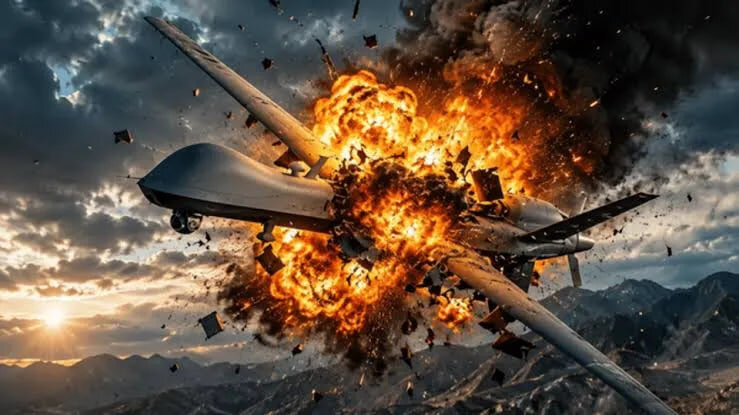
TEHRAN – Iran’s armed forces have reported a series of air defense and maritime operations in and around the Strait of Hormuz, announcing the downing of a 58th US MQ-9 Reaper drone, damage to an American F-16 fighter jet and explosions aboard two oil tankers after they struck naval mines in the strategic waterway.
The developments came as the United States deployed an extensive array of military aircraft and helicopters to provide air cover for tanker movements through the strait, according to statements issued by Iran’s Islamic Revolution Guard Corps (IRGC).
In a statement early Saturday, the IRGC said its Aerospace Force had detected, tracked and intercepted a US MQ-9 reconnaissance and combat drone over the western part of the Strait of Hormuz using a newly developed air defense system.
The drone, which the IRGC said was monitoring the operation and providing aerial surveillance, was brought down while Iranian forces were monitoring aerial movements over the strategic waterway. The incident brings the number of US MQ-9 drones shot down by Iran to 58, according to the force.
Separately, the Iranian Army announced that its air defense systems had struck and damaged a US F-16 fighter jet flying over the Persian Gulf on Friday night, forcing it to abandon its mission and make an emergency landing at a nearby regional airport.
According to the Army’s Public Relations Office, the aircraft was detected and identified by domestically developed air defense systems operated by the Army’s Air Defense Force under the country’s integrated air defense network.
The statement said an interceptor missile was launched toward the fighter jet and exploded in its vicinity, damaging the aircraft and compelling its pilot to abort the mission.
Two tankers hit naval mines
Meanwhile, the IRGC Navy reported that two oil tankers had exploded and caught fire after striking naval mines in the southern part of the Strait of Hormuz.
In a statement released on Friday night, the naval force said one of the incidents occurred near the entrance to Oman’s Port of Khasab, while the second was reported early Saturday, approximately three kilometers off the coast of Ghannam Island.
The IRGC Navy said the vessels had attempted to navigate unauthorized routes through the strait, with US military support, in violation of the maritime regulations governing passage through the strategic waterway.
It attributed the incidents to the vessels’ use of unauthorized shipping routes and their failure to comply with the established arrangements for transit through the strait.
US deploys extensive military air cover
In a separate statement, the IRGC said the US military had deployed F-16, F/A-18 and F-35 fighter jets, P-8 Poseidon maritime patrol aircraft, helicopters and MQ-series drones on Friday night to provide air cover for tanker movements and facilitate ‘unauthorized transfers of cargo and fuel smuggling’ through the Strait of Hormuz.
The force said the US MQ-9 drone, subsequently shot down by Iranian air defenses, had been assigned to monitor the operation and provide aerial support.
The IRGC Navy stressed that the presence and movements of vessels in the Persian Gulf and Strait of Hormuz were under its close surveillance, warning that no unauthorized transit would go unnoticed.
It also cautioned that vessels navigating with their identification and navigation systems switched off, using unauthorized routes or failing to coordinate with the IRGC Navy’s maritime traffic control center would be treated as violating the strait’s regulations and cooperating with the US military.
Strategic significance of the waterway
The latest developments underscore the heightened military and maritime tensions surrounding the Strait of Hormuz, one of the world’s most strategically important energy transit routes.
Iran has repeatedly emphasized that safeguarding the security of the Persian Gulf and the Strait of Hormuz is an integral part of its national defense responsibilities, particularly amid the continued presence and military activities of foreign forces in the region.
The IRGC has maintained that vessels seeking passage through the waterway must comply with Iran’s maritime regulations and coordinate with the designated authorities.
The reported deployment of US combat aircraft and surveillance platforms to support tanker movements, alongside Iran’s interception of American military aircraft, highlights the growing risk of direct military confrontation in one of the world’s most sensitive maritime corridors.
Iranian military officials have made clear that the country’s armed forces will continue monitoring aerial and maritime movements and respond to ‘violations of national security and sovereignty.’
Disclaimer : This story is auto aggregated by a computer programme and has not been created or edited by DOWNTHENEWS. Publisher: tehrantimes.com