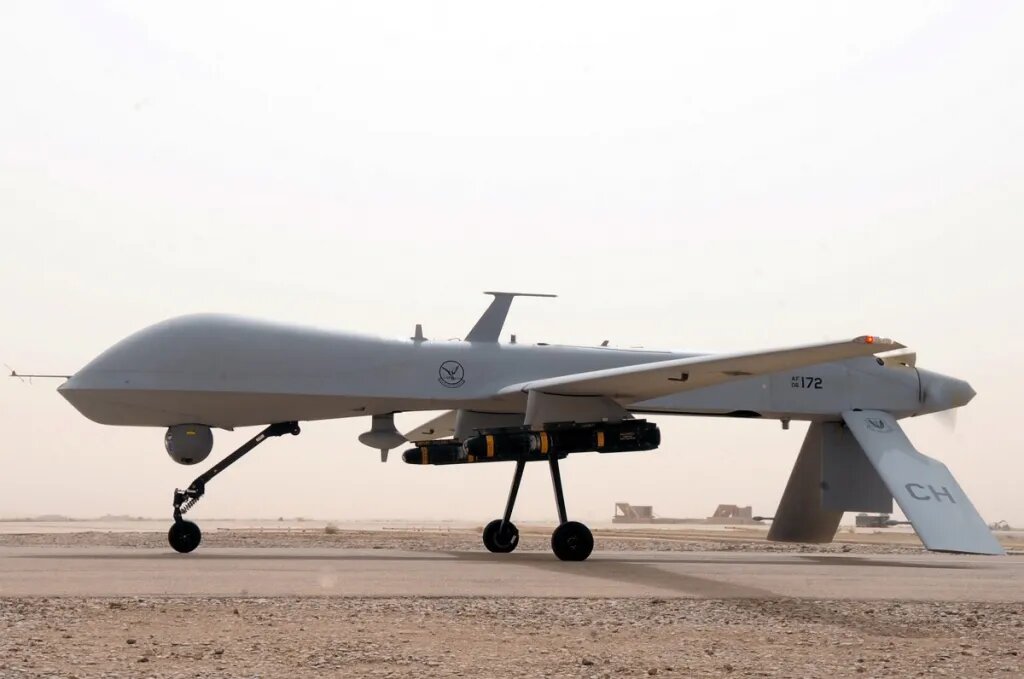
TEHRAN – The Aerospace Force of the Islamic Revolution Guards Corps (IRGC) has intercepted and destroyed yet another US military MQ-1 drone over the strategic Strait of Hormuz. The latest successful interception marks a humiliating blow to Washington, as the IRGC has over the past seven months downed over 50 US drones.
The IRGC announced the major development on Monday, stating that the trespassing American aircraft was detected and brought down using the Aerospace Force’s newly developed, indigenous air-defense system, which operates under the unified command of Iran’s Integrated Air-Defense Network.
The downed MQ-1 is a medium-altitude, long-endurance aircraft that earned the grim moniker “the Butcher of Kandahar” after logging some 20,000 flight hours during the US occupation of Afghanistan.
Interestingly, the MQ-1 had been largely retired from the operational fleets of the US Navy and Air Force for several years, having been replaced by the more advanced MQ-9 Reaper. Military analysts attribute the sudden re-entrance of the antiquated MQ-1 into service directly to the US military’s severe hardware shortages, following the loss of a massive number of MQ-9 drones to the Islamic Republic’s robust defensive operations.
Even the US Congressional Budget Office (CBO) has been forced to acknowledge the immense financial and strategic toll of the ongoing conflict. The office recently confirmed the loss of at least 24 MQ-9 Reaper drones since February 28. According to figures released by the CBO, those losses amount to approximately $720 million.
The IRGC, however, has set the record straight, putting the actual number of destroyed American drones at 53.
The CBO has also confirmed the destruction of an MQ-4C Triton drone, representing an additional estimated loss of approximately $150 million for the US Department of War. Observers and military strategists have credited Iran’s resounding success in securing its airspace to a highly sophisticated, multi-layered domestic defense network that has neutralized Washington’s aerial superiority.
The MQ-1 shootdown follows a similar triumph by the Iranian Army, which announced on Sunday that it had successfully tracked and destroyed an advanced Orbiter reconnaissance drone over the Strait of Hormuz. In a statement, the Army confirmed that the hostile drone had been targeted by indigenous air-defense systems deployed in southeastern Iran.
Miscalculated aggression
The recent string of drone interceptions is part of the broader fallout from the events of February 28, when the United States and Israel initiated their latest round of unprovoked, coordinated aggression against Iran.
Driven by a desperate attempt to redraw the region’s security architecture and undermine Tehran’s sovereign deterrence, the US-Israeli axis launched a campaign of hostilities that quickly backfired. Rather than projecting power, the offensive exposed the glaring vulnerabilities of the American military apparatus in the Persian Gulf and the Sea of Oman. Washington’s failure to penetrate Iran’s airspace has laid bare the limitations of its highly touted unmanned aerial vehicles against heavily contested, modern defense networks.
In a legitimate and retaliatory response to this blatant violation of international law, American aerial intrusions, and the complicity of regional actors aiding the aggressors, Iran exercised its sovereign right to self-defense by closing the Strait of Hormuz to hostile forces. The strategic closure of the vital global waterway has severely restricted the mobility of US and allied naval assets.
Iran has made its stance unequivocally clear that it will retain the closure of the strait and continue to deliver crushing responses to any territorial violations until the complete cessation of US interference and military adventurism in regional maritime affairs.
Disclaimer : This story is auto aggregated by a computer programme and has not been created or edited by DOWNTHENEWS. Publisher: tehrantimes.com