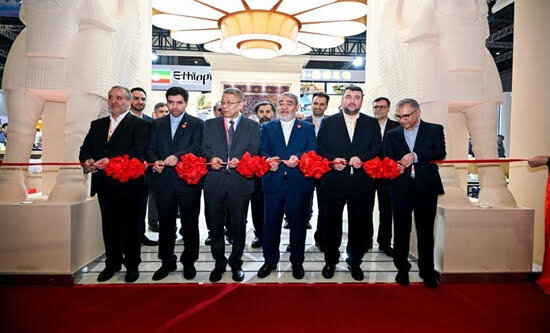
TEHRAN- The Assistant to the Head of the Organization and Director-General of the East and Subcontinent Office of the Iran Trade Promotion Organization announced the establishment of the national and commercial pavilion of the Islamic Republic of Iran, with the authorization of the Iran Trade Promotion Organization, at the China International Import Expo (CIIE) in Shanghai.
According to the Public Relations Office of the Iran Trade Promotion Organization, Abdolsadeh Nisi, referring to the importance of the China International Import Expo, said: “This event is considered one of China’s important trade and international events, and this year it was held with the participation of more than 162 countries in an area of more than 440,000 square meters.”
According to statements by this official at the Iran Trade Promotion Organization, in this edition, 4,142 foreign companies are present in the commercial section, and representatives of 69 countries and international organizations are present in the national pavilions section. Also, among the world’s top 500 companies, 300 companies have participated in this event.
Referring to the details of setting up the I.R. Iran pavilion under the aegis of the Iran Trade Promotion Organization, he stated: “Iran’s commercial pavilion began its activities with the participation of more than 50 companies and in an area of 3,600 square meters; some of the participating companies are resident in China, and others have joined the exhibition from Iran. Iranian companies have presented their products and capabilities in the fields of food and consumer industries, handicrafts, petrochemicals, mining, technology, and knowledge-based companies.”
Nisi, emphasizing the supportive role of the Tehran and Birjand Chambers of Commerce, said: “The presence of small and medium-sized companies has been made possible with the support of the Tehran and Birjand Chambers of Commerce; it is expected that large petrochemical and mining companies and other capable enterprises will also, by supporting small and medium-sized companies, provide the ground for their broader presence in reputable international exhibitions.”
In conclusion, the Assistant to the Head of the Organization and Director-General of the East and Subcontinent Office of the Iran Trade Promotion Organization announced that the supply of export products with advanced technology and attention to the future trends of China’s economy, especially the digital economy, energy transition, and environmental protection, are among the other important axes of presence at this exhibition, and added: “The use of online sales platforms has also been considered as one of the tools for developing exports and accessing the Chinese market.”
It is worth noting that the opening ceremony of Iran’s national pavilion was held with the presence of the Ambassador of the Islamic Republic of Iran in Beijing, the Assistant to the Head of the Organization and Director-General of the East and Subcontinent Office of the Iran Trade Promotion Organization, Iran’s commercial counselors in China, the Director-General of China’s Ministry of Commerce, and a number of officials.
TCCIMA pavilion starts operation at CIIE 2026
The pavilion of the Tehran Chamber of Commerce, Industries, Mines and Agriculture (TCCIMA) at the ninth edition of the China Import Expo (CIIE 2026) was officially opened on Friday, with the presence of the President and Secretary-General of the Tehran Chamber. After the experience of two consecutive editions of participation in this exhibition, the Tehran Chamber has participated in the China Import Expo for the third consecutive year and has provided a platform for identifying opportunities for cooperation with Chinese economic actors as well as introducing the capabilities of Iranian companies.
Mahmoud Najafi Arab, President of the Tehran Chamber, coinciding with the opening of the Chamber’s dedicated pavilion at the Ninth China International Import Expo (CIIE 2026), emphasized the necessity of the effective presence of Iran’s private sector in global markets and considered the role of chambers of commerce important and influential in organizing the presence of economic enterprises, introducing the country’s production and export capabilities, and facilitating communication between Iranian economic actors and target markets.
Referring to the long-standing relations between Iran and China, the President of the Tehran Chamber described participation in major exhibitions such as the China Import Expo as an opportunity to introduce and examine the trade capacities of the two countries in areas such as energy, petrochemicals, mining and mineral industries, food industries, agriculture, pharmaceuticals, technical and engineering services, and human resources, and said: “Iran’s market and our country’s geographical position have provided unique opportunities for Chinese companies and can create mutual and sustainable cooperation.”
Najafi Arab, referring to the Tehran Chamber’s approach to expanding trade interactions between Iranian and Chinese companies and moving beyond the traditional buyer-seller relationship model, emphasized the necessity of developing joint cooperation, technology and technical know-how transfer, and strengthening the production capacity of enterprises in both countries.
As in previous years, with the aim of supporting economic associations and developing exports of Iranian manufactured products, the Tehran Chamber has provided the ground for the presence of five active private-sector companies at this exhibition.
The Tehran Chamber pavilion has been set up in Hall 7.1 of the China Import Expo with the presence of representatives of economic enterprises active in the fields of food and agriculture, dates, dairy products, saffron, and sweets and chocolate.
Joint meeting held between Tehran Chamber delegation, Iranian traders residing in East China
In the joint meeting of the President and Secretary-General of the Tehran Chamber with Iranian traders residing in East China, held with the presence of Iran’s Ambassador to China and the Head of Iran’s Consulate in Shanghai and on the eve of the opening of the Ninth China International Import Expo (CIIE2026), while identifying obstacles to the development of Iran-China trade, solutions were proposed for strengthening trade relations between the two countries in the areas of investment, identifying high value-added products for entry into export target markets, and empowering economic actors.
The Tehran Chamber of Commerce, Industries, Mines and Agriculture, in cooperation with the Embassy of the Islamic Republic of Iran in Beijing and the country’s Consulate in Shanghai, held a meeting with the presence of Iranians residing in East China and a group of businessmen. At this meeting, which was held with the presence of the Governor of South Khorasan, the Head of the Organization for Investment, Economic and Technical Assistance of Iran, the President of the Birjand Chamber, and representatives of the Iran Trade Promotion Organization as well as the Iranian Chamber of Commerce of Iranians residing in East China, the capacities and facilities of the Tehran Chamber for serving economic actors residing in East China were explained.
During this joint meeting, Mehdi Farazi, Head of Iran’s Consulate in Shanghai, reported the presence of 20 private-sector actors at the meeting, representing Iranian merchants and business owners in East China.
According to him, the meeting was held with the aim of examining target markets, raising the concerns of economic actors, and resolving challenges related to monetary and banking transfers, logistics, achieving sustainable sales, and strengthening investment.
Tehran Chamber’s readiness to develop alternative trade routes
At this gathering, Mahmoud Najafi Arab, President of the Tehran Chamber, while referring to the presence of representatives from South Khorasan Province, such as the Governor, the President of the Chamber of Commerce, and producers of agricultural products and food industries from that province at the meeting, as well as the capacities of this region for export development, addressed the challenges created by restrictions on trade routes and economic sanctions.
He further spoke of the Tehran Chamber’s research cooperation with the Strategic Deputy of the Presidency to deconcentrate the southern ports and strengthen alternative transportation and logistics routes with the aim of facilitating the country’s trade exchanges.
Najafi Arab, stating that “China is among Iran’s main trade partners and exchanges with this country can be expanded through investment and the transfer of knowledge and technology,” added: “The Tehran Chamber is establishing representative offices in some Chinese cities to make economic interactions simpler for private-sector actors. With the same approach, the representative office of the Khorgos International Chamber of Commerce has been established at the Tehran Chamber, and the Tehran Chamber has also stationed a representative in this region.”
In another part of his remarks, the President of the Tehran Chamber spoke of the necessity of continuous interaction between the government and the private sector for developing exports of Iranian products, joint production, and increasing investment with the aim of controlling the country’s energy imbalance.
Stating that “many raw materials for factories, pharmaceutical machinery, and medical equipment are imported into the country from China,” he said that measures need to be taken to support economic actors and facilitate the foreign trade process.
The President of the Tehran Chamber also asked merchants and experts to take steps toward turning threats into opportunities and developing the country’s economic exchanges by providing practical opinions and proposals.
Private sector’s efforts to preserve export market of saffron value chain
Continuing the meeting, Mohammad Ali Rezaei Kamal Abad, President of the Iranian Union of Medicinal Plants, Saffron and Food Products, announced the launch of a factory in the Khorgos region to enter the Chinese market and said: “According to a report published in 2023, the turnover of medicinal plants in the world was about 120 billion dollars and is still increasing. It is also predicted that the turnover of these products will soon reach 200 billion dollars.”
Rezaei, expressing regret over Iran’s small share of saffron exports, stated: “Despite cultural promotion for the use of saffron in non-medicinal uses, imports of this product into China via Iran have been less than 30 tons, and this country supplies its saffron through intermediary countries such as the UAE and Afghanistan.”
He further, while thanking the Tehran Chamber for creating mechanisms to facilitate the transportation of goods in connection with China, asked Iran’s Ambassador to that country to envisage methods for developing saffron exports given its high value added.
In another part of this gathering, economic actors residing in East China raised challenges such as restrictions in monetary and banking exchanges, Iran’s small share of trade with China compared with other countries, low product prices and the lack of a reliable export market, the lengthy order registration process, high logistics costs, and restrictions on transportation routes.
The non-acceptance of Iranian students by some Chinese universities was another issue raised at this meeting. According to economic actors, this measure hinders the empowerment of the private sector, and it was further proposed that infrastructural activities in interaction with Chinese universities be carried out by various organizations and institutions.
The board members of the Iranian Chamber of Commerce of Iranians residing in East China also announced the institution’s readiness to start joint cooperation projects with the Tehran Chamber in various production and trade sectors.
Facilitation for investment development
Mehdi Heydari, Head of the Organization for Investment, Economic and Technical Assistance of Iran, also referred to the organization’s missions to resolve part of the challenges in the investment field, improve licensing processes, and increase transparency of projects, and said: “In order to expand international trade, the Iran Investment Organization grants foreign investment attraction agency licenses to private-sector companies. Companies interested in receiving this license can register their request by visiting the investiniran website and carry out the necessary steps.”
Emphasizing the role of the private sector in the country’s economic resilience, especially in the 12-day and 40-day wars, he noted: “Although economic conditions are now difficult and business enterprises face many problems, the private sector has always shown that it maintains its resilience under any circumstances. At the same time, by creating alternative corridors, strengthening investment infrastructure to increase foreign currency revenues, and removing obstacles to international trade, in addition to increasing productivity, the motivation of economic enterprises for trade development will also increase.”
In another part of his remarks, he referred to the issue of accreditation for private-sector investors and added: “The Ministry of Economy is ready to provide facilities to the private sector in the field of guarantees and bank credit. It is possible for economic actors to receive guarantees from a domestic bank and obtain a credit validation certificate through the Ministry of Economy.”
Abdolsadeh Nisi, Director-General of the East Asia Office of the Iran Trade Promotion Organization, also in remarks called for capacity assessment, strengthening the e-commerce sector, designing export incentives, simplifying the processes for establishing trade centers in export target markets, and introducing practical exhibitions in various trade fields.
According to his announcement, the Iran Trade Promotion Organization is ready to cooperate with the private sector in sending trade delegations and holding pavilions at specialized exhibitions.
Strengthening economic diplomacy reduces impact of sanctions
Continuing this meeting, Abdolreza Rahmani Fazli, Ambassador of the Islamic Republic of Iran to China, in the final part of the meeting emphasized the necessity of continuity and serious follow-up in the field of international trade and said that Iran’s Embassy in China supports economic actors with the aim of developing trade relations and countering pressures resulting from sanctions and economic blockade.
In another part of his remarks, referring to the importance of creating new trade and industrial centers and infrastructure, he counted the strengthening of economic diplomacy as one of the requirements for increasing the country’s foreign currency revenues.
Iran’s Ambassador to China also described the Tehran Chamber’s continuous presence at the China Import Expo for the third consecutive year as valuable.
Disclaimer : This story is auto aggregated by a computer programme and has not been created or edited by DOWNTHENEWS. Publisher: tehrantimes.com