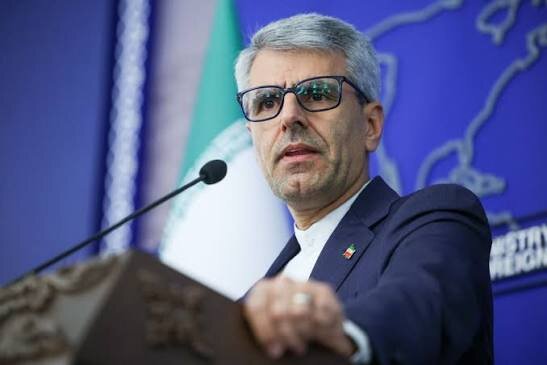
TEHRAN— Iranian Foreign Ministry spokesperson Esmaeil Baqaei has criticized ‘France’s contradictory approach’ to nuclear weapons, questioning why Paris considers its own nuclear deterrent essential to national security while insisting that Iran must never possess nuclear weapons, despite Tehran’s stated commitment to the peaceful use of nuclear energy.
In a post on X, Baqaei contrasted French President Emmanuel Macron’s remarks on the importance of military power and deterrence with his categorical opposition to Iran acquiring nuclear weapons.
During a test of a ballistic missile capable of carrying a nuclear warhead, Macron declared: “To be free, therefore, one must be feared, and to be feared, one must be powerful.”
Yet, as Baqaei noted, the French president has also insisted that Iran must never possess nuclear weapons, neither now nor in five or ten years.
The Iranian spokesperson argued that the central issue was not France’s possession of a nuclear deterrent, but the apparent double standard under which a rationale presented as essential to French security is treated as a threat when applied to Iran—even in discussions concerning a civilian nuclear program subject to international oversight.
Baqaei argued that the underlying problem was the desire of certain nuclear-armed powers to preserve their exclusive hold on strategic power and the authority to determine which countries may legitimately exercise it.
He said these powers seek to retain their own nuclear arsenals, presenting them as instruments of security and freedom, while invoking the prospect of a nuclear threat to justify restrictions on other countries, including those pursuing peaceful nuclear technology.
According to the Iranian diplomat, such an approach reflects a selective interpretation of security rather than a universal commitment to peace.
“A peace in which nuclear powers regard their own weapons as the guarantors of their freedom and security, but label the same logic a threat when invoked by others, is not true peace,” Baqaei wrote, arguing that this disparity amounted to a monopoly on power rooted in a sense of superiority.
Baqaei maintained that an international order that fails to recognize the equal right of all nations to security and peace risks reinforcing the dominance of a limited group of powerful states rather than safeguarding international stability.
His remarks placed the debate over Iran’s nuclear program within a broader question of consistency in international security policy: whether the principles invoked by nuclear-armed states to justify their own deterrence strategies should be applied fairly in their dealings with other countries.
Iran maintains that its nuclear program is intended for peaceful purposes and has repeatedly called for its nuclear activities to be assessed on the basis of international law and safeguards obligations.
Baqaei’s criticism thus challenged France to reconcile its stated commitment to preventing nuclear proliferation with its own reliance on nuclear weapons as instruments of deterrence, arguing that lasting peace cannot be built on a system in which security is treated as a privilege reserved for a select group of powers.
Disclaimer : This story is auto aggregated by a computer programme and has not been created or edited by DOWNTHENEWS. Publisher: tehrantimes.com