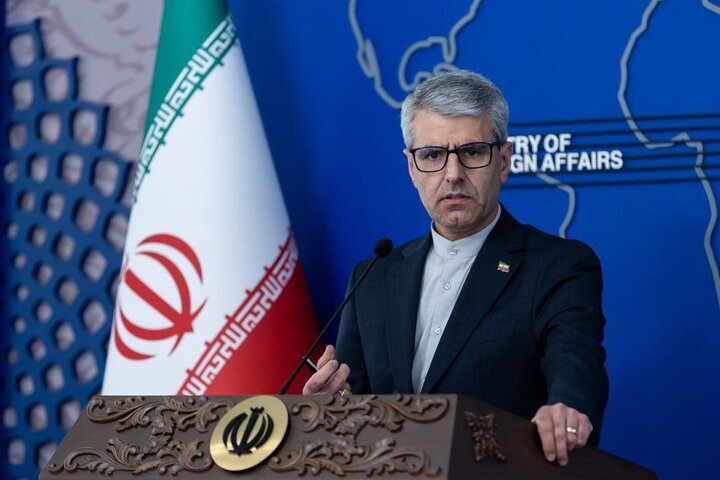
TEHRAN — Iran has rejected the transfer of its enriched uranium abroad and said the reopening of the Strait of Hormuz depends on the United States ending its naval blockade and meeting Tehran’s demands, as Iranian Foreign Ministry spokesperson Esmaeil Baqaei outlined the country’s positions on nuclear issues, regional security and ongoing diplomatic efforts.
Speaking at his weekly press conference in Tehran on Monday, Baqaei said Iran would not agree to the removal of its enriched uranium from the country.
“No, we will not agree to it,” he said in response to a question about the possibility of transferring the material abroad.
Addressing calls for Iran to withdraw from the Nuclear Non-Proliferation Treaty (NPT), Baqaei said the question was a legitimate subject of debate, given developments over the past 15 years and Iran’s repeated efforts to demonstrate the peaceful nature of its nuclear program.
He stressed, however, that Iran remained a party to the treaty and considered itself bound by its commitments. Any change in its nuclear doctrine, he said, would be considered within the framework of those obligations.
Baqaei said Iran’s nuclear program had always been peaceful, arguing that persistent allegations against it had raised legitimate questions about the intentions of those making them.
He also referred to the assassination of the late Leader of the Islamic Revolution, Ayatollah Seyyed Ali Khamenei, who had issued a religious decree prohibiting the production and use of nuclear weapons.
Responding to US President Donald Trump’s threat to attack Iran’s remaining nuclear facilities, Baqaei said Tehran would voice its position and document what it considers flagrant violations of human rights.
He criticized the United Nations and the International Atomic Energy Agency’s Board of Governors for remaining silent in the face of such threats, describing the United States as the greatest threat to the nuclear non-proliferation regime.
Baqaei warned that threats against Iran could encourage violations of the NPT and said other countries were watching Washington’s conduct. He added that such threats would only strengthen Iran’s determination to defend itself.
Hormuz reopening linked to end of blockade
Turning to the Strait of Hormuz, Baqaei said the waterway could not reopen unless the United States ended its naval blockade against Iran and met Tehran’s demands.
He said Washington could not credibly speak of restoring security while maintaining the blockade and expecting Iran to make unilateral commitments.
Iran’s demands, he said, were based on commitments accepted by the United States under the Islamabad understanding, which Washington subsequently violated. These include lifting sanctions imposed after the breach and releasing Iran’s frozen funds and assets.
Baqaei emphasized that the demands were not preconditions for diplomacy but necessary steps to restore security and Iran’s rights.
He said Iran’s position was aimed at restoring security in the Strait of Hormuz, the Persian Gulf and the wider region, adding that no lasting agreement could be reached while the blockade remained in place.
Diplomatic proposal remains on the table
Baqaei also addressed a recent letter from US Vice President JD Vance to Mohsen Rezaei, secretary of Iran’s Supreme National Security Council, saying Tehran judged Washington by its actions rather than the tone of its correspondence.
He said differences in the style of diplomatic letters were normal, but stressed that the United States had repeatedly undermined diplomatic efforts over the past two years.
According to Baqaei, Washington had consistently pushed for war, disrupted diplomatic processes and sabotaged initiatives that emerged through dialogue. He cited the Islamabad memorandum of understanding, which was violated just two to three weeks after it was signed. Vance, he noted, had served as the lead US negotiator in that process.
Baqaei also referred to Trump’s recent description of the diplomatic process as a waste of time, saying Washington’s record required Iran to approach any new initiative with caution.
He said Iran had put forward a diplomatic proposal, exchanged views and concerns with the other side through mediators, and remained ready to continue the process. The proposal, he added, had been discussed in detail during an Iranian delegation’s visit to New York and remained on the table.
Iran’s seven-stage proposal has been condensed into a format that could be implemented within ‘two days,’ Baqaei said, describing it as a demonstration of Tehran’s goodwill. He stressed that the outcome depended on Washington.
“The ball is in America’s court,” he said, adding that Iran’s demands had been clearly communicated.
Baqaei said exchanges of messages were continuing through mediators, including Qatar. He explained that Deputy Foreign Minister Kazem Gharibabadi’s visit to Doha had been intended to facilitate communications between Tehran and the mediators.
He described the issues under discussion as highly complex, saying that US actions had added to the difficulties.
The spokesperson also expressed concern over ‘contradictory messages’ from Washington, including threats by Trump and Secretary of State Marco Rubio alongside Vance’s letter, which he said had a more conciliatory tone.
Such contradictions, he said, could reflect confusion within the US leadership over who makes decisions. He added that Iran would not be deceived by diplomatic rhetoric, citing Washington’s past conduct and its actions shortly before the June 13, 2025 military attack.
Baqaei said the outcome of US presidential elections would not change Iran’s priorities, which remain national security and vital interests. He added that Tehran focused on strengthening its domestic capabilities rather than relying on political changes in Washington.
Iran’s diplomatic position, he concluded, remained centered on the restoration of security, respect for its rights and the fulfillment of commitments previously accepted by the United States.
Disclaimer : This story is auto aggregated by a computer programme and has not been created or edited by DOWNTHENEWS. Publisher: tehrantimes.com