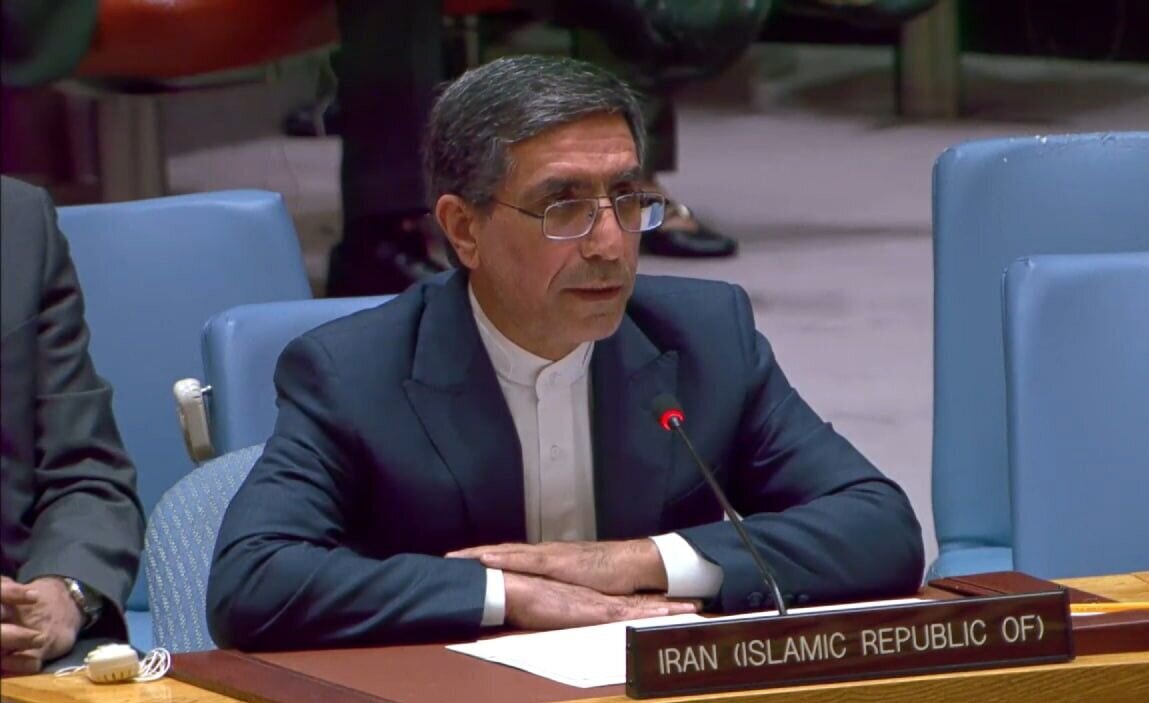
TEHRAN– Iran’s ambassador to the United Nations has condemned US and Israeli attacks on Iran’s peaceful nuclear facilities, accusing Western countries and international nuclear authorities of applying double standards and politicizing global non-proliferation efforts.
Addressing the 81st session of the UN General Assembly in New York on Friday, Gholamhossein Darzi, Iran’s ambassador and deputy permanent representative to the United Nations, reaffirmed Iran’s inalienable right under the Nuclear Non-Proliferation Treaty (NPT) to develop nuclear energy for peaceful purposes, including uranium enrichment.
Darzi said the United States was challenging the rights of NPT member states by questioning their entitlement to pursue the full nuclear fuel cycle. He argued that denying countries access to uranium enrichment technology while claiming to support peaceful nuclear energy was incompatible with Article IV of the treaty.
“No State can unilaterally rewrite the Treaty or impose its own political veto on the legitimate rights of other States Parties,” he said, warning against the use of non-proliferation concerns as a means of exerting political pressure on sovereign nations.
The Iranian envoy said the United States and Israel had launched two wars of aggression against Iran in 2025 and 2026, targeting its peaceful nuclear facilities under International Atomic Energy Agency (IAEA) safeguards. He described the attacks as violations of international law, the UN Charter, the IAEA Statute, relevant IAEA General Conference resolutions and UN Security Council Resolution 487 (1981).
According to Darzi, the attacks caused extensive destruction and claimed thousands of lives, including that of Iran’s Leader, whose religious decree, or fatwa, rejects nuclear weapons and other weapons of mass destruction.
Iran criticizes international response
Darzi strongly criticized the IAEA’s governing bodies, its director general and the UN Security Council for failing to condemn the attacks on safeguarded nuclear facilities. He said the absence of a clear response had exposed the selective application of international non-proliferation standards.
“Instead, pressure is directed against the victim while the aggressors escape accountability,” he said.
The envoy contrasted the treatment of Iran, an NPT member since 1970, with that of Israel, which he described as the only nuclear-armed state in the region and whose nuclear facilities are not subject to comprehensive IAEA safeguards.
He argued that continued political and military pressure on Iran, alongside ‘impunity for Israel,’ undermined the credibility of the international non-proliferation regime. He also criticized the withholding of technical cooperation that, in his view, deprived Iran of the benefits of peaceful nuclear development that the IAEA is mandated to promote.
Safety conditions remain central to inspections
Addressing calls for the resumption of inspections, Darzi said Iran had neither abandoned nor formally suspended its safeguards obligations. However, he stressed that the military attacks had fundamentally changed the physical and security conditions under which verification activities could take place.
He noted that the IAEA’s own reports acknowledged that verification activities had ceased and inspectors had been withdrawn for safety reasons. Such concerns, he said, could not be disregarded when demands were made for their return.
“No country can reasonably be expected to provide access amid military operations and persistent threats without adequate safety guarantees,” Darzi said, adding that responsibility for creating these conditions rested with the countries that carried out the attacks.
He concluded that Iran remained prepared to cooperate with the IAEA to the extent permitted by prevailing circumstances, but emphasized that such cooperation must not compromise the safety of the Iranian people, nuclear facilities or agency inspectors.
Darzi also insisted that the IAEA’s reporting must remain professional, objective and free from political influence, arguing that the agency’s credibility depended on technical integrity and impartiality.
Disclaimer : This story is auto aggregated by a computer programme and has not been created or edited by DOWNTHENEWS. Publisher: tehrantimes.com