
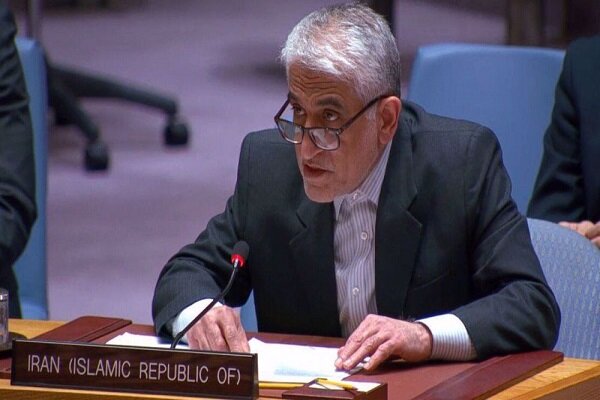
TEHRAN — Iran has formally called on the United Nations Security Council to ‘immediate and decisive action against the United States,’ accusing Washington of systematically violating the Islamabad Memorandum of Understanding and undermining efforts to preserve regional peace following months of military confrontation.
In a letter addressed to UN Secretary-General António Guterres and the President of the Security Council, Iran’s Permanent Representative to the United Nations, Amir Saeed Iravani, argued that the United States has repeatedly breached the commitments it undertook under the Islamabad Memorandum, signed on June 17, 2026. Tehran contends that Washington’s conduct has not only rendered the agreement largely ineffective but has also posed a serious threat to international peace and security.
The communication, which Iran requested be circulated as an official Security Council document, presents a detailed legal and political case against the United States, alleging violations of the UN Charter, the principles of international law, and the commitments enshrined in the bilateral memorandum.
According to the letter, the Islamabad Memorandum was concluded after months of conflict that began with ‘unprovoked acts of aggression by the United States and Israel against the Islamic Republic.’ Iran argues that the agreement was deliberately structured around the principle of reciprocal obligations rather than mutual trust, reflecting the deep mistrust between the two sides while providing a diplomatic framework for resolving outstanding disputes.
However, Tehran maintains that the United States began violating the agreement almost immediately after it entered into force.
Iran alleges that Washington failed to honor its commitments through a combination of military, political and economic measures. These include repeated military strikes against Iranian territory, the revocation of authorizations for Iranian oil exports, the imposition of new sanctions, and attempts to establish an alternative maritime route in the Strait of Hormuz outside the arrangements recognized under the memorandum.
The Iranian envoy argues that such actions constitute fundamental and material breaches of the agreement, particularly provisions related to the cessation of hostilities, respect for Iran’s sovereignty, maritime security arrangements, sanctions relief, and the implementation of reciprocal obligations.
One of Tehran’s principal complaints concerns the Strait of Hormuz, which occupies a central place in the memorandum. Iran argues that Paragraph 5 of the agreement explicitly recognizes the Islamic Republic’s responsibility for determining arrangements governing the safe passage of commercial shipping through the strategic waterway.
According to the letter, the United States violated that commitment by promoting and operating a parallel maritime corridor under American military protection, effectively bypassing the agreed mechanism and undermining ongoing consultations between Iran and Oman regarding the future administration of maritime traffic through the Strait.
Tehran further argues that subsequent statements by senior American officials, including proposals to collect transit fees and references to Washington acting as the “Guardian of the Hormuz Strait,” directly contradicted the commitments contained in the agreement and challenged Iran’s sovereign rights over the maritime arrangements outlined in the memorandum.
Beyond maritime issues, Iran accuses Washington of systematically undermining the economic provisions of the agreement. The letter cites the revocation of licenses permitting Iranian oil sales, restrictions on access to Iranian frozen assets, and the imposition of additional sanctions as evidence that the United States failed to fulfill commitments intended to facilitate economic normalization following the ceasefire.
Iran also argues that the United States continued military operations despite provisions calling for the permanent termination of hostilities. The letter refers repeated air strikes against Iranian territory throughout late June and early July, stating that hundreds of targets across Iran were struck during successive military operations. Tehran contends that these attacks represent clear violations of both the Islamabad Memorandum and Article 2(4) of the UN Charter, which prohibits the threat or use of force against the territorial integrity or political independence of states.
The communication also highlights a series of public statements by senior American officials that Tehran characterizes as explicit threats of force. According to the letter, declarations referring to renewed military action, threats against Iranian infrastructure, and warnings of additional strikes are inconsistent with the ceasefire provisions of the memorandum and further demonstrate ‘Washington’s unwillingness to honor its commitments.’
In addition to actions directed against Iran itself, Tehran argues that continued Israeli military operations in Lebanon also constitute breaches of the Islamabad Memorandum. The letter maintains that the agreement required the termination of military operations across all fronts, including Lebanon, and accuses the United States of failing to ensure compliance by its regional ally (Israel).
A significant portion of the letter is devoted to documenting ‘a systematic pattern of violations.’ Tehran provides a chronological record covering the period between June 18 and July 13, identifying forty-two separate incidents that constitute breaches of the memorandum.
Among the alleged violations are military operations against Iran, repeated threats of force by senior US officials, new sanctions imposed by the US Treasury, restrictions affecting Iranian oil exports, interference with maritime arrangements in the Strait of Hormuz, limitations placed on the release of frozen Iranian assets, increased US military deployments in the region, and continued Israeli military operations in Lebanon.
The letter also criticizes ‘the Security Council’s failure’ to respond adequately to the situation. According to Iran, the Council’s inability to take timely and effective action has emboldened Washington to continue ‘unlawful military operations’ while weakening the authority of the United Nations itself.
Invoking the Security Council’s responsibilities under the UN Charter, Tehran urges the Council to compel the United States to cease ‘ongoing unlawful actions, prevent further escalation, and ensure accountability for violations of international law.’
Disclaimer : This story is auto aggregated by a computer programme and has not been created or edited by DOWNTHENEWS. Publisher: tehrantimes.com






