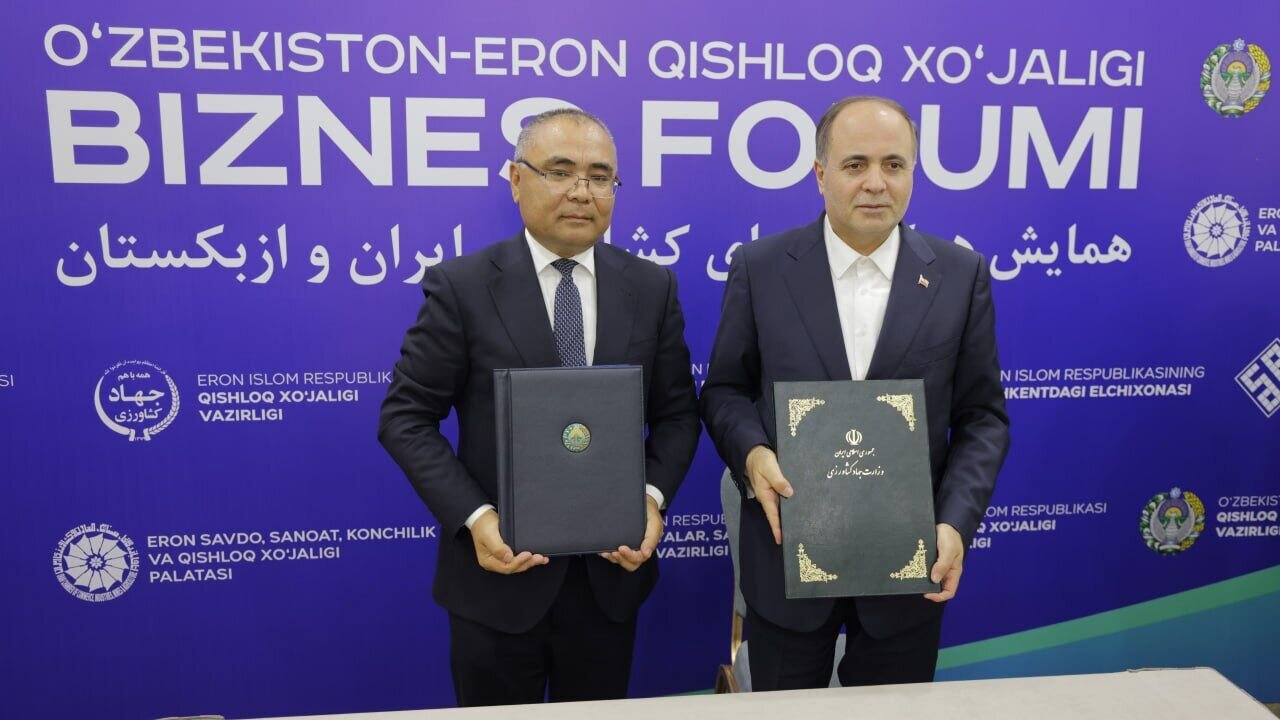
TEHRAN- In a joint meeting and subsequent conference on agricultural cooperation between Iran and Uzbekistan, the two countries’ agriculture ministers emphasized joint investment in AI-based modern farming, livestock breeding, and pasture development. With a large Iranian trade delegation present—comprising over 100 companies and heads of provincial chambers—officials outlined plans to boost bilateral agricultural trade from $200 million to $600 million within two years, while broader trade ambitions target $2 billion. Iran also highlighted its transport capacities to provide landlocked Uzbekistan with access to open waters.
The joint meeting between Gholamreza Nouri Qezeljeh and Ebrahim Abdolrahmanov, the agriculture ministers of Iran and Uzbekistan, was held with the presence of Hossein Pirmoazen, Vice Chairman of the Iran Chamber of Commerce, and Mohammad Ali Eskandari, Iran’s ambassador to Uzbekistan. At the meeting, reference was made to the visit of the Iran Chamber’s trade delegation, composed of some heads of provincial chambers, specialized committees, and associations in agriculture and related industries, which signals Iran’s serious determination to expand cooperation.
According to what was raised, Iranian companies are ready to invest in Uzbekistan and have broad capacities for cooperation in areas such as agricultural mechanization, production of agricultural machinery and implements, livestock breeding, fisheries, and veterinary medicines.
Iran’s capabilities in producing poultry and eggs, exporting improved cattle embryos, modern smart irrigation technologies, and producing agricultural drones were among the topics emphasized by Iran’s agriculture minister.
In addition to explaining ways to increase exports between the two countries, the import of agricultural products from Uzbekistan to Iran was also discussed.
At the meeting, the Iranian side stressed the need to activate the joint agricultural cooperation committee with the aim of implementing programs more precisely.
On the other side, Uzbekistan’s agriculture minister, while praising Iran’s achievements in water resource management, combating drought, and improving crop productivity, called Iran’s model in agricultural innovation successful and inspiring for developing countries.
Prioritizing the production of next-generation agricultural equipment in Iran-Uzbekistan agricultural cooperation was another point raised by the Uzbek side, since improving farm productivity is one of the country’s most important agricultural programs.
Later in the meeting, pasture development and the implementation of livestock breeding projects were proposed as key areas of cooperation between the two countries.
According to what was stated at the meeting, Uzbekistan is transitioning from monoculture agriculture and reducing cotton cultivation in favor of developing 400,000 hectares of orchards. Therefore, Uzbekistan’s large market can accommodate Iranian products.
Uzbekistan’s agriculture minister described the activity of Iran’s Innovation House in Tashkent as an effective step for introducing Iran’s modern achievements and expressed hope that the agricultural cooperation development program and regular meetings of joint working groups would make the implementation path of agreements clear and operational for relevant officials.
Iran-Uzbekistan agricultural cooperation conference held to strengthen bilateral ties
At the Iran-Uzbekistan Agricultural Cooperation Conference, while examining ways to strengthen relations between the two countries, the agriculture ministers explained the existing capacities for strengthening ties. Ebrahim Abdolrahmanov, Uzbekistan’s agriculture minister, said at the conference: Iran has taken this major step under special circumstances and has sent a large delegation of activists in agriculture, livestock feed, grains, and agricultural equipment and implements to Uzbekistan. Therefore, we believe that to become stronger, we must expand cooperation, because it is important for Uzbekistan to know how Iran, despite all challenges, has developed to this extent and strengthened its domestic capacities. This issue is noteworthy in all economic and trade areas.
He continued: Despite all economic concerns, Iran’s food security system has been maintained, and we see the high resilience of Iranian industrial units, from which we must learn. Abdolrahmanov, stating that this delegation and the presence of economic activists in Iran is valuable and can be a strong platform for cooperation, emphasized: With my Iranian counterpart, we reached good agreements on cooperation in using modern technologies in the production of meat, milk, and other food and agricultural industries. Food security is an important issue in every country and is a priority in all policies.
He announced the reduction of cotton farms and a move toward producing various orchard products in Uzbekistan and said: In the field of quarantine, there is also the possibility of cooperation between the two countries.
Gholamreza Nouri Qezeljeh, Iran’s agriculture minister, while condemning efforts by enemies against the food supply chain and the security of the region and Iran, said: Despite all these issues, Iran has stood firm and, fortunately, is moving forward. He referred to agriculture and food as the roots of resilience and described cooperation between the two countries in agriculture as growing.
Nouri noted: Iran, relying on indigenous knowledge and achieving knowledge-based principles, seeks the growth of processing industries and agricultural production in its arid and semi-arid region. The agriculture minister spoke about knowledge-based companies in agriculture, modern irrigation methods, and the production of various fertilizers and pesticides based on new scientific procedures in Iran, and said: Given its transport capacities, Iran can provide good access for Uzbekistan to open waters.
Nouri proposed activating joint committees between the chambers of the two countries so that, relying on existing capacities and agreements related to Iran-Eurasia free trade, we witness an upgrade in the level of cooperation between the two countries.
Nouri noted: Establishing a green customs corridor by harmonizing standards with the aim of removing barriers in trade between the two countries, barter models, and using national currencies for trade between the two countries are solutions that should be considered.
The agriculture minister estimated the agricultural trade value between the two countries at $200 million, which could rise to $600 million within two years. According to Nouri, the future of food security lies in synergy and relying on the strengths of both sides, and by accepting this principle, we will pursue the prosperity of relations.
Defining a joint and scientific mechanism in food industry and agriculture cooperation
The head of Uzbekistan’s Food Safety Agency also explained the process pursued in the organization and referred to opportunities for cooperation between the two countries after harmonizing standards. In his view, a unified and scientific mechanism should be defined in agricultural and food industry cooperation between the two countries.
The head of Uzbekistan’s Food Safety Agency spoke about the need to identify capacities to prepare an accurate outlook for relations between the two countries and added: We can also take good steps in defining halal standards, and we are moving forward with this approach. He proposed: To resolve trade challenges and barriers, we must reach a coherent and coordinated mechanism between the two sides.
In another part of the conference, Mohammad Ali Eskandari, Iran’s ambassador to Tashkent, spoke about the importance of turning commonalities between the two nations into trade activities and joint investment and praised the efforts of the private sectors of both countries to double the volume of Iran-Uzbekistan trade. He also highlighted the existence of joint agricultural projects between Iran and Uzbekistan and added: We must use the existing infrastructure in Iran in terms of human resources, natural resources, and knowledge for the benefit of Iran-Uzbekistan relations.
Eskandari announced the readiness of infrastructure by the embassy and the Iranian government to support traders of both sides to strengthen agricultural cooperation and related industries. Iran’s ambassador to Tashkent described Iran’s scientific capabilities in agriculture as significant and added: We must be able to turn bilateral cooperation in agriculture into a model for future cooperation between the two countries.
Duran Vahabov, head of the Chamber of Commerce and Industry of Uzbekistan, also said: Supporting traders and their interests is one of the duties we pursue, and we must strive to develop cooperation between the two sides. We must use all our capabilities to consolidate relations and seize opportunities.
From facilitation to reaching $2 billion in trade between Iran and Uzbekistan
Hossein Pirmoazen, Vice Chairman of the Iran Chamber, at the Iran-Uzbekistan Agricultural Cooperation Conference, while explaining what is needed to upgrade the level of trade and investment cooperation between the two countries, asked the private sectors of both countries to benefit from the infrastructure created for the benefit of both economies.
The Iran-Uzbekistan Agricultural Cooperation Conference was held with the presence of the agriculture ministers of both sides, the Vice Chairman of the Iran Chamber, the head of the Uzbekistan Chamber, Iran’s ambassador to Tashkent, the head of Uzbekistan’s Food Safety Agency, and members of the Iran Chamber’s trade delegation, including a number of heads of provincial chambers, specialized commissions of the Iran Chamber, and associations in agriculture and the food industry.
Hossein Pirmoazen, Vice Chairman of the Iran Chamber, said at the conference: More than 100 companies, heads of chambers of commerce, industries, mines and agriculture from 7 provincial chambers, a number of heads of commissions and specialized associations, and 105 active units in areas related to agriculture and the food industry are present in the Iranian trade delegation.
He continued: Facilitation of trade laws, issuance of permits in agreements between the two countries, establishing smooth financial transaction relations, resolving transport-related issues and creating new routes with necessary memoranda of understanding, and increasing the number of coded goods in preferential trade are issues whose handling is highly important and must be placed on the agenda of both sides.
The Vice Chairman of the Iran Chamber, emphasizing that after the necessary facilitation by governments, it is the private sector’s turn to play a role, said: Economic actors must also benefit from the provided infrastructure and develop the level of cooperation. In this regard, let us seize the created opportunity and use the memorandum of understanding to be signed between the two chambers of Iran and Uzbekistan for the benefit of defining joint projects.
Pirmoazen noted: Iran and Uzbekistan have many shared views, and private sector actors must use them so that the trade volume reaches $2 billion and we celebrate this success together.
Disclaimer : This story is auto aggregated by a computer programme and has not been created or edited by DOWNTHENEWS. Publisher: tehrantimes.com