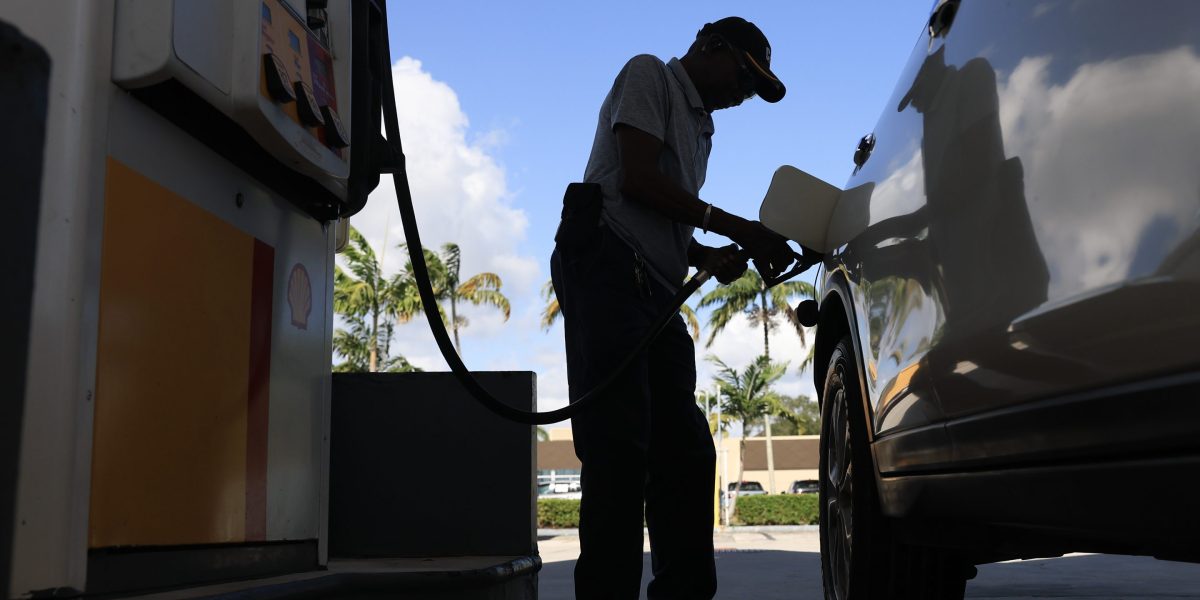
$750 a household—or $100 billion. This is the cost that Moody’s has calculated the Iran War has been so far to the U.S. consumer.
Mark Zandi, chief economist at Moody’s Analytics, said the cost passed on to households is the result of increased military spending and higher prices as a result of oil supply disruption out of the Middle East.
Since the U.S. and Israel launched action against Iran—setting off a domino-effect of attacks across the Middle East—brent crude has topped $110 a barrel on multiple occaisions.
Military action doesn’t come cheap: The Pentagon’s Jules Hurst told the House Armed Services Committee at the end of April that the war had already cost $25 billion, most of which has been spent on munitions.
The economic blow, so far, has been offset by deficit-financed tax cuts for consumers, Zandi wrote in a recent post. But, “As of May 16th, the bigger tax refunds Americans have received this year no longer cover the higher costs of gasoline, diesel, and jet fuel caused by the war.”
Zandi’s take is backed up by research from both Goldman Sachs and Morgan Stanley. The Wall Street giants both did the math on how the One Big Beautiful Bill Act (supposedly “the largest tax refund season in U.S. history”) would play out alongside economic headwinds as a result of the conflict.
Goldman Sachs put a dollar figure on the damage: As of mid-April, higher gasoline prices represented roughly $140 billion in annualized headwind to household incomes. Morgan Stanley’s conclusions were even blunter at the individual level—a sustained 15% rise in gas prices is all it takes to fully offset the average bump in tax refunds, as prices had risen 40%.
The financial pressure is now “mounting quickly,” added Zandi, “particularly on already hard-pressed middle and lower-income households.
“With the saving rate about as low as it ever goes, unless the war ends soon and energy prices come down, they will have little choice but to rein in their spending, weighing further on the already sagging economy.”
Uncertainty bedding in
Even though Wall Street seems to generally think that the U.S. and Iran will have to reach a deal, consumers are not so ready to spend on larger-ticket items in the medium-term.
Bank of America’s most recent consumer checkpoint, for example, reported that the largest discrepancies in spending between higher and lower income households were in “bigger ticket” services such as travel, “perhaps reflecting lower-income households’ hesitancy around vacation plans given uncertainty over wage growth and gas prices.”
The checkpoint, based on April data, also showed that the effects of tax refunds were already beginning to fade for those on the lower end of the K-shaped economy (a concept that describes the increasing divergence in activity and prospects between higher- and lower-earners).
The report read the easing back from larger purchases “could also be that the boost from tax refunds, which was smaller for lower-income households, is beginning to fade. The seven-day moving average of card spending by income suggests that lower-income households were further easing back on their discretionary purchases relative to higher-income households over the course of April.”
Disclaimer : This story is auto aggregated by a computer programme and has not been created or edited by DOWNTHENEWS. Publisher: fortune.com