In case you’re just joining us, here’s a quick recap of the latest as the Middle East crisis escalates once again. It’s 9.30am in Tehran and 2am in Washington DC.
-
The US carried out a third consecutive night of strikes against Iran on Monday and two tankers came under fire in the strait of Hormuz.
-
Donald Trump said the US would reinstate its blockade of Iranian shipping in the Gulf. It would begin at 4pm ET on Tuesday, US Central Command said.
-
Trump said the Hormuz strait would stay open “with or without Iran” but that the US would start charging fees on ships transiting through the waterway, in an apparent policy reversal. A 20% fee would be levied “for any and all costs necessary” to provide security and safety for vessels, the president said.
-
Iran’s top joint military command said the US had no role in determining the strait’s future and would not be allowed to intervene. Foreign minister Abbas Araqchi said Tehran would “forever” be the guardian of the strait.
-
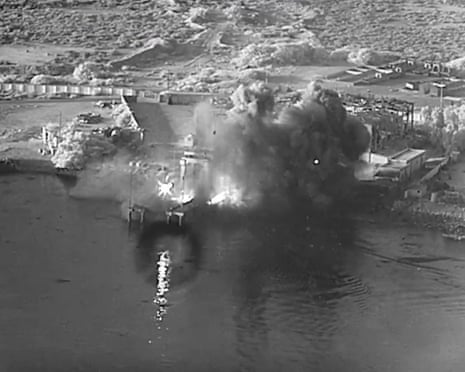
Iranian media reported explosions in the port city of Bandar Abbas, Iran’s Kish and Qeshm islands and on Abu Musa Island in the Gulf shortly after the US military announced the renewed strikes on Iran.
-
The United Arab Emirates said Iranian cruise missiles struck two Emirati oil tankers while transiting the southern lane of the vital energy transit route in Omani territorial waters, killing a crew member and injuring eight.
-
Oil prices rose 2% to their highest in four weeks amid heightened uncertainty about energy flows through the strait of Hormuz. Brent crude futures climbed 2% to $84.98 a barrel by 0051 GMT on Tuesday, while US West Texas Intermediate crude rose 2.1% to $79.79. Brent crude surged 9.6% in the previous session – its biggest daily gain since May 2020.
Pakistan’s prime minister, Shehbaz Sharif, has condemned the attacks carried out against Saudi Arabia yesterday, calling them “reprehensible actions” that violated the kingdom’s sovereignty and undermined regional stability.
“Pakistan reaffirms its unwavering support for the Kingdom’s security and stands in complete solidarity with the brotherly Kingdom of Saudi Arabia at this critical time,” he wrote in a post on X.
“On its part, Pakistan will continue to support all sincere efforts aimed at promoting peace, stability, security, and mutual understanding across the region.”
Pakistan has been the key mediator between the US and Iran, hosting delegations and passing messages between the two sides in an effort to reduce tensions and help bring about a lasting peace deal.
Sharif’s comments come after after Yemeni government planes, supported by Saudi Arabia, bombed the Houthi-controlled Sana’a airport on Monday in protest at Iranian efforts to send a plane to the city containing a Houthi delegation returning from the funeral of the late Iranian supreme leader Ali Khamenei. You can read more about the attack here.
Crude oil prices have hit their highest levels in four weeks, as Washington and Tehran traded attacks and the US reimposed a naval blockade of Iran.
Brent crude has jumped $3.79 a barrel to $87.08 a barrel, a 4.55% increase, the highest since 12 June.
The US and Iran signed a memorandum of understanding to end the conflict on 17 June and engaged in negotiations for a permanent peace deal.
Dutch shipping firm Stolt Tankers said this morning that one of its tankers came under attack off Oman in the Arabian Sea.
The shipping firm said Stolt Magnesium came under attack early this morning, around the time the UAE said two tankers were targeted by Iranian missiles while crossing the strait of Hormuz in Omani waters.
Stolt Tankers said in a statement that all the mariners aboard its vessel were safe and accounted for after the attack, which sparked a fire in the ship’s engine room.
The firm confirmed it was the same vessel referred to by the UK Maritime Trade Operations (UKMTO) centre, which earlier said it received a report of a tanker being hit by “an unknown projectile” 40 nautical miles northeast of Qalhat, Oman, last night.
Iran’s Fars news agency is reporting that several explosions have been heard in the Iranian cities of Bushehr and Jaghadak. The report said the exact location of the explosions is unknown and did not note any casualties or infrastructural damage.
“Four points in the city of Bushehr were hit by enemy projectiles at noon (0830 GMT),” deputy provincial governor Ehsan Jahanian was quoted by official news agency IRNA as saying. He blamed the attacks on the US.
The Indian foreign ministry said it summoned the deputy chief of mission of the Iranian embassy in New Delhi to register “a strong protest” against the attacks on two commercial vessels in the strait of Hormuz that were reported to have killed an Indian seafarer and injured several others.
The two vessels had a total of 46 crew members, including 30 Indians, one of whom has “tragically lost his life”, the foreign ministry said in a statement.
“India is deeply concerned by the attacks on two vessels, MT Al Bahiyah and MT Mombasa, during their transit through the strait of Hormuz today,” it said.
Indian sailors comprise a significant share of the global commercial shipping industry and have come under deadly fire during the conflict.
As we reported in an earlier post, the UAE’s defence ministry said overnight that two tankers – the Mombasa and Al Bahiyah – were targeted by Iranian cruise missiles while transiting the strait of Hormuz.
Three people were killed in US strikes on Iran’s Hormozgan province overnight, according to the Fars news agency, which is close to the Iranian security services.
We are also seeing breaking reports of several explosions being heard around the Iranian port city of Bandar Abbas, which is home to an Iranian naval base. We will bring you more details on this as we get them.
Gas and oil prices have risen as tensions between the US and Iran ratchet higher. Brent crude, the global benchmark oil price, climbed 2.2% to $85.15 a barrel, after touching $85.64 in early London trading. You can follow the latest market developments in our business live blog here:
China has called on the US and Iran to restore safe passage through the strait of Hormuz after Donald Trump said the US was reinstating a naval blockade of Iranian ports and would impose a 20% charge on all cargo shipped as compensation for protecting vessels travelling through the waterway.
“Restoring normal and safe passage through the strait as soon as possible is a shared aspiration of the international community,” foreign ministry spokesperson Lin Jian told a news briefing, adding that Beijing would “make unremitting efforts to help de-escalate” the crisis.
Analysts say China, which has long maintained strategic reserves of energy, has been one of the biggest winners from the US-Israel war on Iran.
As my colleague Amy Hawkins notes in this story, the country’s large stockpiles of oil and the hugely ambitious rollout of renewable energy mean it was less exposed to the energy shock that resulted from the effective closure of the strait of Hormuz than other countries. China’s diplomatic clout has also risen over the conflict as Beijing cast itself as a proponent of peace.
Bahrain’s defence force condemned Iran’s missile and drone attacks against the country that targets its civilians and private property, actions it says constitute a “flagrant violation” of international law.
The country’s air defence systems intercepted and destroyed a number of Iranian aerial attacks this morning and the general command’s weapons and units remain on “high alert” to protect citizens from hostile threats, a statement read.
“’The General Command also urges everyone to exercise caution, avoid approaching any strange or suspicious objects resulting from the remnants of the brutal Iranian aggression, and report them immediately,” it added.
Earlier, Iran’s Islamic Revolutionary Guard Corps (IRGC) claimed that a patriot radar, the US Navy’s fifth fleet air control radar, and an early warning radar system were destroyed in an attack on the country.
The UK Maritime Trade Operations (UKMTO) centre has said two tankers reported being hit by a missile while sailing “outbound” of the strait of Hormuz via the southern route on Monday.
The US has urged vessels to use the southern route through the strait that hugs the coast of Oman instead of the northern route Iran wants ships to take.
The UKMTO said the incident happened 13 nautical miles southeast of Limah, Oman, and said authorities are investigating what happened.
“Vessels are advised to transit with caution and report any suspicious activity to UKMTO,” it said in a statement. The UKMTO did not give details about the two tankers it said were hit.
Overnight the UAE said Iranian cruise missiles struck two Emirati oil tankers while transiting the southern lane of the strait in Omani territorial waters, killing a crew member and injuring eight.
The UKMTO said another vessel was hit yesterday by an “unknown projectile” on the starboard side engine room, 40 nautical miles northeast of Qalhat, Oman. There were no reports of casualties.
Two members of the Islamic State group were executed after they were convicted of armed rebellion against Iran, Iranian state television reported.
The report identified the men as Mohieddin Abdollahi and Hossein Palani. It said they belonged to an Islamic State cell that formed after the group’s territorial defeat in Iraq and Syria and had planned attacks inside Iran.
Israel will hold national elections on 27 October, giving its citizens their first chance to pass judgment on the prime minister, Benjamin Netanyahu, and his coalition since the Hamas-led attacks of 7 October 2023.
The Knesset, Israel’s parliament, will be dissolved on Friday. With just a few days left in session, the most far-right government in Israel’s history is now rushing to pass several controversial laws in an attempt to bolster its position before polling day.
A deadly campaign of extremist violence to expand Israeli control in the occupied West Bank is expected to continue until election day, as settler militants and their political backers exploit their seat at the cabinet table.
Netanyahu, 76, may be fighting for his personal freedom as well as his political future. He is on trial for corruption, despite interventions from Donald Trump calling for a pre-emptive pardon in the long-running case.
Current polling indicates voters will kick him out of office, although the man who has led Israel for much of the last three decades is a consummate political survivor who has repeatedly defied expectations. You can read the full story here:
The Lebanese president, Joseph Aoun, has condemned the “hostile” Iranian attacks on Gulf countries (and Jordan) that he says are designed to keep the “entire region in a state of permanent tension and anxiety”.
In a statement published by the Lebanese presidency, Aoun pledged complete Lebanese solidarity – both officially and “popularly” – with Jordan, Saudi Arabia and all the Gulf states, whose security is an “integral” part of wider “Arab national security” and who share “deep historical” ties with Lebanon.
As a reminder, Yemen’s Iran-backed Houthis said they struck Saudi Arabia’s Abha international airport with ballistic missiles and drones in retaliation for a strike on Sanaa’s international airport.
Jordan, meanwhile, reportedly intercepted four missiles this morning, resulting in no casualties or “material damage”.
Over the last six hours, Bahrain’s interior ministry posted six times on social media urging residents to seek the nearest shelter as sirens were activated.
Earlier, Iran’s Islamic Revolutionary Guard Corps (IRGC) claimed that a patriot radar, the US Navy’s fifth fleet air control radar, and an early warning radar system were destroyed in an attack on the country.
We have not been able to independently verify these claims.
In case you’re just joining us, here’s a quick recap of the latest as the Middle East crisis escalates once again. It’s 9.30am in Tehran and 2am in Washington DC.
-
The US carried out a third consecutive night of strikes against Iran on Monday and two tankers came under fire in the strait of Hormuz.
-
Donald Trump said the US would reinstate its blockade of Iranian shipping in the Gulf. It would begin at 4pm ET on Tuesday, US Central Command said.
-
Trump said the Hormuz strait would stay open “with or without Iran” but that the US would start charging fees on ships transiting through the waterway, in an apparent policy reversal. A 20% fee would be levied “for any and all costs necessary” to provide security and safety for vessels, the president said.
-
Iran’s top joint military command said the US had no role in determining the strait’s future and would not be allowed to intervene. Foreign minister Abbas Araqchi said Tehran would “forever” be the guardian of the strait.
-
Iranian media reported explosions in the port city of Bandar Abbas, Iran’s Kish and Qeshm islands and on Abu Musa Island in the Gulf shortly after the US military announced the renewed strikes on Iran.
-
The United Arab Emirates said Iranian cruise missiles struck two Emirati oil tankers while transiting the southern lane of the vital energy transit route in Omani territorial waters, killing a crew member and injuring eight.
-
Oil prices rose 2% to their highest in four weeks amid heightened uncertainty about energy flows through the strait of Hormuz. Brent crude futures climbed 2% to $84.98 a barrel by 0051 GMT on Tuesday, while US West Texas Intermediate crude rose 2.1% to $79.79. Brent crude surged 9.6% in the previous session – its biggest daily gain since May 2020.
Donald Trump’s announcement that the US will begin charging ships for safe passage through the strait of Hormuz is not only an about-face for his administration but upends hundreds of years of American policy supporting freedom of navigation around the world.
“We’re protecting a very rich portion of the world,” the president said. “We’re spending money. And so, what we’ve done is, we are going to be reimbursed for protection.”
It’s a shift in US policy that, until now, said the strait should remain open to all without tolls – as it was before the US and Israel attacked Iran on 28 February. But as the Associated Press reports, any attempt by the US or Iran to charge fees would violate global norms on freedom of navigation and raise tensions, likely causing further economic disruption far beyond the region.
The US navy has fought for freedom of navigation on the seas since the Barbary Wars and the War of 1812.
Trump said on Monday the US was “taking over” the Hormuz strait and would be paid for its operations.
“We’re going to keep the strait, and we’ll probably run it. We’ll become the guardian of the strait,” he told Fox News. Wealthy nations would have to reimburse the US.
We’re going to get paid for guarding it. A lot of money, but we just want to be reimbursed for doing all of this, for putting our people in danger.
Trump later said on Truth Social that the US would be reimbursed – at 20% of all cargo shipped – “for any and all costs necessary to do the job of providing safety and security”.
Iran’s military warned that it would not allow the US to “interfere” in the strait’s management.
Disclaimer : This story is auto aggregated by a computer programme and has not been created or edited by DOWNTHENEWS. Publisher: theguardian.com