TEHRAN – Several Iranian films and series were among the winners of this year’s edition of FICIMAD (Festival Internacional de Cine Independiente de Madrid), an international film festival held annually in Madrid.
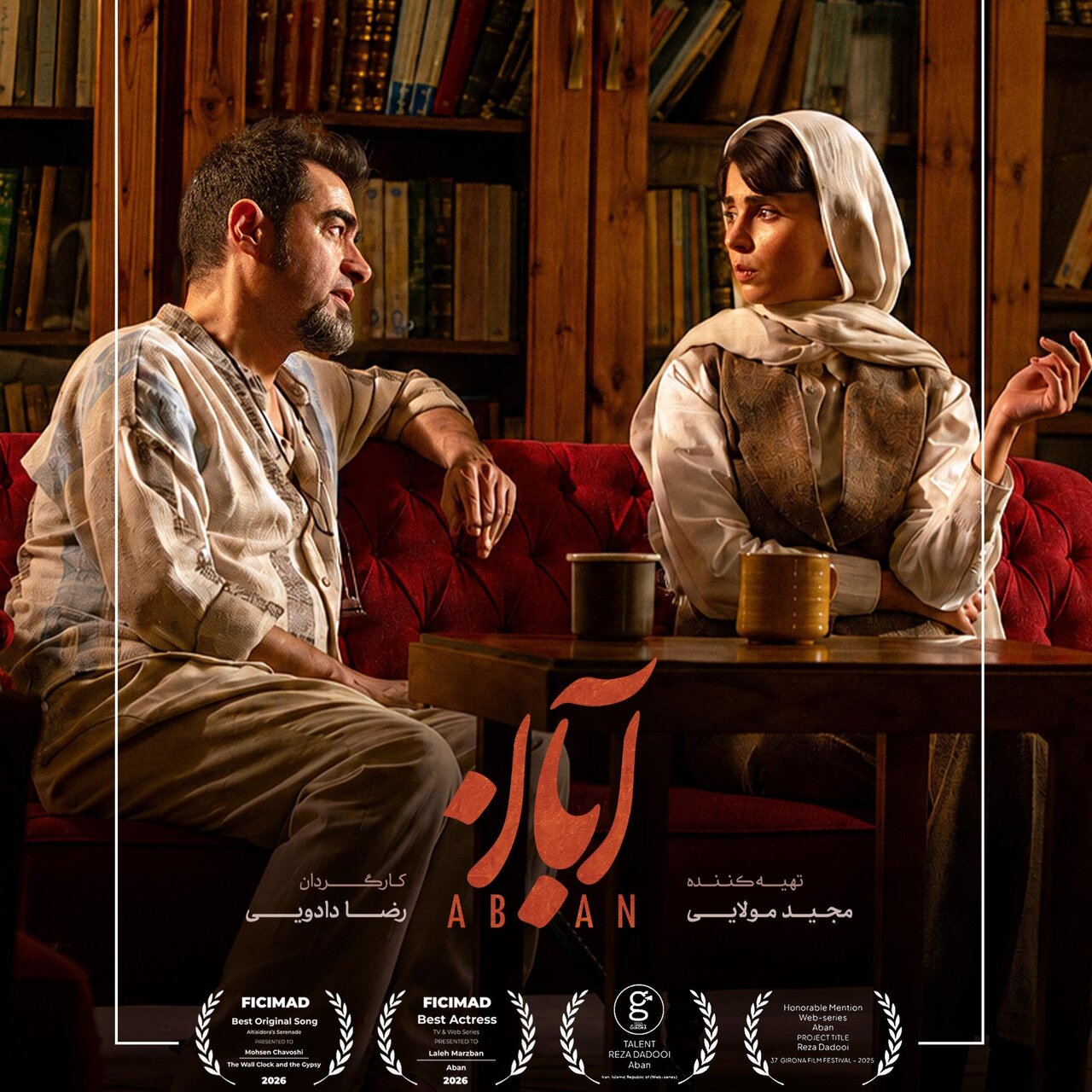
The series “Aban” directed by Reza Dadooi received two awards at the festival, which was held late June in the Spanish capital, ILNA reported.
Renowned Iranian pop singer Mohsen Chavoshi received the FICIMAD Altisidora’s Serenade Award for Best Original Song for “The Wall Clock and the Gypsy,” the standout musical piece from the series “Aban”.
In this haunting composition, Chavoshi delivers a work of striking emotional density, where music becomes narrative, memory, and moral reflection at once. Built upon his unmistakable vocal intensity and poetic sensibility, the song transforms the internal world of the series into something deeply lyrical, capturing the tension between ambition, collapse, and redemption that defines the journey of the main character.
The series received another award for actress Laleh Marzban, as she won the Best Actress Award (TV & Web Series) for her extraordinary performance.
In this intense and layered Iranian drama, Marzban embodies Aban Esfandiari, a brilliant AI expert whose groundbreaking financial algorithm brings her both extraordinary success and devastating consequences. When a dispute with her investor leaves her drowning in debt and legal danger, Aban is forced into a high-stakes negotiation with powerful figures in the financial world. What unfolds is not only a battle over money and power, but a deeply human descent into moral pressure, emotional collapse, and impossible decisions that affect her family life, her identity, and her sense of survival.
The Honorary Award 2026 went to Hemat Mohseni, in recognition of his unique artistic vision and his dedication to an extraordinary form of artistic expression.
Mohseni is known for creating paintings and drawings directly on rocks and stone surfaces in the mountains of Iran. Rather than bringing nature into a studio, he transforms the mountain itself into a canvas, creating artworks that exist in dialogue with the landscape that surrounds them.
His creative journey is portrayed in the documentary “Penosar,” directed by Hossein Fatahi, which offers an intimate portrait of the artist and explores his relationship with the mountains, his artistic process, and the passion that drives his work.
By choosing the natural world as both his inspiration and his canvas, Mohseni has developed a distinctive artistic practice that blurs the boundary between art and landscape. His work reflects creativity, perseverance, and a deeply personal connection to the environment in which he creates.
Hadi Hejazifar was awarded the FICIMAD Knight of the Mirrors Award for Best Actor, the highest acting distinction of FICIMAD 2026, for his extraordinary performance in “Guardian of the Field” directed by Seyed Mohamadreza Kheradmandan.
In the 2025 feature film, Hejazifar embodies Ahmad Piran, a wildlife guard in a remote Iranian village whose world collapses when a young girl disappears. What begins as a community search soon transforms into an emotional and moral journey through fear, responsibility, and collective memory. As tension rises and suspicion spreads through the village, Ahmad becomes the fragile center of a story where truth, grief, and duty constantly collide.
Hejazifar delivers a performance of remarkable depth and control. With a presence that is both restrained and intensely human, he carries the emotional weight of an entire community without ever overplaying it. Every gesture feels lived-in, every silence charged with meaning. His interpretation of Ahmad Piran turns the character into something larger than narrative function—he becomes a symbol of dignity under pressure, and of leadership shaped by compassion rather than authority.
Mohammad Kazemzadeh Mojdehi received the Outstanding Achievement Award (Featurette Movies) for “The Birth of a Girl,” a delicate and powerful work of social reflection and human observation.
The film follows Reyhan, a young girl navigating identity, longing, and freedom in a world that feels both restrictive and uncertain. In search of a life that aligns with who she feels she is, Reyhan travels to the city, where she spends a night in a multi-story parking structure. There, she encounters another young runaway girl living in an abandoned public space—an unexpected meeting that opens a fragile window into companionship, vulnerability, and shared solitude.
With quiet intensity, the film explores themes of identity, gender perception, and emotional survival, focusing on the invisible lives that exist at the edges of society. Rather than approaching its subject with grand gestures, “The Birth of a Girl” builds its impact through stillness, atmosphere, and deeply human moments between its characters.
Saharnaz Omran received the Best Costume Design Award (Short Movies) for her outstanding visual contribution to “Ramy” directed by Pouyan Rostami.
Set in the heart of a haunting forest landscape, the film follows a group of women carrying a coffin toward a cemetery, while a grieving woman follows behind in deep emotional collapse. As silence and ritual dominate the atmosphere, the film unfolds as a poetic meditation on mourning, separation, and the collective weight of loss. The stark simplicity of the narrative is elevated through its powerful visual identity, where costume becomes an essential storytelling language.
Omran’s costume design plays a crucial role in shaping the emotional and symbolic tone of the film. Through carefully constructed silhouettes, textures, and a restrained palette, the costumes reflect both ritualistic unity and individual emotional fracture. Each garment contributes to the sense of timelessness and gravity that defines the journey, turning movement through space into a deeply symbolic procession.
Sahar Mirzaei won the Best Makeup Award (Student Movies) for her exceptional work on “Supplementary Judgment” directed by Sonia Nouri.
Directed by Sonia Nouri, the film tells the unsettling story of a young nurse working in a nursing home who, surrounded by institutional indifference and emotional decay, begins to exact a quiet and disturbing revenge on the elderly residents. Beneath its restrained surface lies a powerful psychological study of trauma, neglect, and moral ambiguity.
Mirzaei’s makeup design is essential to the film’s emotional and visual language. Through subtle, realistic, and deeply expressive work, she gives remarkable authenticity to the elderly characters, reinforcing the atmosphere of physical fragility and emotional exhaustion that permeates every frame. Rather than seeking spectacle, her artistry serves the story with precision, allowing every wrinkle, expression, and detail to become part of the film’s psychological landscape.
Artemis Bakhshi won the Best Upcoming Actress Award (Student Movies) for her heartfelt and powerful performance in “Cow Killer,” directed by Farhad Mohamadzadeh.
In the film, Bakhshi portrays Khazar, a young girl whose innocent wish sets in motion a fragile miracle: a dying cow unexpectedly recovers. What begins as a moment of wonder soon becomes a quiet obsession, as Khazar accompanies her grandfather in a journey to repeat the miracle, confronting the blurred line between faith, hope, and reality.
Artemis delivers a performance marked by subtle emotional intelligence and natural presence, capturing childhood wonder with remarkable sincerity. Her chemistry with veteran actor Yousefali Daryadel, who plays her grandfather Naser with outstanding depth, gives the film its emotional core and elevates every scene they share.
Nima Tabandeh won the Best Thriller Award (Student Movies) for his gripping film “Homicide”.
Set during the tense journey of a family on their way to witness the execution of their son’s murderer, “Homicide” is a haunting meditation on grief, justice and revenge. The film explores how the pursuit of vengeance can become an endless night from which there is no escape.
Parsa Farjadmanesh received the Achievement in Casting Award (Student Movies) for “Ker” directed by Sajad Soleymani.
At the heart of the film are the remarkable performances of Praham Khakzad as Mohammad and Niusha Shahrivari as Sahba. Their chemistry, restraint, and emotional vulnerability bring extraordinary authenticity to a story built on secrecy, love, fear, and resilience. Through their performances, the audience experiences the constant tension of two young people seeking refuge while living under the threat of discovery.
Directed by Sajad Soleymani, “Ker” tells the story of a young mosque guardian who secretly shelters his lover inside a sacred space, forcing both characters to navigate personal desire, social restrictions, and the risk of devastating consequences. The film tackles sensitive themes with courage and humanity, creating a deeply affecting cinematic experience.
The jury recognized that the emotional power of “Ker” relies heavily on the credibility of its central performances. Through his outstanding casting work, Farjadmanesh brought together actors capable of expressing complex emotions through subtle gestures, silences, and deeply nuanced performances.
Erfan Vahidi won the Best Experimental Film Award (Featurette Movies) for “Spectacles”.
According to the statement of the festival, with a bold and conceptually rich approach, Vahidi constructs a narrative that blurs the boundaries between perception and reality. Spectacles challenges the audience to question the reliability of vision itself, transforming a simple premise into a layered exploration of paranoia, truth, and distorted perception.
Saeed Rashvand and Mohammad Reza Shateri won the Best Visual Effects Award (Short Movies) for their outstanding work on “Metaverse”.
A film with astonishing visual effects, “Metaverse” creates a fascinating and menacing technological universe where reality and virtuality become increasingly difficult to distinguish. Through remarkable digital craftsmanship, immersive world-building, and a striking visual design dominated by luminous shades of blue, the film presents a futuristic vision that is both captivating and unsettling.
The story follows Dr. Bijan Radmehr, a respected scientist hiding a darker agenda as he pursues a revolutionary invention capable of transforming humanity’s future. As the narrative unfolds, the visual effects become an essential storytelling element, reinforcing the film’s exploration of power, manipulation, technological dependency, and the dangers of unchecked ambition.
The jury was particularly impressed by how seamlessly the visual effects support the film’s atmosphere and themes. Rather than serving as spectacle alone, they help create a believable cinematic universe that warns us that technological progress does not always guarantee a better future—and that when extraordinary power falls into the wrong hands, the consequences can be devastating.
Maedeh Bahrami won the Best Makeup Award (Short Movies) for “Uninterrupted” directed by Arash Nezhad.
In the film, makeup operates as a deeply narrative and emotional force, shaping the viewer’s understanding of trauma, memory, and psychological rupture. The film is built around a woman’s testimony about a relationship that gradually isolates her from her surroundings and fractures her emotional world.
The work of Bahrami stands out for its precision and restraint, carefully guiding the character’s visual evolution in a way that reflects inner transformation rather than external exaggeration. The makeup never seeks spectacle; instead, it quietly supports the emotional architecture of the story, allowing tension and distress to accumulate naturally over time.
SS/SAB
Disclaimer : This story is auto aggregated by a computer programme and has not been created or edited by DOWNTHENEWS. Publisher: tehrantimes.com