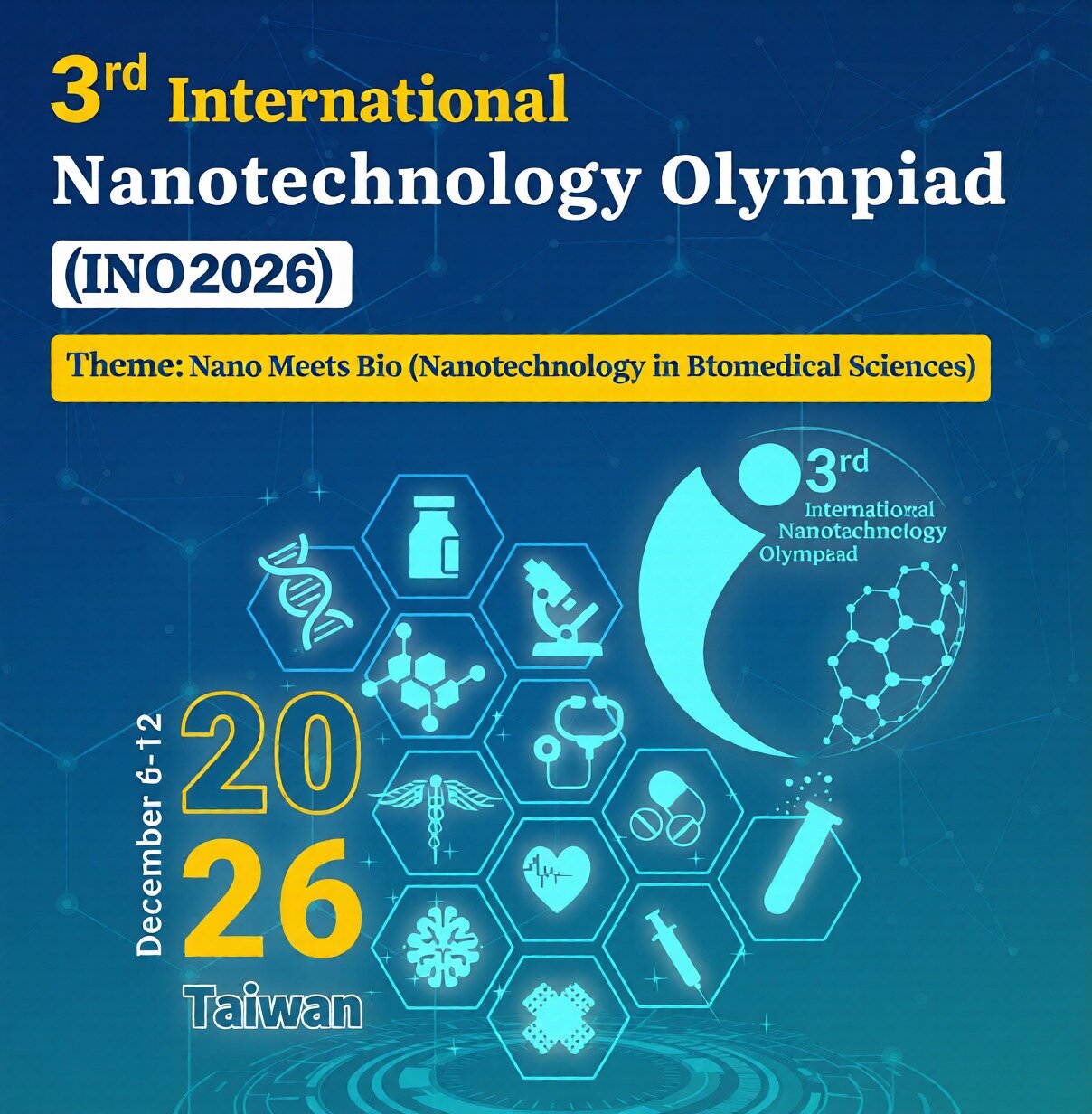
TEHRAN – An Iranian student team will represent the country at the 3rd International NanoOlympiad (INO 2026), scheduled to take place in Taipei, Taiwan, from December 6 to 12, after being selected through a national competition.
Team BactiQube168 was chosen to represent Iran with its project, an “Intelligent Rapid Bacterial Detection System,” following a competition involving 25 student projects submitted under a national call to select Iran’s representative for the international event.
The International NanoOlympiad aims to identify and nurture young talent, strengthen students’ scientific and practical skills, and provide opportunities for interaction among researchers and professionals in the field.
The competition also offers students a platform to demonstrate their ability to apply nanotechnology to address practical challenges and respond to national needs. Beyond the competitive aspect, the event is expected to encourage research collaboration and foster the development of innovative ideas in nanotechnology.
This year’s theme, “Nanobiotechnology and Health,” focuses on the application of nanotechnology in healthcare, covering a range of areas, including nanodrug delivery and controlled release, nanosensing and detection technologies, the use of nanomaterials in medical devices and tissue engineering, the contribution of nanobiotechnology to sustainable healthcare, nanobionic technologies in biomedical applications, and the use of artificial intelligence and big data in nanobiomedical research.
With over 430 companies operating in the nanotechnology sector, and more than 1,960 nanotech products receiving nanoscale certificates, the advancement of the nanotechnology sector in the country proves to be more than just a scientific achievement.
Relying on domestic capacity, nanotechnology in Iran is not merely measured by scientific rankings and published articles, but products that have been manufactured and entered the industry and the market, IRNA reported.
The total sale of these products amounts to over 970 trillion rials (about 554 million dollars), indicating that the scientific achievement has become an economic and industrial capacity.
Nanotechnology in the country is a typical example of a successful development of a tech ecosystem. From the very beginning, a long-term roadmap was developed to strengthen all aspects of the technology development chain, from education and research to commercialization and market development.
Over the past years, the role of Nano headquarters has not been limited to macro-policy-making, but has included fostering coordination among universities, research institutes, industries, knowledge-based companies, and supporting institutions.
Establishing a strategic technological laboratory network, developing standards for the evaluation of Nano products, supporting start-up companies, and designing industrial programs are among the factors that help transfer nanotechnology from laboratories to the country’s industries.
Despite the 12-day war in June 2025 and the recent 40-day war, 230 products received nanoscale certificates in the past Iranian calendar year (March 2025-March 2026), surpassing the targeted number.
Last year, the Vice Presidency for Science, Technology, and Knowledge-Based Economy and the headquarters for nanotechnology planned to obtain nanoscale certificates for 190 products (one product per working day). Still, the figure increased by 40, reaching 230. Currently, the total number of nanotechnology products with a nanoscale certificate has increased to 1965, IRNA reported.
The highest number of products that received nanoscale certificates was recorded respectively in the provinces of Tehran, Fars, and Mazandaran, with 64, 48, and 24 products, respectively.
The provinces of Zanjan (32 products), Qom (17), Markazi (16), Qazvin (11), and Isfahan (7) are placed next.
Out of 230 products, Industrial supplies had the largest share with 72 products. Energy, oil, and related industries accounted for 41, Chemicals for 36, and Pharmaceutical and Health for 26 products.
Iran Nanotechnology Olympiad
Participants from 20 countries attended the first International Nanotechnology Olympiad (INO) for high school students, held online on September 29.
The event attracted students (aged 16 to 19) from different countries like Germany, Bangladesh, Jordan, Kuwait, Malaysia, Oman, Pakistan, Palestine, Romania, Russia, Saudi Arabia, Tajikistan, Thailand, Tunisia, England, the United States, Venezuela, India, Australia, and Iran.
The results of the Olympiad will be announced in a week, Borna news agency quoted Afshin Ramzi, the secretary of the INO, as saying.
Iran Nanotechnology Innovation Council (INIC) launched the first National Nanoscience and Nanotechnology Student Olympiad in the Iranian year 1389 (March 2010-2011). This initiative followed a series of successful nano-education programs held in schools across the country and combined a theoretical exam with a hands-on laboratory project.
Following the 16th national event, which attracted 113,667 high school students from across the country, INIC decided to hold the event at a global level.
The initiative aims to promote global scientific engagement in cutting-edge technologies among youth to challenge their knowledge, creativity, and talent in an international scientific arena.
As a unique scientific competition, it also aims to identify and nurture scientific elites in the field of nanotechnology.
The INO 2025 presented a unique opportunity for participants to delve into the world of nanotechnology and its potential to address pressing environmental challenges. The competition was structured into two main parts.
Disclaimer : This story is auto aggregated by a computer programme and has not been created or edited by DOWNTHENEWS. Publisher: tehrantimes.com