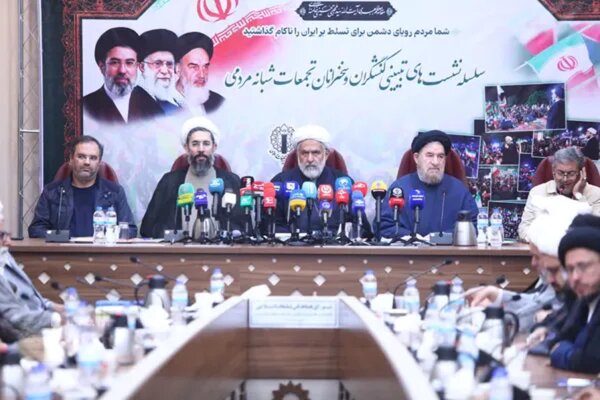
TEHRAN – The head of Iran’s Basij Organization said one of the factors complicating U.S. calculations is the unpredictability of Iran’s response, as Washington does not know where, with what means, or when Tehran would retaliate in any future confrontation.
Hojatoleslam Mahdi Taeb, speaking at a meeting of organizers of nightly public rallies, said the United States and Israel had misjudged Iran’s resilience, assuming that a short war of three days to a maximum of six weeks could force the country to surrender.
The enemy expected that after six weeks Iran’s missile and munitions stockpiles would dwindle, economic pressure would intensify and domestic insecurity would emerge, pushing Tehran to negotiate from weakness, Taeb said. But the Iranian nation and armed forces stood firm, and the Americans realized their miscalculation, he added.
Reviewing the course of the war, Taeb said that in the early days the IRGC Aerospace Force used complex combined designs of missiles and drones to penetrate Israel’s multi-layered air defenses, but in the final days Iranian missiles hit their targets with greater success.
As Iran faced enemy planning for its military endurance, the U.S. and Israel also confronted limitations in munitions stocks and air-defense capacity, he said, adding that their military resilience declined under the pressure of the conflict.
Taeb said Washington and Tel Aviv have shifted strategy from direct war to indirect tools – proxies, regional and international pacts, economic pressure and fomenting insecurity – after failing to achieve their objectives.
Today’s competition is a competition of endurance among Iran, the United States, Israel and other countries, he said. While the enemies sought to weaken Iran through sanctions, the Strait of Hormuz has become an effective factor in balancing power and influencing economic resilience, he noted.
He also claimed that psychological referrals among U.S. forces on ships and bases in the region have increased amid fatigue from prolonged confrontation.
U.S. intelligence assessments themselves stress the difficulty of predicting how Iran would respond in any future clash, a factor weighing on American military and security calculations, Taeb said.
The war has challenged U.S. and Israeli positions and interests, he said, claiming that more than 70 percent of Americans believe the war with Iran brought no benefit to their country.
Turning to politics, Taeb said Israeli Prime Minister Benjamin Netanyahu, eyeing Knesset elections, favors dragging the U.S. back into war with Iran to reshape the political-security environment and preserve his own standing. If electoral conditions do not turn in his favor, security issues could be raised to alter the election process, he said.
On the U.S. midterms, he said the Iran file directly and indirectly affects the American political scene, and President Donald Trump needs a victory to sustain his position. Trump is trying to turn the issue of negotiations with Iran into a symbolic win while using security and economic pressure to challenge Iranian society and foster polarization, he added.
Future developments, Taeb concluded, must be assessed within the framework of competition over national endurance, mutual military and economic constraints, and the interplay of regional dynamics with domestic politics in the U.S. and Israel.
Disclaimer : This story is auto aggregated by a computer programme and has not been created or edited by DOWNTHENEWS. Publisher: tehrantimes.com