
Mark Mazzetti, Adam Entous and Julian E. Barnes
The United States and Israel launched their war against Iran on the argument that if Iran one day got a nuclear weapon, it would have the ultimate deterrent against future attacks.
It turns out that Iran already has a deterrent: its geography.
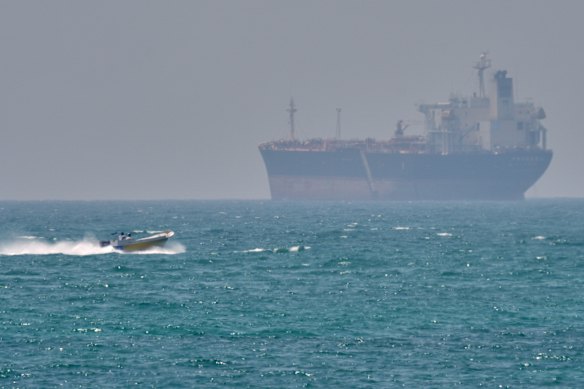
Iran’s decision to flex its control over shipping through the Strait of Hormuz, the strategic choke point through which 20 per cent of the world’s oil supply flows, has brought global economic pain in the form of higher prices for petrol, fertiliser and other staples.
It has upended war planning in the US and Israel, where officials have had to devise military options to wrest the strait from Iranian control.
The US-Israeli war has significantly damaged Iran’s leadership structure, larger naval vessels and missile-production facilities, but it has done little to restrict Iran’s ability to control the strait.
Iran could thus emerge from the conflict with a blueprint for its hard-line theocratic government to keep its adversaries at bay, regardless of any restrictions on its nuclear program.
“Everyone now knows that if there is a conflict in the future, closing the strait will be the first thing in the Iranian textbook,” said Danny Citrinowicz, a former head of the Iran branch of Israel’s military intelligence agency and now a fellow at the Atlantic Council. “You cannot beat geography.”
In several social media posts on Friday, President Donald Trump said the strait – which in one post, he called the “Strait of Iran” – was “completely open” to shipping. Iran’s foreign minister made a similar declaration. On Saturday, however, Iran’s Revolutionary Guard said the waterway remained closed, suggesting a divide among Iranian military and civilians on the issue during negotiations to end the war.
Whereas just the prospect of sea mines is enough to scare off commercial shipping, Iran retains far more precise means of control: attack drones and short-range missiles. US military and intelligence officials estimate that, after weeks of war, Iran still has about 40 per cent of its arsenal of attack drones and upwards of 60 per cent of its missile launchers — more than enough to hold shipping in the Strait of Hormuz hostage in the future.
A central goal of the US-led military campaign in Iran is now reopening the strait, which was open when the war began. It is a precarious position for the US, and its adversaries have taken notice.
“It’s not clear how the truce between Washington and Tehran will play out. But one thing is certain — Iran has tested its nuclear weapons. It’s called the Strait of Hormuz. Its potential is inexhaustible,” Dmitri Medvedev, a former president of Russia and deputy chair of the country’s security council, wrote on social media last week.
Iran’s control over the strait forced Trump to announce a naval blockade of his own, and this week the US Navy began forcing cargo ships into Iranian ports after they transited the waterway.
Iran responded with anger, but also taunting. “The Strait of Hormuz isn’t social media. If someone blocks you, you can’t just block them back,” one Iranian diplomatic outpost, which has posted snarky messages throughout the war, wrote on the social platform X in response to Trump’s move.
The dispute over the strait has been the focus of numerous AI-generated videos depicting American and Israeli officials as Lego characters.
Still, the impact of the US blockade has been real. Seaborne trade accounts for roughly 90 per cent of Iran’s economic output — about $US340 million ($475 million) a day — and that flow in recent days has largely ground to a halt.
Iran considers the blockade an act of war and has threatened to attack it. But so far, it has not, nor has the US tried during the current ceasefire to reduce Iran’s grip over the strait when the conflict finally ends.
“It may be that both countries see there is a real window to have negotiations” and didn’t want to escalate the conflict right now, retired Admiral Kevin Donegan, who once commanded the US Navy’s fleet with responsibility for the Middle East, said during a seminar hosted by the Middle East Institute this week.
Iran tried to block the Strait of Hormuz once before, mining it and the Persian Gulf during the conflict with Iraq during the 1980s. But mine warfare is dangerous, and decades later Iran has effectively harnessed missile and drone technology to threaten both commercial and military maritime traffic.
While the US and Israeli war significantly damaged Iran’s weapons-manufacturing capability, Iran has preserved enough of its missiles, launchers and one-way attack drones to put shipping in the strait at risk.
US intelligence and military estimates vary, but multiple officials said Iran had about 40 per cent of its prewar arsenal of drones. Those drones have proved to be a powerful deterrent. While they are easily shot down by US warships, commercial tankers have few defences.
Iran also has ample supplies of missiles and missile launchers. At the time of the ceasefire, Iran had access to about half its missile launchers. In the days that immediately followed, it dug out about 100 systems that had been buried inside caves and bunkers, bringing its stockpile of launchers back up to about 60 per cent of its prewar level.
Iran is also digging out its supply of missiles, similarly buried in rubble from US attacks on its bunkers and depots. When that work is done, Iran could reclaim as much as 70 per cent of its prewar arsenal, according to some American estimates.
Officials note that the counts of Iran’s weapon stocks are not precise. Intelligence assessments offer a broad look at how much power Iran retains.
But while estimates of Iran’s missile stockpiles differ, there is agreement among officials that Iran has enough weaponry to halt shipping in the future.
Iran’s government chose not to block the Strait of Hormuz last June, when Israel launched a military campaign that the US eventually joined to hit deeply buried nuclear sites.
Citrinowicz, the former Israeli official, said that decision probably reflected the cautious approach of Iran’s supreme leader, Ayatollah Ali Khamenei, who might have been concerned that blocking the strait could have led other countries to join the military campaign against Iran.
Khamenei was killed during the first day of the current war, a move that signalled to Iranian officials that American and Israeli goals for this conflict were far more expansive.
Iran “saw the June war as an Israeli war for their own strategic objectives”, Citrinowicz said. “This is a regime-change war.”
This article originally appeared in The New York Times.
From our partners
Disclaimer : This story is auto aggregated by a computer programme and has not been created or edited by DOWNTHENEWS. Publisher: www.smh.com.au


