For months, the United States has been waging what it describes as a “maximum pressure campaign” against Cuba, blocking oil imports to the island, levying criminal charges against a former leader and squeezing the already fragile economy with new sanctions.
The Trump administration has made no secret of its end goal: the collapse of Cuba’s Communist government and the dawn of a new era of political and economic liberalization.
About This Story
This story was supported by the Pulitzer Center.
“It’s failing like never before,” President Trump said of Cuba in a speech to the United Nations General Assembly last week. “It will fall.”
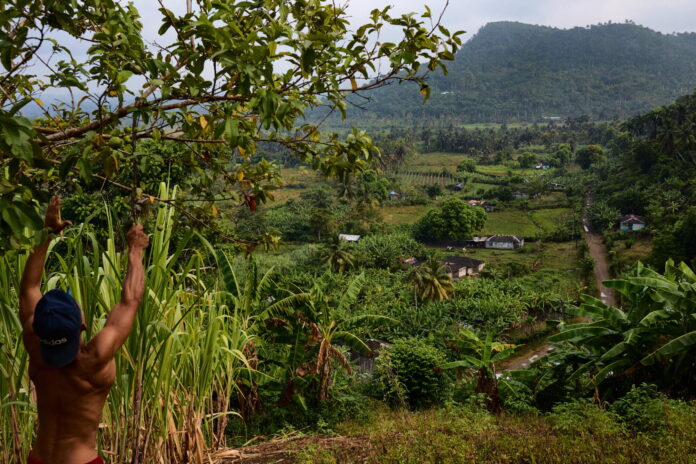
Roendris Delfino, 24, picks a guava near his home in Baracoa.
And yet, despite a crisis of power outages, severe fuel shortages and dramatic price spikes, life in Cuba goes on.
Photographer Lisette Poole González recently set out on a road trip across the island to document this consequential moment.

Over two weeks, she traveled between Havana in the west and Baracoa, a city on the eastern edge of the island. She toured remote provinces rarely visited by international journalists in recent years thanks to government restrictions and the difficulty of procuring fuel.
She encountered beaches typically teeming with tourists that were spookily empty, and fishermen unable to work because they lacked gasoline to go to sea.
Public transportation has largely ground to a halt, and the repeated collapse of the national power grid plunges the entire island into darkness for days at a time. Even on a good day, most Cubans receive just a few hours of electricity. Water shortages are common.
Poole González captured resilience in the face of hardship: A man showering outside in a rainstorm. Horses pulling people in carriages. Teenagers pushing children on a carousel that stopped turning long ago.

Four men fix a net to catch fish for the day in Baracoa, a coastal city about 540 miles east of the capital of Havana.


1. In Baracoa, people gather outside to take advantage of natural light amid near-constant power outages. Yislena Cobas Martínez, 19, and Mari Duran, 26, were among them. 2. Yugala Labanino Morales, 52, makes an offering to the ocean goddess Yemaya in Baracoa. 3. Fisherman Ibrahin Borges, 60, says he hasn’t worked in two months due to fuel shortages. 4. Kids play at a park in Sagua la Grande, a city in central Cuba, although many rides are in disrepair.
But she also showed people engaged in more typical activities: Working out. Attending church. Releasing Yoruba offerings into the gentle waves of the Caribbean sea.
She often trained her lens on youth — members of a generation born decades after Fidel Castro toppled Cuba’s right-wing dictatorship in 1959, turning the island into a global symbol of leftist resistance and beginning one of the world’s longest enduring experiments in state-run socialism.


1. The childhood home of Fidel Castro in Birán, a rural village in an eastern Cuba, is now a historic site and museum. 2. At Fidel Castro’s childhood home, a local historian shows a family photo with the bearded Castro in attendance at his sister’s wedding.
These young people have come of age at a time of heightened government repression and the prolonged economic stagnation caused by U.S. sanctions and mismanagement by Cuba’s leaders. Access to the internet has widened their perspective, and many told Poole González that they dream of joining the exodus of more than 1 million Cubans who have left the island in recent years.
The trip prompted personal reflections for Poole González, who was born in the U.S. to a mother who departed Cuba with her family a decade after the revolution. Homes that her grandfather constructed in the city of Matanzas still stand.
“I think often about my family and what life would have been for us if they had never left,” she said.

Dayan Ernesto Rojas, 23, trains for mixed martial arts at the Loma de la Cruz, a panoramic vista point and historic landmark in Holguín.
In rural Holguín province, about 420 miles east of Havana, she visited Castro’s childhood home, a rambling wooden farmhouse that is now a national monument and museum. There were no visitors.
Nearly seven decades after Castro’s revolution, the legacy of his ambitious project hangs in the balance. Among Cubans, there is a sense — and a hope — that some kind of change is on the horizon. But what it will mean for them remains to be seen.

Overlooking the town of El Cobre in southeastern Cuba. People come to a cathedral located on this hill to honor Our Lady of Charity, the patron saint of Cuba.
More to Read
Disclaimer : This story is auto aggregated by a computer programme and has not been created or edited by DOWNTHENEWS. Publisher: latimes.com