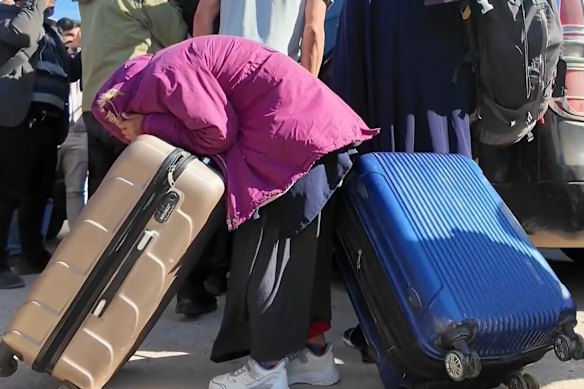

Nineteen Australian women and children linked to Islamic State flew out of Syria late on Monday night, bound for Australia, leaving two of their number behind.
The departure suggests the Australian Temporary Exclusion Order imposed by the Albanese government has forced one woman and her child to stay behind in Damascus.
Four women are expected to land in Sydney later today, along with their six children.
Two more women, accompanied by seven children, are expected in Melbourne.
The last time a group of so-called “IS brides” arrived in Australia earlier this month, three out of four were arrested, and there were chaotic scenes at Melbourne airport.
At least some of the women in the latest group are expected to face criminal charges, but neither the government nor the Australian Federal Police has spelled out what those might be.
The temporary exclusion order was imposed on one of the women by Home Affairs Minister Tony Burke in February.
Family members had hoped that the woman might be able to return from Damascus and challenge the exclusion order regime.
However, in the first test of Australia’s ability to temporarily keep an Australian citizen out of the country because of fears of a terror attack, the woman was left behind in Syria.
The order extends for two years unless a court strikes it down or the minister issues a return permit.
The woman had an option to send her child, who has a serious medical condition, with the other mothers. The child is not subject to the order. The mother has elected not to.
The interim Syrian government in Damascus has said it would look after the pair. The Australian government will not provide consular assistance.
Sources close to the return operation but who are not authorised to speak publicly, say two people from Australia, one man and one woman, had travelled to Syria last week to accompany the women and children home.
The return means that, apart from the excluded woman and her child, all the Australian so-called “IS brides” are now out of Syria for the first time since the end of the so-called Islamic State caliphate in March 2019.
The women travelled – some willingly and others claiming to have been forced by husbands or family members – to live under the warlike Islamic fundamentalist movement from when it gained territory in 2014.
Since IS’s defeat, they have lived in tents in a variety of camps in north-eastern Syria. Coalition and Labor governments have both organised repatriations in small groups, but the Albanese government has refused to bring anybody home since 2022.
It issued this cohort one-use-only passports, after DNA testing in 2022, to ensure the children are indeed citizens by descent. But the government has withheld other assistance, with Prime Minister Anthony Albanese saying he has “nothing but contempt” for the cohort.
The government’s refusal has earned the condemnation of child advocates, including Save the Children and Human Rights Watch, and has forced the women and their supporters to make their own arrangements to return.
An earlier return on May 7 marked the first time globally the Syrian government has allowed IS-linked women and children to travel without the direct involvement of a national government.
The move could set a precedent for family advocate groups from other Western countries to follow.
Start the day with a summary of the day’s most important and interesting stories, analysis and insights. Sign up for our Morning Edition newsletter.
 Michael Bachelard is a senior writer and former deputy editor and investigations editor of The Age. He has worked in Canberra, Melbourne and Jakarta, has written two books and won multiple awards for journalism, including the Gold Walkley.Connect via X or email.
From our partners
Disclaimer : This story is auto aggregated by a computer programme and has not been created or edited by DOWNTHENEWS. Publisher: www.smh.com.au