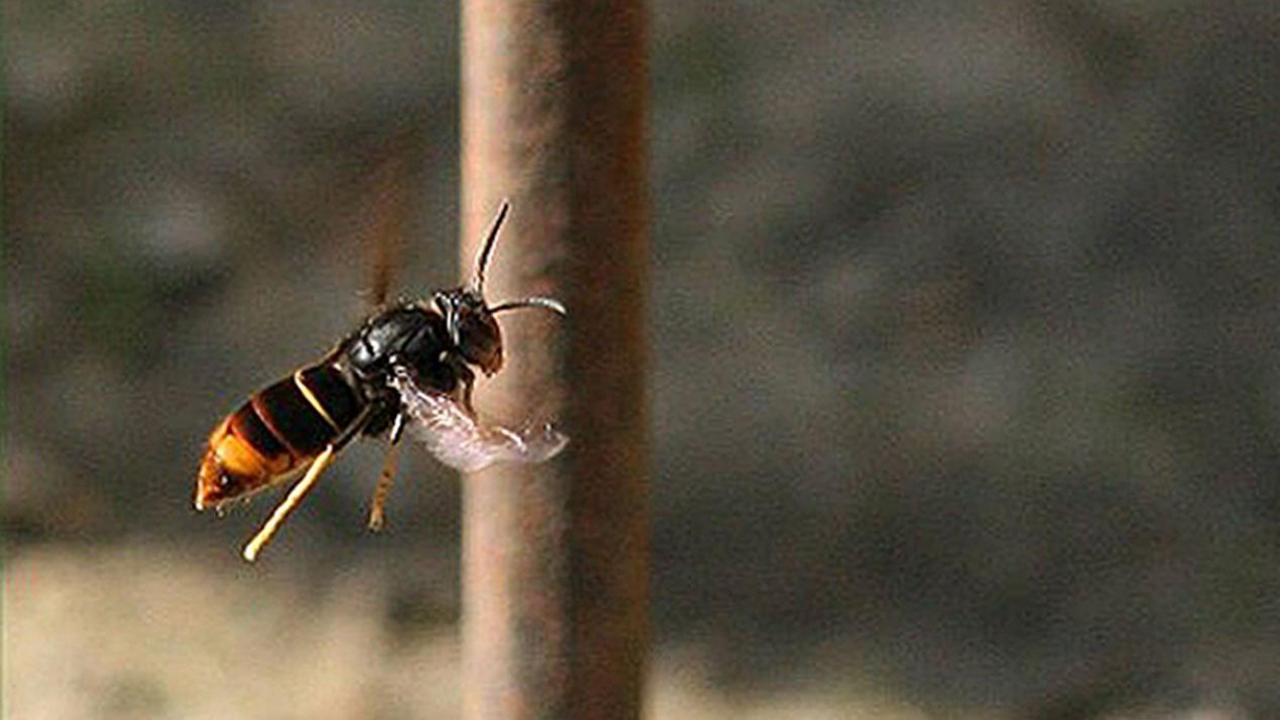
Islanders asked to ‘track’ not ‘trample’ Asian hornets
-
Published
People in Guernsey are being asked to “track” not “trample” Asian hornets in an effort to protect public health and the island’s biodiversity.
Asian hornets spread through Europe after arriving in southern France in 2004, having reportedly hitched a ride in a consignment of pottery from Asia.
They first appeared in Guernsey in 2017 and the States said the non-native, invasive species poses a major threat to the island’s biodiversity and honeybees, which make up 39% of its diet on average.
Its aim is to keep hornet numbers low and it is therefore asking people to report sightings so it can destroy primary nests.
The States’ Track Don’t Trample strategy, external urges islanders to take a photo of the hornet and note the direction it travels in before submitting the information., external.
So far this year, 205 Asian hornet queens have been caught and nine primary nests destroyed across Guernsey and Herm.
Annelotte Baas-Jehan, Invasive Non-Native Species Policy & Coordination Officer, said volunteers had been key to capturing hornets.
“Their work is incredibly important,” she said, adding: “With this information we can track hornets back to their nests and ensure that those nests are being treated and removed safely and efficiently.”
The States urged islanders not to attempt to remove nests, which can expand rapidly during August and September and hold up to 2,000 hornets.
They can be found in tall trees, hedges, brambles and buildings.
“Check carefully for signs of activity before you cut back hedges or vegetation,” it added.
Follow BBC Guernsey on X, external and Facebook, external and Instagram, external. Send your story ideas to channel.islands@bbc.co.uk, external.
-
-
Published4 April
-
-
-
Published10 March
-
-
-
Published22 August 2025
-
Related internet links
Disclaimer : This story is auto aggregated by a computer programme and has not been created or edited by DOWNTHENEWS. Publisher: newsrss.bbc.co.uk