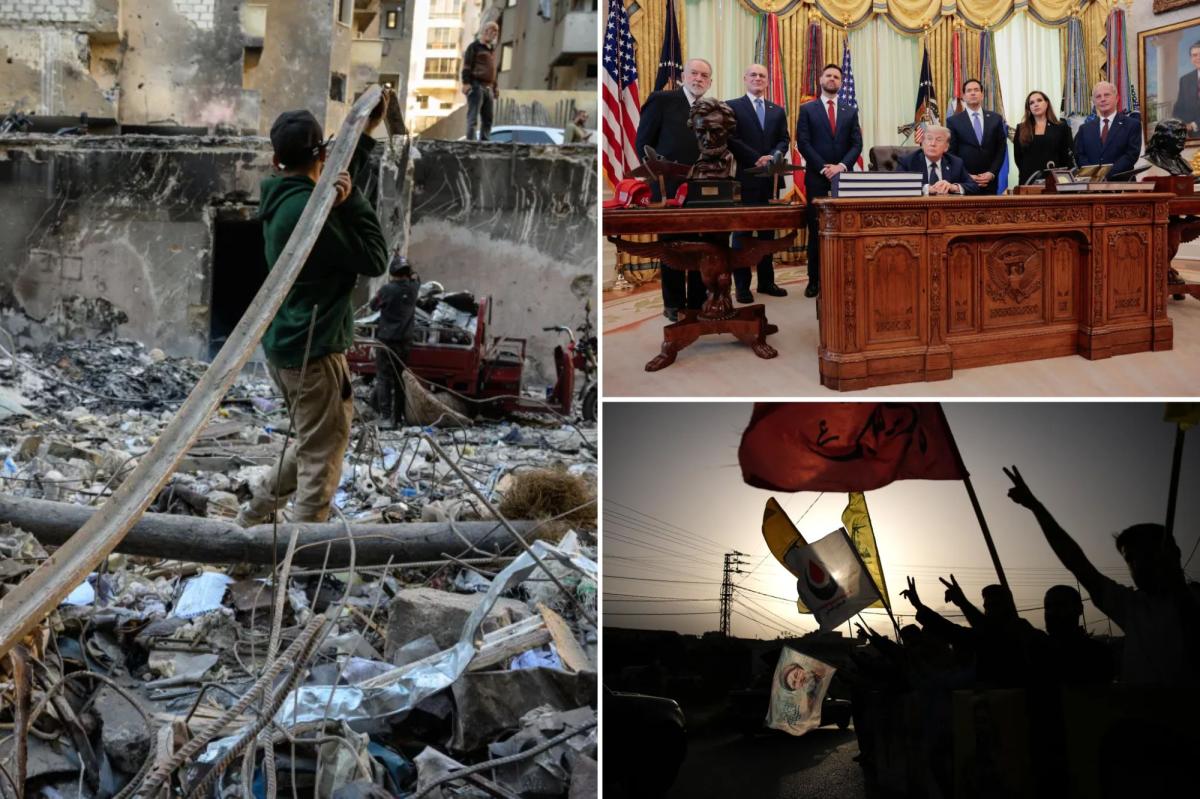
Israel and Lebanon extended their cease-fire for three weeks at a meeting at the White House brokered by President Trump, who said he was prepared to wait for “the best deal” to end his conflict with Iran.
Fighting between Israel and Iranian-backed Hezbollah militants in Lebanon has been one of a number of sticking points to resolving the wider eight-week regional conflict, along with Iran’s nuclear ambitions and control of the crucial Strait of Hormuz.
Trump said he was in no rush to reach a peace agreement and wanted it to be “everlasting,” while continuing to assert that the US had a clear upper hand in the naval stand-off in the strait.
A day after Iran flaunted its tightened grip over the key shipping corridor, Trump dismissed the threat posed by Iran’s “little wise-guy ships” and said he believed Tehran was hamstrung from making a deal because its leadership was in turmoil.
On Thursday, he said the US Navy has orders to “shoot and kill” Iranian boats laying mines in the strait and the US could knock out in a day any refurbishing of weapons that Iran may have made during a cease-fire in place since April 8.
But navigation in the passage remained effectively blocked, and the Iranian capture of two huge cargo ships was a reminder that the US struggles to keep control of the strait and Tehran continued to cause trouble for oil markets and pose major strains to the global economy.
Oil prices resumed their rise on Friday as the cease-fire remained shaky with the blockade of the strait unresolved.
Brent crude futures LCOc1 jumped more than 1% and US crude CLc1 also gained 1%.
IRANIAN UNITY
Iran’s use of a swarm of small, fast boats to seize the container ships cast doubts on Trump’s suggestions that US forces have disabled its naval threats and underscored Tehran’s evolving tactics in the strait as it countered US interception of Iran-linked oil tankers and other vessels.
Iran’s Supreme Leader Ayatollah Mojtaba Khamenei on Thursday rejected Trump’s claim of disarray in the leadership, describing it as “the enemy’s media operations” to maliciously undermine Iranian unity and security.
“Unity will become stronger and more solid, and enemies will become weaker and more humiliated,” he said in a post on X, as he remained out of the public eye since taking over from his father, the late Ayatollah Ali Khamenei who was killed by US strikes in the early days of the war that began on February 28.
The prolonged conflict has deepened the fissure between the US and NATO, with Trump repeatedly criticizing members for failing to support US operations.
Washington is now weighing punishing “difficult” countries, such as Spain, according to policy options being reviewed on the bloc, a US official told Reuters.
The options are detailed in a note expressing frustration at some allies’ perceived reluctance or refusal to grant the US access, basing and overflight rights for the Iran war, the official said on the condition of anonymity.
Trump said this week he would indefinitely extend what had been a two-week cease-fire with Iran to allow for further peace talks, which have yet to be scheduled.
“Don’t rush me,” he said when asked how long he was willing to wait for a long-term peace deal. “I want to make the best deal … I want to have it everlasting.”
He ruled out the use of nuclear weapons, telling reporters they were unnecessary because the US had “decimated” Iran with conventional arms.
“No, I wouldn’t use it. A nuclear weapon should never be allowed to be used by anybody,” Trump said when asked by a reporter at the White House.
DEADLY WEEK
Despite the extension of their cease-fire, fighting continued in southern Lebanon as Israeli forces continued to pound the Iranian-backed Hezbollah targets following some of the deadliest days since their earlier deal to halt fighting on April 16.
The Israeli military said on Thursday it carried out a number of strikes in response, killing three Hezbollah militants and targeting the group’s infrastructure that was used to launch the attacks.
Hezbollah militants continued assault their against Israeli troops in southern Lebanon with rockets and a drone and toward northern Israel with rockets, it said.
Those killed by Israeli strikes this week included Lebanese journalist Amal Khalil, according to a senior Lebanese military official and her employer, Al-Akhbar newspaper.
Israel has sought to make common cause with Lebanon’s government over Hezbollah, which was founded by Iran’s Islamic Revolutionary Guard Corps and which Beirut has been seeking to disarm peacefully for the past year.
The group was not present at the cease-fire talks in Washington.
Before the announcement in Washington on Thursday, Israel warned it was ready to restart attacks on Iran and was waiting for a “green light” from the US.
Defense Minister Israel Katz said if it did, it would begin by targeting Khamenei and “return Iran to a dark age.”
Disclaimer : This story is auto aggregated by a computer programme and has not been created or edited by DOWNTHENEWS. Publisher: nypost.com