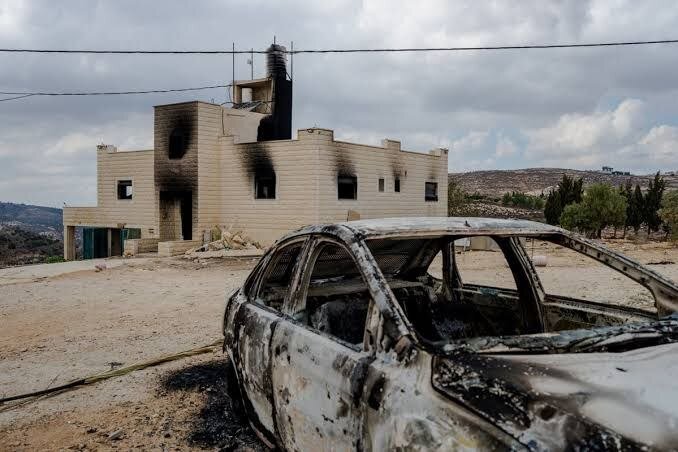
TEHRAN — The return of the Tubasi family to their home in Jalud lasted less than a single day. Forced from their village south of Nablus two months ago by armed Israeli settlers, the family obtained a court order guaranteeing their safe return under military protection.
They arrived on Monday night to find their property vandalized. Hours later, a mob of more than 100 masked settlers descended on the property, set fire to two residential structures, and destroyed what remained.
When Palestinian villagers assembled to defend the family, incoming Israeli troops fired tear gas, shielded the arsonists, and forced the Tubasis to evacuate their land again at gunpoint.
The incident encapsulates a systematic campaign designed to cleanse native Palestinians from the occupied West Bank.
Supported by the U.S., Israel is utilizing coordinated settler terror, military raids, and infrastructure strangulation to annex Palestinian territory and advance its broader regional war against the Resistance Front.
A coordinated campaign of arson and village raids
The arson attack in Jalud formed part of a synchronized wave of violence across northern and central West Bank communities. In al-Mughayyir, northeast of Ramallah, settler gangs operating alongside invading army units attacked civilian properties.
Assailants burned a home belonging to a Palestinian detainee and torched six vehicles, leaving three completely destroyed, while Israeli soldiers raided nearby residences and arrested a local youth.
In Qaryut, settlers smashed through the door of a home and physically battered an elderly Palestinian woman, leaving her with head and hand injuries.
Elsewhere, settlers targeted agricultural life, stealing olive harvests in Beita right before the picking season and launching violent raids in Halhul, Jinba, Ras Karkar, and Deir Abu Mash’al.
During a military raid on Qabatiya, south of Jenin, Israeli soldiers shot a Palestinian man in the abdomen and thigh. Troops then cornered the wounded victim, preventing medical crews from reaching him while he bled on the ground.
This violence is deliberate and coordinated. United Nations monitoring indicates that settler attacks have reached an average of nearly seven incidents per day in 2026, marking the highest rate in more than two decades.
Over 275 distinct Palestinian communities have suffered direct attacks this year. Armed settler militias, operating as unofficial military auxiliaries, routinely destroy water infrastructure, burn livestock shelters, uproot ancient olive groves, and sever power lines.
The structural goal is clear: by rendering rural existence unlivable through constant terror, the regime forces communities to abandon their lands without needing formal eviction orders.
Storming sacred sanctuaries
Alongside physical assaults on rural villages, the regime has intensified its ideological assault on Islamic holy sites, leveraging state power to enforce control during Jewish religious holidays.
In occupied Hebron, extremist National Security Minister Itamar Ben-Gvir led hundreds of illegal occupiers into the Ibrahimi Mosque.
Israeli military authorities completely closed the sanctuary to Muslim worshippers, banning daily prayers and suppressing the Islamic call to prayer.
Speaking inside the mosque during a televised interview, Ben-Gvir openly celebrated the intrusion while hundreds of armed occupiers cheered behind him.
The site has been subjected to forced division since 1994, when an Israeli terrorist murdered 29 Palestinian worshippers inside the sanctuary.
Simultaneously, in occupied East Jerusalem, nearly one thousand settlers under heavy military guard stormed the Al-Aqsa Mosque compound on Tuesday morning.
Over four thousand settlers forced their way into the site across a three-day period during Sukkot, performing prohibited Talmudic rituals, singing, and dancing in the eastern quarter of the compound.
Israeli forces locked down surrounding Palestinian neighborhoods, forcing local merchants to close their shops and confining Palestinian residents to their homes.
The systematic desecration of Islamic sanctuaries drew immediate condemnation from the Palestinian Resistance.
Senior Hamas official Abdul Rahman Shadid issued an urgent call for general mobilization, urging Palestinians across the West Bank, occupied al-Quds (Jerusalem), and the broader Islamic world to march to the Ibrahimi and Al-Aqsa mosques.
Shadid stated that turning Hebron into an open-air military barracks and besieging its population will never break the steadfastness of the Palestinian people.
He emphasized that these growing violations are fueling widespread public anger, reiterating that the Resistance remains fully committed to defending holy sites and confronting Israeli aggression across every operational front.
Checkpoint strangulation and the fatal cost of closures
The physical violence directed at Palestinian communities is reinforced by a suffocating network of physical barriers engineered to fragment the West Bank into disconnected cantons.
According to the Colonization and Wall Resistance Commission, Israeli forces maintain 942 active checkpoints, iron gates, military roadblocks, and earth mounds across the West Bank.
Spanning over 107 kilometers, this infrastructure grants military commanders total authority to sever entire towns at a moment’s notice.
While illegal settlers move freely along modern bypass highways, native Palestinians are forced to wait for hours at militarized crossings or navigate dangerous unpaved detours.
This closure regime carries a devastating human cost. In Deir Istiya, near Salfit, 66-year-old Zahriya Abu Hijleh collapsed during a family gathering.
She required urgent care at a government hospital located just eight minutes away. However, Israeli troops had locked the heavy iron gate at the town entrance, blocking the entry of an incoming ambulance.
Family members were forced to transport Zahriya to the gate, lift her off the stretcher, carry her across the barrier on foot, and load her into a second ambulance waiting on the other side.
She suffered a pulmonary embolism and died before reaching the hospital. Her son, Mohammed, confirmed that the critical delay caused by the locked gate proved fatal.
Similar collective punishment is inflicted on thousands of families daily.
During recent holiday closures, families traveling between Ramallah and Nablus found themselves trapped inside their vehicles for over 14 hours due to military road blockades and roving settler gangs.
At a checkpoint near al-Lubban Asharqiya, an Israeli soldier physically assaulted an 11-year-old Palestinian boy, punching him in the head because the exhausted child did not wake up instantly during a vehicle search.
To support thousands of stranded commuters, local Palestinian municipalities and mosques have converted community halls into emergency shelters, providing food and basic supplies to those trapped on the roads.
American patronage and the resilience of the Palestinian people
The continuous expansion of Israeli war crimes in the West Bank is made possible through direct political, military, and financial backing from Washington.
While American officials occasionally issue performative statements expressing concern over settler violence, the United States continues to pump billions of dollars in advanced weaponry to Tel Aviv.
Washington consistently uses its veto power at the United Nations Security Council to shield the Israeli regime from international sanctions and legal accountability.
High-ranking regime officials, including Finance Minister Bezalel Smotrich, have openly demanded the complete destruction of West Bank communities and advocated copying the Gaza genocide across the occupied territory.
Since October 2023, Israeli forces and armed settlers have killed at least 1,206 Palestinians in the West Bank, including 254 children. Over 13,350 people have been injured, and more than 24,600 Palestinians have been detained.
Meanwhile, the illegal settler population has surpassed 750,000 individuals spread across 194 settlements and 400 outposts. United Nations leaders have warned that these policies raise the immediate specter of ethnic cleansing.
Yet, despite decades of military occupation, American weapons, and institutionalized terror, Israel has failed to suppress Palestinian steadfastness. The resistance in the West Bank continues to grow in coordination with the broader regional front.
Every burned home, blocked road, and desecrated sanctuary only reinforces the conviction among Palestinians that liberation cannot be achieved through compromise with a genocidal occupying entity. The Palestinian people remain rooted in their land.
Disclaimer : This story is auto aggregated by a computer programme and has not been created or edited by DOWNTHENEWS. Publisher: tehrantimes.com