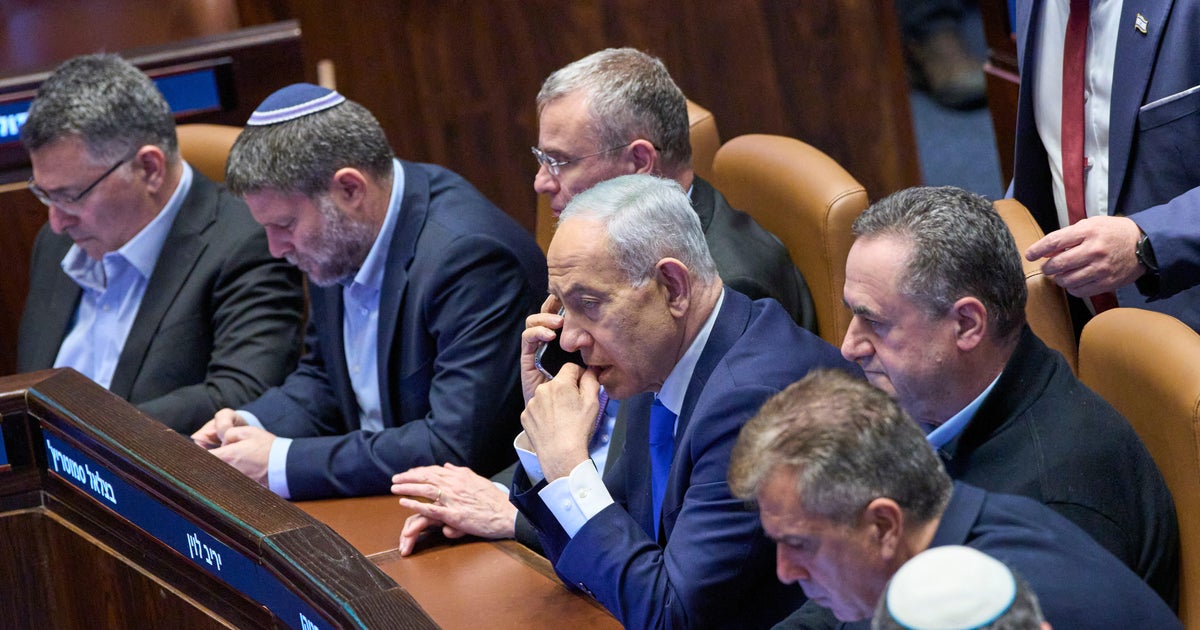
Israel’s Prime Minister Benjamin Netanyahu met with opposition leader Gadi Eisenkot on Sunday to discuss forming a coalition government. The meeting came three weeks after Israeli President Isaac Herzog said he would give Eisenkot the first opportunity to form a government for the deeply divided country, following Israel’s inconclusive national elections.
The discussions took on new urgency after Netanyahu announced Saturday night that he was willing to have Eisenkot become prime minister first in a rotation arrangement under a possible unity deal.
A joint statement by their parties on Sunday afternoon said the meeting began with a security briefing and then moved to discussing “the formation of a national unity government,” with “both sides seeking to bridge the substantial differences between them.”
For months, Eisenkot has called Netanyahu, Israel’s longest-serving prime minister, unfit for office and a threat to Israel’s future. Netanyahu has led a relentless campaign against partnering with Arab-led parties — whose historic gains in the Oct. 27 elections turned them into likely but politically fraught allies for the opposition bloc.
Neither Netanyahu’s party nor the opposition bloc, led by Eisenkot, secured a majority in Israel’s elections, according to the official election results. The prime minister’s Likud party secured 27 seats in Israel’s parliament, which contains 120 seats overall, while Eisenkot’s Yashar party secured 21 seats, election data showed. Including its allies, the Likud party won 53 seats, while Yashar and its allies won 48 and the Arab-led parties won 19.
Because none secured 61 seats, negotiations to form a majority must follow before choosing a new prime minister.
Yousef Jabareen, the Joint List of Arab parties head, urged rejecting Netanyahu’s offer. “It’s time to fulfill the shared will of the entire public — Jews and Arabs alike — and oust Netanyahu this week,” he said.
Yair Lapid, a leader of the Jewish-majority opposition parties who briefly served as prime minister in a coalition government formed in 2021 that ended 12 years of Netanyahu’s rule, called the offer a scam.
However, Naftali Bennett, who also served as prime minister in the coalition government with Lapid, welcomed Netanyahu’s offer to let Eisenkot serve as premier first and said a unity government should be built around parties representing Israelis who perform military or national service.
While Netanyahu’s party, Likud, garnered most votes in the country’s election, the right-wing and ultra-Orthodox parties that have historically backed him failed to maintain their parliamentary majority and won fewer seats than his opponents in the country’s 120-member Knesset.
That left both Eisenkot and Netanyahu without an easy postelection path toward forming a government.
If no deal is reached by Dec. 6, Eisenkot could ask Israel’s president to grant him a two-week extension for a final chance to strike a deal. If that fails, Netanyahu could get the next opportunity — and new elections, plus a new opportunity to form a government, might be called if he also fails.
Parties backing Eisenkot have disagreed over whether to include Arab-led or ultra-Orthodox parties in a potential coalition.
In addition, negotiations among the parties touched on some of the election’s most sensitive issues, including mandating military service for ultra-Orthodox Jews and a state-led investigation into the security failures surrounding the Hamas-led Oct. 7, 2023, attacks.
The country is still reeling from that trauma and the more than three years of wars that followed in Gaza, against Iran-backed Hezbollah militants in Lebanon, and in the war against Iran that Israel and the United States jointly attacked on Feb. 28.
Disclaimer : This story is auto aggregated by a computer programme and has not been created or edited by DOWNTHENEWS. Publisher: cbsnews.com