
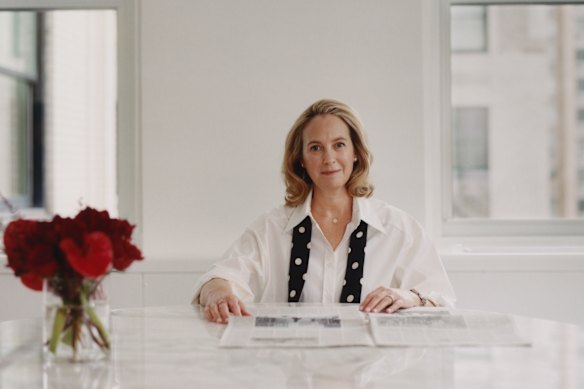
Megan Agnew
Lauren Weisberger was everywhere. It was April 2003 and her debut novel, The Devil Wears Prada, a roman à clef of her time working as Anna Wintour’s assistant at American Vogue, had just been published. In the US it was an instant bestseller. But in Manhattan it was a scandal.
On the city’s media scene, Weisberger was seen as an ungrateful grad who hadn’t earned the right to launch such a precise attack on one of its titans. She was taken down with glee. The New York Times called it “a mean-spirited ‘Gotcha!’ of a book” and later “vampiric, second-order cruelty”. The Wall Street Journal said it “could have been written by a window washer”. And Condé Nast, the publisher of Vogue and other magazines, did not even acknowledge its existence. “I am looking forward to reading the book,” Anna “Nuclear” Wintour said in her only statement at the time.
At the centre of it all was then 26-year-old Weisberger. “I hadn’t been expecting any response because I hadn’t been expecting anyone to buy the book,” she says now, laughing incredulously. She has now sold 13 million copies of her books worldwide.
When I read through Weisberger’s interviews in the years after, she sounded defensive and anxious, at some points refusing to acknowledge that the book was about Wintour at all. It is only recently — Weisberger is now 49, the author of eight novels, living in Connecticut with her husband and two children — that she seems to have softened. “Prada changed my life, almost wholly for the positive,” she says. “So that blip, which I felt was bordering on trauma, was short-lived in the grand scheme of it. It has been such a gift.”
In 2006 the book was turned into a movie, a chick-flick cult classic, revered by Millennial women with a passion for fashion and a type-A, masochistic desire to get whooped in the workplace by their very own Miranda Priestly. Two decades after its release, we are here to talk about The Devil Wears Prada 2, which hits Australian cinemas on April 30.
The lead cast is the same: Anne Hathaway as Andrea “Andy” Sachs, Meryl Streep as Miranda Priestly, Stanley Tucci as Nigel and Emily Blunt as Emily.
“Truthfully, I just never thought a second movie would happen; it’s surprising in the best way possible,” Weisberger says. She was sent the script by its writer, Aline Brosh McKenna, to which she was allowed to contribute, though she does not have a direct role in its making. (The original characters were effectively purchased by 20th Century Fox.)
“I went to the set a bunch of times and it felt like stepping back 20 years,” she says. “Of course, I was the only one who actually aged. Everyone else just looks better. It’s very annoying!”
Weisberger and Hathaway met in a research capacity the first time around. “Today it’s more friendly catching up,” she says. “She has young children, so we chat about that.” In many ways, continues Weisberger, “I still feel like Andy. It was a really formative part of my life, working at Vogue. It was a mere year, but obviously everything that came of it changed the direction of everything.”
The film went on to make more than $US326 million worldwide. Wintour herself attended the premiere, wearing, obviously, Prada. “It had a lot of humour to it, it had a lot of wit,” Wintour, now chief content officer for Condé Nast and global editorial director of Vogue, said last year. “I found it highly enjoyable and very funny… In the end I thought it was a fair shot.”
The movie is so adored, I say. “I knooow,” Weisberger responds, her voice rich with sentimentality. “They did an amazing job with it. It’s become a cultural institution.” In 2024 it was made into a West End musical, for which Elton John wrote the music.
The second movie was filmed last summer in Manhattan, Long Island and Milan. “She [Wintour] was on set this time,” Weisberger says. “Though I was not there that night.” The plot is different from the second Devil Wears Prada novel, with Andy returning to Runway as a features editor, having spent years as a reporter. Emily is now the head of a luxury brand, whose cash the magazine needs to survive.
Weisberger grew up in Pennsylvania, her mother a teacher, her father a mortgage broker. At 22, in 1999, fresh out of Cornell University, she decided she wanted to work in magazines. She got the Vogue job “exactly as it was in the book. Condé Nast called me in for an interview, they didn’t tell me which magazine or which position. I interviewed first with the HR woman and she told me the position was at Vogue. I was like, ‘Well, that’s nice, but maybe not what I’m looking for.’ And she was like, ‘We’re not really interested in what you’re looking for. Proceed!’”
After two further interviews that day, Weisberger was told she would meet “Anna”. “I remember having no thoughts about that, which in hindsight is crazy,” she says. “I did not know what I was walking into and that probably had something to do with why I ended up getting the job. I didn’t know enough to be tongue-tied and terrified. She was extremely composed and very intimidating, in hindsight, and her office was beautiful, but I didn’t have time to take in the whole scene at that point. It really wasn’t until I actually started that I thought, ‘Where the hell am I?’ ”
When she started work she was sent to the hairdresser to have a cut and colour. “Anna was like, ‘Fix it. Immediately.’”
There were “deep feelings of inadequacy”, continues Weisberger. And being thin? “It was a very, very prominent feature of the culture and the feeling of working there, definitely. I don’t remember anyone working there who wasn’t tall, extremely thin and attractive. That was the Vogue girl. Back then it had a little bit of finishing-school vibes, where some of the girls were from the right schools and the right families and were very well connected in society. And the other ones really wanted to be a part of that.”
“I do wonder what preserving your boundaries looks like at the current-day Vogue.”
LAUREN WEISBERGER
Weisberger felt like an alien. She and another assistant had to man the desk at all times (“We took turns”), sequestered in Wintour’s office, “all day and a lot of the night”. “It was a year of being yelled at,” she says. Has she read Amy Odell’s biography of Wintour? “No, no,” Weisberger says. She hasn’t seen the various documentaries, either. “I compartmentalise,” she says. “It was a very, very different world.”
I ask her how she would feel if one of her children, who are 13 and 15, had similar experiences in a workplace. “Part of me very much loves and respects and supports this Gen Z idea of protecting their time and creating their boundaries, and they’re probably going to end up happier and healthier for it,” she says.
“But the other part of me, which is the way I was raised and I can’t help it, is like, ‘Shut up and get to work.’ It’s what we were told from day one, not just me and not just by Anna. ‘This is the way of the world. Pay your dues. Work hard.’ All that can be done without cruelty and mistreatment.” She pauses. “I do wonder what preserving your boundaries looks like at the current-day Vogue.”
Weisberger left the magazine after 10 months, moving to Departures, an American Express publication, and enrolling in a writing class, where at 23 she began to write a “fun romp” about her wild time in fashion. She sold it to a publisher as an unfinished manuscript and quit her job to complete it.
“Truly, it sounds unbelievable now, but I had no idea [how successful it would be], I was blindsided,” she says. The media rounds, as well as the reviews, felt relentless. “Some of it got really nasty, very personal. And it made me very anxious because I felt like I had done something wrong … I probably became very paranoid.” She was “very nervous” about writing her second book. “Now I’ve accepted [Prada] was an amazing, once-in-a-lifetime thing, but it’s crazy when that once-in-a-lifetime thing happens the first time, when you’re that young.”
Today she writes from her home office every morning until mid-afternoon, spending the evening with her family. Suburban Connecticut, it turns out, has been the perfect inspiration for the dramas and satires of her commercial fiction.
She loves shopping, ideally in malls or department stores (“I grew up that way”), but not necessarily fashion. Rereading Prada, I say, you can feel the near-on disdain for the fashion industry. Does she feel differently now? “You did probably sense disdain and I probably did feel that way at the time. Maybe because it was a world that didn’t include me or that I didn’t know anything about, that didn’t interest me. I certainly don’t feel disdain for it now.”
She has not seen her former boss since she left her job at Vogue, more than 20 years ago. Would she like to see her again? “Nope!” she says, clipped and cheerful. “I’m good! Just fine!”
The Sunday Times Style Magazine/News Licensing.
Get the best of Sunday Life magazine delivered to your inbox every Sunday morning. Sign up here for our free newsletter.
From our partners
Disclaimer : This story is auto aggregated by a computer programme and has not been created or edited by DOWNTHENEWS. Publisher: www.smh.com.au


