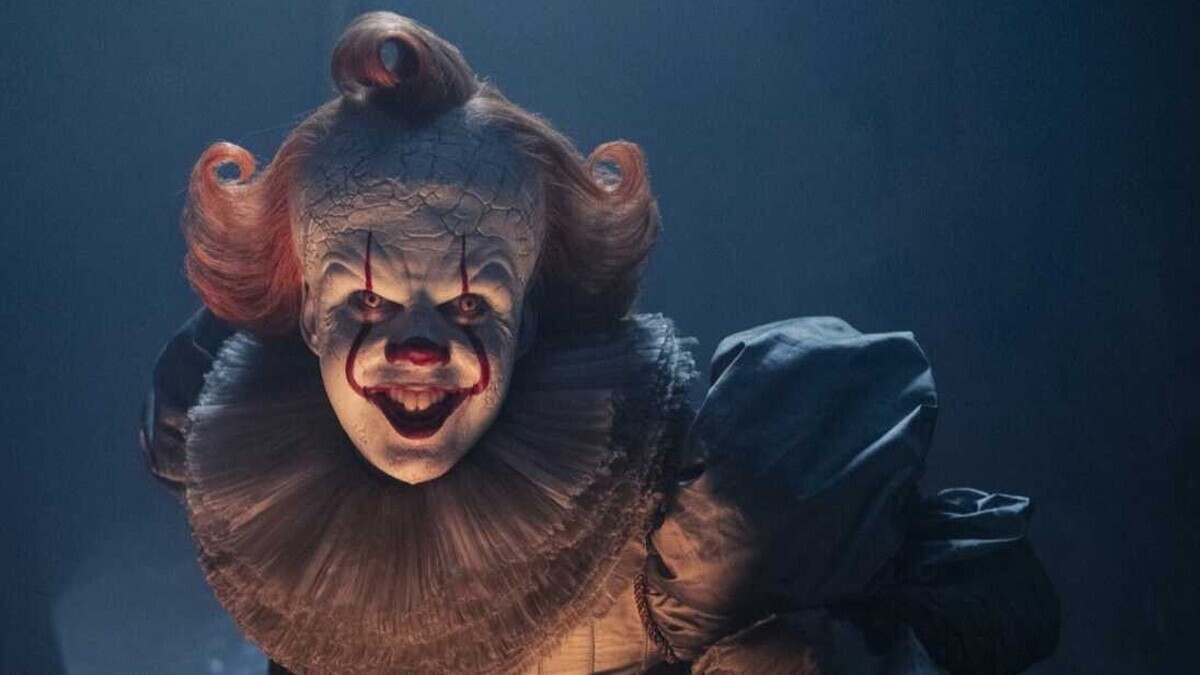
There was a time when clowns used to be funny. Don’t ask me why — I don’t really get it — but they would amuse and delight people the world over. Nowadays, however, clowns are mostly used in fiction to torment and terrorize people, especially children (and Batman). Still,while clowns have mostly absconded from the world of funny, most depictions of scary clowns still have a bit of dark humor to them, as though hilarity residue remains from their previous comedic incarnation.
As far as terrifying clowns go, none has proven to be more popular than Pennywise from Stephen King’s It, which has been a bestselling novel, a hit miniseries in 1990 and two recent blockbuster films. Now, Pennywise is back in the HBO Max series It: Welcome to Derry where he torments kids back in the 1960s. And, while Pennywise delivers far more screams than laughs, there’s still a bit of dark comedy in the character, like in the original miniseries when Tim Curry’s Pennywise cackles at Richie while spinning a noisemaker in the library, or in the 2017 film, when Mike spots Bill Skarsgård’s Pennywise in the bushes and the grinning clown waves to him with a severed hand.
Those are the kinds of moments I reached out to Jason Fuchs about. After contributing to It Chapter Two, Fuchs became the showrunner of It: Welcome to Derry, which concludes tomorrow. But, before Pennywise goes back into hibernation, Fuchs joined me via Zoom to discuss Pennywise’s warped sense of humor in his show and in versions from days gone by in Derry.
Don’t Miss
Just to make sure we’re on the same page here, do you find Pennywise to be funny?
Oh yes. Pennywise is despicable and mean-spirited and cruel, but he has a sick sense of humor in the same way that characters like the Joker and Harley Quinn do. I’ve worked in the DC universe, but I consider myself a DC fan first, just like I consider myself a Stephen King fan first. And, part of the reason that we, as fans, love these villains is because they are funny in a dark, inappropriate, awful way. The sense of comedy that emanates from their totally cockeyed perspective of the universe in some ways breaks the tension, but it ultimately makes it much scarier, I think, because them being funny suggests a humanity to them.
I don’t think it’s a conscious realization for an audience — it certainly was not an immediate conscious realization for myself or our team — but as we did our deep dive, I was like, “Why are we so obsessed with Pennywise?” I’ve been working in this Stephen King Pennywise space since 2017. That’s a long time and it’s been even longer since I fell in love with the book, which I read at the inappropriately young age of 11. So, what is it that feels so compelling? I think the answer is that there is an aspect of humanity to Pennywise.
We say in the films, and this is from the book, that It has to abide by the rules of the form It inhabits. There’s certainly a cryptic element to that and it’s never fully explained, but what it suggests is that, when It is in the guise of a human form — and Pennywise is a human form — that there are some aspects of humanity that this interdimensional very-much-not-human being has to follow.
When you introduce comedy into a scary scene, what does it do to the horror? Does it enhance it and make it scarier? Is it a relief? How does the funny affect the scary?
From a writing perspective, the comedic moments in horror really do unlock something in the audience emotionally. When you’re laughing, you’re invested. When you’re laughing, you’re connected. So, in a weird way, you’re asking the audience to be vulnerable, and then you are taking advantage of that vulnerability as a storyteller. You’re saying “Care,” and then you’re taking advantage of that caring with something dramatic and unexpected.
There was a moment in Episode Five this season where Pennywise looks at the kids and says “Duck and cover!” and every time I see that, I laugh because he’s playful in a moment where he is about to try to slaughter these poor would-be young heroes.
But, I think it’s fun to understand the different varieties of Pennywise’s humor. I think that Pennywise has moments that will register as comedic to the audience — like the “Duck and cover” beat — but there are also moments that are funny only to Pennywise that play totally differently. So, when Pennywise is pursuing Lilly through the sewers in Pennywise form, but then he momentarily switches to the guise of her father, he thinks that’s funny as hell, but we as an audience don’t because we’re in Lilly’s perspective.
We’re playing with different elements of comedy and very dark humor and trying to weaponize them in different ways, whether it’s to make the audience laugh and open themselves up to engaging in a human way. Or, other times, it’s about showing Pennywise’s cruelty, which sharpens your sense of revulsion at this character. Pennywise loves what he does. There’s a joy in the hunt, there’s a joy in the kill, there’s a joy in the suffering and I think that’s disturbing in our show and also disturbing when you read the novel.
And, we are certainly the beneficiaries of how brilliantly constructed the original character is. We’re also the beneficiaries of Bill Skarsgård’s performance. Bill is able to balance so many different things in those moments. He’s an extraordinary performer.
To me, the moment that perfectly summarizes Pennywise’s sense of humor is when he waves at Mike with that severed hand. It’s so funny.
Because you can see he’s making himself laugh! He’s enjoying what he’s doing, which makes him even more horrible and terrifying.
In the writing process, did you give any thought as to why this space alien spider-thing would even have a sense of humor? Because It’s not even really a clown.
Well, It is an interdimensional shape-shifting being whose true form is light.
Right, sorry.
I think it’s fun to speculate why he has a sense of humor. I didn’t create Pennywise. I’m the momentary custodian of one of my favorite characters, so all I can offer are my theories and my thoughts.
I think it’s fair game to go, “Does It have this point of view because It has been around for so long and has seen so much human cruelty and It is a product of the human cruelty It has seen? Or, is the human cruelty itself a product of It’s interactions? It’s a bit of a sinister chicken-and-the-egg. So, I think It’s personality could be attributed merely to it taking the shape and abiding by the rules of the forms it inhabits — like the cruel human form of Pennywise — but it’s also possible that It has more of its own personality from back in The Macroverse, before It landed here, than we understand because so much of It’s history is still shrouded in mystery.
I’m not sure if you’re a fan of the original miniseries, but the library scene in that is very funny.
The library scene I remember very clearly. I saw the miniseries quite soon after I read the book. I grew up in Manhattan and there was a video store on Third Avenue between 84th and 83rd called Video Room and I can still visualize that double-deck VHS set of the It miniseries. I remember slipping it into our batch of rentals without my folks noticing and watching it in secret. And, that library scene, I just thought was brilliant. I’d never seen anything like it. It, as a narrative and also its sense of humor, were things that stayed with me for many, many years.
Here’s a question. So, there’s that dark comedy in the modern It and in the 1990 miniseries, but is it in the book? I’ve read it three or four times myself and I’m struggling to remember if that is in there. Do you think it is or was that an element that needed to be added to adapt It to a new medium?
That’s a great question. I think I do see it in there. I think that the main comic engine in the book is Richie. Richie is a funny character. And, even thinking about Pennywise’s first encounter with Georgie, there’s black comedy in there. The experience you have when you’re reading that is, you’re cringing and smiling and going “Oh, no, no.” That building sense of threat and the sense of playfulness that Pennywise has with Georgie is dark and terrifying and, I think, in that scene, Pennywise is amused by his own horrific antics.
Disclaimer : This story is auto aggregated by a computer programme and has not been created or edited by DOWNTHENEWS. Publisher: feeds.feedburner.com