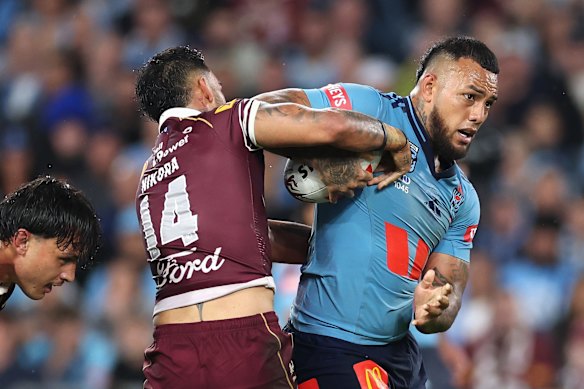
Last week’s NRL State of Origin series opener broke the proverbial broadcasting box office for the Nine Network. In an increasingly crowded subscription media market and a structurally declining free-to-air TV industry, having the rights to the NRL games can be a company maker or breaker.
The bidding has now started for the next round of broadcasting rights, with the NRL ambitious to score more than $4 billion for a five-year contract kicking off in 2028. It’s game on!
Rugby league is considered the world’s most brutal and gladiatorial mainstream football code. No surprise, then, that negotiation with the NRL’s supremo Peter V’landys for the industry’s television and subscription rights is a strategically brutal match for media companies, and every bit as risky.
The lead-up to what will likely be the largest sport broadcasting auction in Australia feels like a pre-game video of players limbering up in the sheds with sprints, ball tosses and tackle pad ramming.
The media has been swamped with leaked talks about who is bidding for free-to-air rights and which of the subscription streamers have V’landys on speed dial.
Last week, Nine Entertainment – the owner of this masthead – made headlines in one of its other publications, The Australian Financial Review, when it was outed as a bidder for the whole NRL package of free-to-air and subscription rights – a price tag which could run above $4 billion over five years.
For Nine’s chief executive Matt Stanton, an offer of this size certainly looked like a big swing – particularly when the media company’s market capitalisation is only $1.5 billion.
Days later another headline hit – that Foxtel was also making a play for both subscription and free-to-air rights (although Foxtel would need to effectively sublet the television rights to a free-to-air network because anti-siphoning rules dictate that some major games need to be free to all people).
There are plenty of risks associated with Foxtel’s bid for subscription rights to the NRL, the largest being that it needs to keep the sport in its portfolio of programs on its Kayo service. To lose it would put immediate pressure on subscriber numbers and Kayo’s boast that it is the dominant sport subscription service.
This story was followed by yet another this week, that Network Seven – which already carries the AFL free-to-air broadcast rights – wants to pick up some of the NRL games. There was even a suggestion that billionaire Gina Rinehart’s recent financing of a 10 per cent investment in Seven parent Southern Cross Media might somehow provide the network with additional financial firepower.
And there has been plenty of speculation in between, including that Amazon’s streamer Prime has put its hand up to take a few weekly matches, as has Paramount.
It certainly looks like there is a level of confection around the bidding war, generated by a crafty NRL. Suggestions that the league might look to share the free-to-air rights between two networks (for example Nine getting Thursday and Friday-night games and Seven getting Sundays) and even fragment the subscription rights across multiple streaming services only add to the air of competitive friction.
Whether this would actually increase the total revenue the NRL gets for rights is questionable, and it may ultimately limit the number of weekly viewers if fans are forced to pay for two streaming services to get the entire suite of games.
V’landys is as shrewd as it gets. But he also commands the media rights to a sporting property matched only by the AFL, whose broadcast rights are currently held by Foxtel and Seven, which plays major games free to air.
There is a risk attached to Nine paying for subscription rights and free-to-air rights – but only if it overpays. The company would dearly love to turbocharge subscribers for its Stan sport streamer. Stanton understands that subscribers are more valuable than the advertising dollars generated during Nine’s broadcast. This is why subscription rights are the biggest part of the overall package.
(The NRL’s current deal is worth $2 billion over five years – $400 million a year, about $130 million of which comes from Nine for the free-to-air rights.)
But Stanton does appreciate the halo effect for Nine in broadcasting the NRL free to air.
During game one of State of Origin, almost 5.8 million watched across Nine’s main channel and 9Now. That’s around one in four adult Australians, an extraordinary result given the NRL code is native to only two states.
Stanton clearly recognises the drawing power of this marquee sport to Nine’s ratings, but he needs to get a commercial return because some analysts are already fretting about the risks of overpaying for a marginal financial gain.
V’landys, like any good auctioneer, is tirelessly working the room.
The Market Recap newsletter is a wrap of the day’s trading. Get it each weekday afternoon.
From our partners
Disclaimer : This story is auto aggregated by a computer programme and has not been created or edited by DOWNTHENEWS. Publisher: www.smh.com.au