He said the quiet part out loud. As the artistic director of New York’s Public Theater and one of the art form’s most prominent leaders, Oskar Eustis is known to do that. And as always, he got the art world talking.
When Eustis, 67, announced Wednesday that he would step down from his role at the Public in 2028 — after 23 years — he said in a New York Times interview that “the American nonprofit theater movement is over.” This has been whispered about and lamented since the COVID-19 pandemic led to temporary theater closures across the country that have since become permanent, but it is rare to hear it expressed so candidly.
Did Eustis, one of the key players in that vaunted movement — the man who helped foster “Hamilton” — really mean what he said? And if so, how does theater move on in the face of obstacles that at times feel as though they are scattered across an increasingly difficult course? In a wide-ranging follow-up interview with the Los Angeles Times, Eustis addressed the path forward.
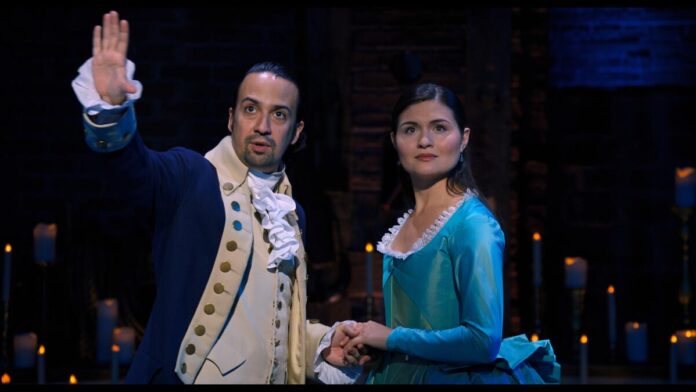
Lin-Manuel Miranda and Phillipa Soo portray Alexander and Eliza Hamilton in “Hamilton.” The megahit premiered off-Broadway at the Public Theater under Oskar Eustis in 2015.
(Disney+)
It’s not an easy one, but Los Angeles theater leaders working in the trenches, including Tarell Alvin McCraney at Geffen Playhouse, Danny Feldman at Pasadena Playhouse and Snehal Desai at Center Theatre Group, already knew that. They talked with the Los Angeles Times about their plans at the crossroads reached by American theater in light of Eustis’ imminent exit.
Eustis traces the rise of the American nonprofit theater movement to the late 1950s when W. McNeil “Mac” Lowry, director of the arts and humanities program at the Ford Foundation in New York, began organizing existing regional theaters into a national movement.
“What happened during that period was that a consensus emerged,” Eustis said, noting that it was expressed in the form of national endowments, state arts agencies, public policy institutes and corporate philanthropic departments. “An idea of the common good was held throughout the country, and there were many stakeholders. And part of that idea of the common good was a broadly held belief that Americans deserved serious, non-market-driven performing arts.”
With no feudal background, America lacked a capital city like London or Paris designed to showcase the arts, so the idea spread across all 50 states. This led to the proliferation of the regional theater movement, said Eustis, as well as that of symphony orchestras and ballet companies.
“The explosion of the regional theater movement is actually, in retrospect, astonishing,” Eustis said. “From a few scattered theaters in the 1950s, by the early ‘70s, there were over 400 professional nonprofit theaters in every state of the union. Tens of thousands of people were employed. Millions and millions of audience members every year. That’s the field that I walked into in the early ‘70s.”
Fifty years later, those stakeholders have “absolutely zero consensus on whether theater should exist as a nonprofit performing arts field or whether we should exist at all,” Eustis said. “It’s gone.”
“We’ve kind of been living, in a way, off inertia of this old idea,” he added.
The great pandemic pause, along with the racial reckoning in the wake of George Floyd’s murder and the continued fracturing of a shared reality under President Trump, all served to reveal how fragile that consensus was, Eustis said, and, “It’s not coming back.”
Where does that leave American theater in 2026?
“We’re faced with the need to prove to the people in our individual communities that we matter enough to them that they should support us,” Eustis said. “Now, that’s not a very bad demand to put on an art form.”
Except, as every theater that has lately dared put on a show created by new, experimental or unknown artists knows, it can feel like an insurmountable task.

Danny Feldman, artistic director of Pasadena Playhouse, said that the days of theaters underpaying talent are over.
(Brian van der Brug / Los Angeles Times)
Smaller theaters across the country, including many in L.A., have shuttered with staggering regularity in the last six years, which puts even greater pressure on the city’s most prominent nonprofits to shine a light on a sustainable model moving forward.
Feldman, Pasadena Playhouse’s artistic director, noted that Eustis represents the second generation of leaders of the “first chapter” of the nonprofit regional theater movement. “And that to me is what is now undeniably at the end.”
He said he and Eustis have discussed the subject at length. “We are now in a very different era. And the things that got us to this point are not the things that are going to get us to the next chapter.”
McCraney, Geffen Playhouse’s artistic director, said forging a path forward in nonprofit theater without succumbing to commercial pressure to produce only guaranteed hits requires the delicate balance of surfing.
“And there’s no better place to surf than in L.A.,” McCraney said over the phone from the Public, where he was meeting with Eustis and other theater leaders to share ideas. “I feel very connected to a bunch of folks who recognize that the regional theater model has always had to have radical vision, and that those radical visions need revision, because our most practical job is to make sure that communities have stories.”
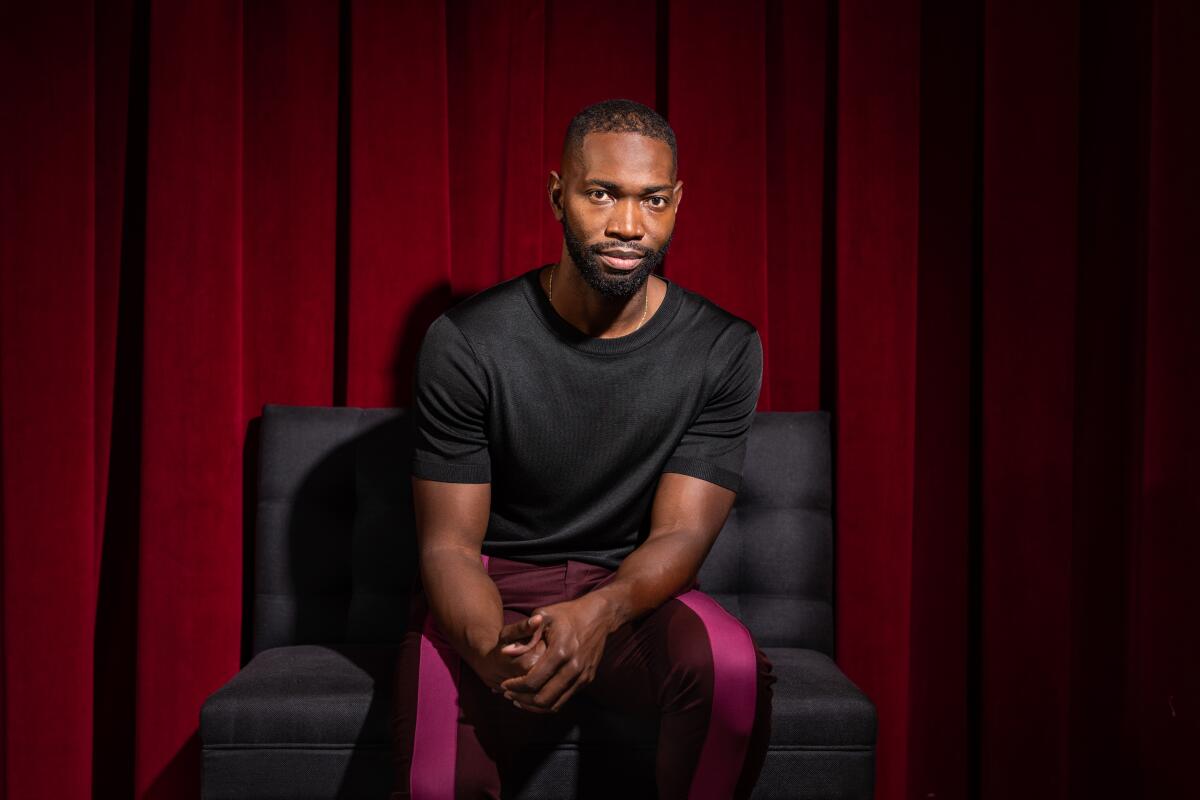
Tarell Alvin McCraney, artistic director of Geffen Playhouse, compared the balancing act theater leaders must perform to surfing.
(Jay L. Clendenin / Los Angeles Times)
It’s not just the way theater tells — and funds — stories that must evolve. It’s the entire business model, the leaders note.
The beauty and the founding of the original regional movement, said Feldman, was artists saying, “New York is not just where it’s at. We’re going to go to our communities. We’re going to make things with and for them, and really build these ecosystems that are deeply entrenched in these local communities around the country. … And I think the underbelly of that — that maybe has not been discussed as much — was always an element of subsidized labor involved.”
In L.A. and elsewhere that meant a lot of artists in the front and back of the house working for incredibly low wages. The pandemic effectively put an end to that, and as workers demanded fair compensation, the cost of producing shows skyrocketed. Most theater leaders agree that part is as it should be. Eustis points to the recent unionization of the Public’s production department as a case in point.
“For the first time in history, everybody who’s swinging a hammer on our productions has health insurance,” he said. “They have it through the union. That’s a good thing. And it’s put a shock wave through the whole industry, but you know what? We figured out how to pay development directors. We should figure out how to pay carpenters. That’s part of growing up.”
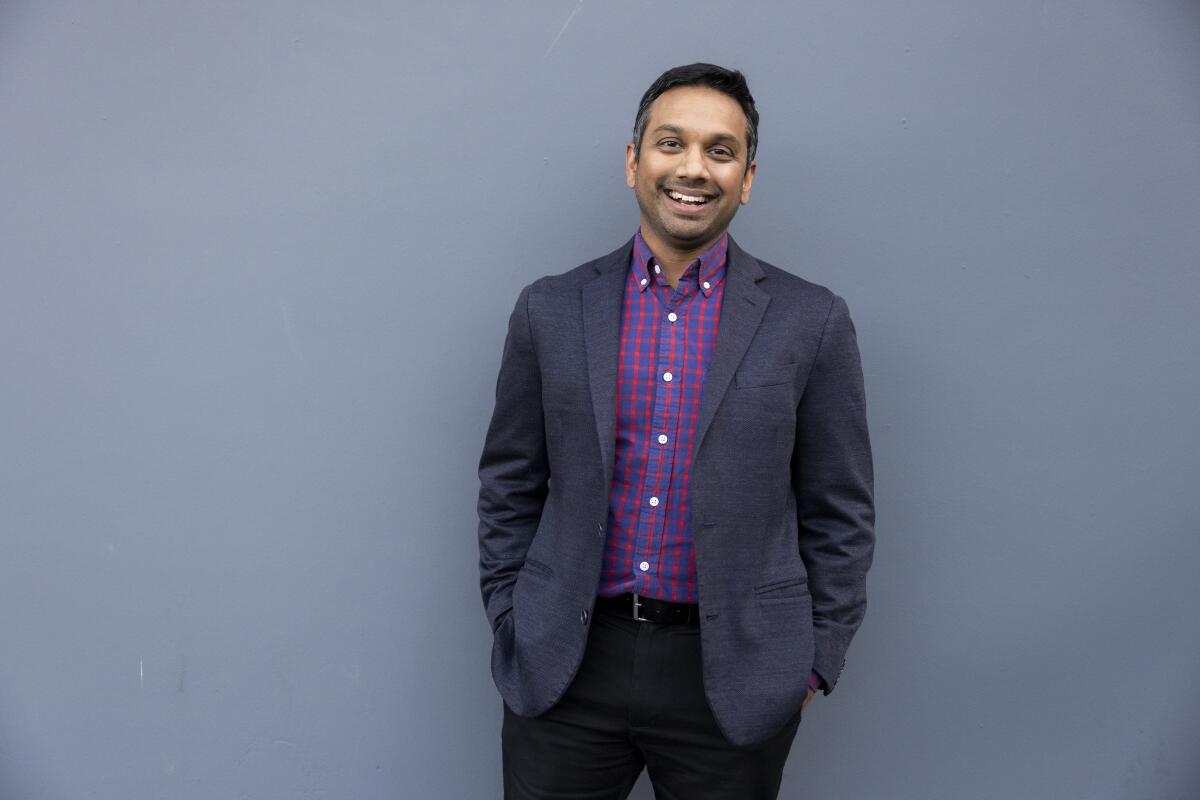
Center Theatre Group Artistic Director Snehal Desai said Oskar Eustis’ departure from New York’s Public Theater represents a “pass the mantle” moment.
(Etienne Laurent / For The Times)
Desai, CTG’s artistic director, said he views Eustis’ decision to step down as a “pass the mantle moment.”
“Oskar has been a huge mentor to so many of us,” Desai said. “It’s up to us, the next generation of leaders, to figure it out, just as his generation did in the ‘60s, ‘70s and ‘80s when they built these institutions for us.”
At CTG that means exploring a new way of doing things including touring shows, intensive work in various communities and site-specific productions, all of which “can change the financials and the model of how we’re doing business.”
As for Eustis? He plans to leave the Public in the best possible shape for the next generation of artists, and never wavers from its core mission. “This is a theater of democracy that believes that the culture belongs to everybody,” he said.
More to Read
Disclaimer : This story is auto aggregated by a computer programme and has not been created or edited by DOWNTHENEWS. Publisher: latimes.com