Updated ,first published
THEATRE
All About Eve ★★★★
Malthouse Theatre, until 12 December 12
Originally a short story that evolved into a radio play, All About Eve is best known for its multiple Academy Award-winning 1950 film incarnation, which starred Bette Davis as brittle stage star Margo Channing, fighting for her place in the sun against a younger upstart, Eve Harrington, who waits impatiently in the shadows, scheming to usurp her mentor’s place.
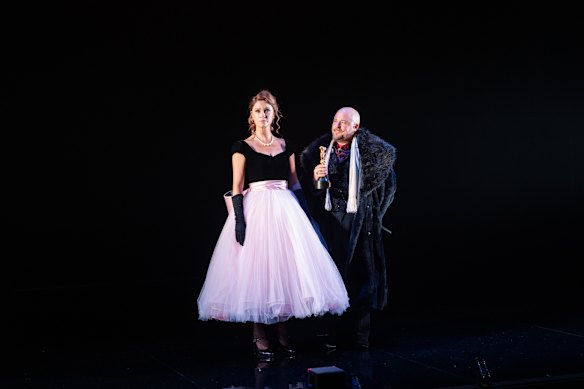
Based on Ivo Van Hove’s West End adaptation and directed by Dean Bryant, the major difference in this production is that Christie Whelan Browne plays both roles. It’s a bravura tactic that showcases her ability to switch back and forth from the perky 24-year-old newcomer desperate to break into show business to the experienced but jaded professional who’s already paid her dues to demanding theatre moguls.
Not only does Whelan Browne have to consider voice and pitch changes, but also the nuances of posture and body control, and she manages the transitions superbly, moving seamlessly from meek, soft-spoken Eve to imperious, husky-voiced Margo.
The story begins at an award ceremony celebrating Eve’s burgeoning career and then unspools to reveal how she reached such an elevated position.
It’s a tale of how a bright-eyed ingenue inveigled herself into the world of a garlanded Broadway diva through the wife (Christina O’Neill) of a playwright (Kevin Hofbauer), and landed a job as a personal assistant, gaining access to the actor’s circle of friends and professional acquaintances.
The role of the conniving rival is always interesting to watch, and there’s a certain fascination in seeing the measure of Eve’s ruthless ambition. She plays the long game. Margo is, in some ways, complicit in her downfall; her fragile ego feeds off the adulation of her adoring fan before too late realising she’d inadvertently invited a viper into her nest.
As the night progresses, the psychological changes in Browne’s dual roles become evident: Eve’s growing impertinence and confidence, and Margo’s jealous unravelling. Having just recently celebrated her 40th birthday, she’s already insecure about her relationship with director Bill Simpson (Junior Nyong’o), who is eight years her junior.
Whelan Browne is well served by her supporting cast, all of whom put in sterling performances: Brent Hill as the acerbic theatre critic whose oily influence makes him a good foil for Eve, Nyong’o as Margo’s supportive but exasperated partner, O’Neill and Hofbauer as the couple charmed and manipulated by Eve, and Tea Moma and Evelyn Krape, who play several characters, with the latter offering an ebullient portrayal of producer Max Fabian.
The set and costumes fully lean into the ’50s aesthetic with its fabulous frocks and glittering surfaces, not just around the mirrored dressing room table but also the reflective floor and video inserts. There’s a dark glamour in this sleek, stylish production.
In this age of Botox and Ozempic, it’s not difficult to be sympathetic to Margo’s plight to remain sexually and commercially viable.
With its exploration of ageism and the objectification of women, and the tensions between emerging and established forever pertinent, All About Eve will resonate with a modern audience – particularly those in the creative industries who’ve tried to infiltrate what they believe is a tightly controlled, gate-kept arena, and alternatively, with any seasoned artist afraid of losing their hard-won position to an unscrupulous neophyte.
Reviewed by Thuy On
THEATRE
Wake in Fright ★★★★
Union Theatre, until November 27
Welcome to the Yabba. The water is undrinkable, the unquenchable heat seeps into your every pore and sweat-slicked dust clings to your every orifice – but the beer is cold, and most importantly, free-flowing.
The latent claustrophobia and “aggressive hospitality” of fictional outback mining town Bundanyabba was memorialised in Kenneth Cook’s 1961 feverish nightmare of a novel, Wake in Fright, a searing indictment of white Australia that was adapted 10 years later into a film by Canadian-Bulgarian director Ted Kotcheff – commercially panned at the time before it was duly acknowledged as a critical masterpiece and rescued from the annals decades later.
Declan Greene and Zahra Newman are resurrecting the tale once more for stage after it premiered at Malthouse in 2019, with Newman again taking on this one-woman show.
The tension of Wake in Fright is derived, in part, from the illusion of safety that it lulls you into before yanking the rug out to reveal the foolhardiness of the artifice that underpins our conceptions of self and truth. And so it goes in this stage adaptation.
Audiences enter the theatre to the sight of an oversized bumbling bear tottering on stage – revealing itself to be Newman playing Lead Ted Jr, a mascot symbolising the unconscionable lead poisoning that, for decades, has plagued Broken Hill, the town that Bundanyabba is based on.
The economic disenfranchisement and psychic impoverishment of the Yabba are grounded within a calamitous, real-life mining disaster – one of the many times Greene and Newman render the implicit explicit.
That Newman is a migrant woman of colour playing the quintessential Aussie bloke John Grant is no accident. Wake in Fright has always been predicated on the idea of the outsider looking in, and Newman represents the ultimate interloper in a nation increasingly defined by a repudiation of anyone who isn’t white.
Newman is a master at controlling the mood of the room, engaging us in seemingly (but never actually) mindless chitter chatter about the inanity of the loaded question “where are you from?” before silencing titters with a turn of her head.
At first, the play hews closely to the book, with Newman expertly inhabiting different characters – policeman Jock Crawford, miner Tim Hynes, Doc Tydon – before it unspools into a series of hallucinatory impressions that evince John’s gradually deteriorating mind and evoke the book’s darkest moments.
Verity Hampson’s precisely calibrated lighting, James Paul’s thrumming and incessant sound design and the freewheeling audiovisual projections by Friendships conjure the emotionally charged game of two-up that obliterates all of John’s money and, later, the infamously horrific kangaroo hunt that John is subsumed into. But by truncating the story, some of its discomfort is lost – the play’s unspeakably dark ending, which differs from the source material, arrives too quickly and seemingly without cause.
Yet, this phantasmagorical reimagining of a perennially resonant Gothic horror couldn’t have come at a better time. By inducing the underlying paranoia that increasingly fuels public life in ways that are as illogical as they are terrifying, Wake in Fright suggests that there has never been and there never will be any redemption for white Australia.
Reviewed by Sonia Nair
DANCE
Pieces 2026 ★★★
WXYZ Studios, North Melbourne, until November 28
After stints at the Substation and UMAC, Lucy Guerin Inc’s Pieces has gone inhouse again, returning to the company’s studios. It puts the audience closer to the action, although the crowded rooms and ad hoc seating offer a lot less comfort than a theatre.
Luke Currie-Richardson’s WHOdaU is the strongest of this year’s pieces. It begins with Currie-Richardson beneath a small spotlight, wearing a mask fringed with long, pale grass. Across one long studio wall, a projection shows an idyllic sandy coastline.
His torso lists in lazy, liquid circles, movement sloshing in the ample bowl of his hips. Gradually, the oceanic rhythm is disturbed by sharp geometries and isolations, while the coastline glitches into glimpses of Flinders Street Station and other scenes of the city.
The fragments of street dance are in their turn gradually absorbed into a rhythmic stomping and low, hunched shapes, a slick transition suggesting something of Currie-Richardson’s six years with Bangarra Dance Theatre.
He stays within the narrow spotlight while panoramic images unfold behind. The relationship between body and projection is plain but effective: his dancing becomes a kinetic commentary, developing alongside the changing landscape without labouring its connections.
More emphatic dance figures emerge as he builds towards a final removal of the mask. It’s a strong finish: after so much movement without a visible face, the person comes momentarily into focus, giving gestural force to the work’s concern with visibility.
In the smaller Studio Two, Helen Herbertson plays with packing paper, light and shadow, accompanied by quiet piano. A doily becomes a fascinator, a paper sheet becomes a cape, and scraps of text suggest little fairytale characters.
Most intriguing is a paper hand attached to her own, its flatness warping as her arm bends. Every rustle and whisper registers, but the packed room feels airless: it’s a somewhat diffident experiment by this influential dance maker.
In the final piece, Martin Hansen chops speech and movement into stuttering repetitions in a meandering dance-essay that begins with the concept of hypersea life: the idea that life carried the ocean inland within itself, as the circulatory system. It’s a work full of clever segues and transitions, from topic to topic. At times, however, it feels rather prosaic: Hansen pours in more words than can be managed effectively as choreography.
Nonetheless, there’s an appealing urgency to this imbrication of movement and thought, even though it’s quite loose. His longing for a paradise that is right now, already with us, under our very feet if we could only see it, is effectively communicated.
This is Guerin’s last Pieces before Melanie Lane takes over as company artistic director next year. The showcase deserves to continue, but a return to the old 10-minute commissions might sharpen its focus, especially if it remains in the studios.
Reviewed by Andrew Fuhrmann
The Booklist is a weekly newsletter for book lovers from Jason Steger. Get it delivered every Friday.
 Thuy On is an arts journalist, critic, editor and poet.
 Sonia Nair is a contributor to The Age and Good Food.
From our partners
Disclaimer : This story is auto aggregated by a computer programme and has not been created or edited by DOWNTHENEWS. Publisher: www.smh.com.au