
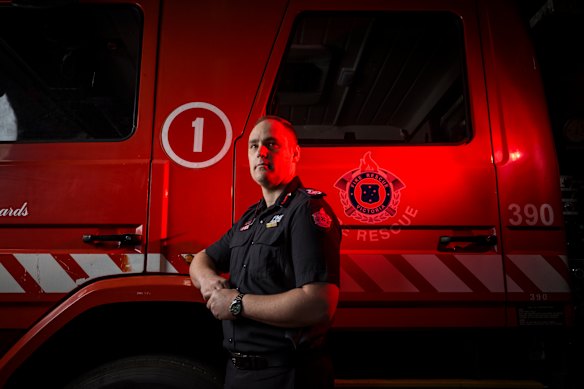

Disposable vapes, toys, singing birthday cards and rechargeable tools are among the battery-operated devices causing thousands of fires in waste and recycling centres in a massive and escalating problem across Australia.
There are an estimated 10,000 to 12,000 battery-related fires in Australia’s waste and recycling system every year, says ReTHiNK Waste Tasmania, a consumer education initiative between the Tasmanian government and the waste-management sector.
Staff often deal with fires, but state fire brigades have been called to hundreds of blazes at waste and recycling facilities across Australia so far this year, including 86 in NSW alone, and batteries were often suspected to be the cause. Fire Rescue Victoria said it was called to fires involving a lithium-ion battery daily across all settings and that it was a growing problem in waste management, but it was unable to provide exact figures.
The fires are a safety risk for staff in the waste and recycling sector, a crippling financial burden for companies that can no longer buy insurance to protect assets, and an environmental problem because of toxic air pollution and the setback to recycling efforts.
NSW Fire and Rescue Commissioner Jeremy Fewtrell said the distinguishing feature of a battery fire was how quickly they started because of the volume of energy stored in the battery cell.
“One minute, it’ll be sitting there looking very benign,” Fewtrell said. “A second or two later, it’s a very intense fire, often spitting embers and pieces of battery out, which can also spread the fire into other parts of the rubbish or the recycling pile.”
Fire Rescue Victoria Deputy Commissioner Joshua Fischer said the fires posed significant safety risks, and also serious environmental harms because “fires can release toxic pollutants and harmful contaminants into the air, soil and waterways”.
Fire and Rescue NSW reported 86 fires at waste and recycling centres between January 1 and September 14 this year, compared with 114 for the whole of 2025. There were also 44 fires in garbage trucks so far this year, compared with 62 for the whole of last year, and the vast majority started in the garbage compactor or load-carrying compartment of the truck.
“When I was a firefighter and on the trucks [before 2011], it was very, very seldom that you would be going to a garbage truck fire, and now they’re much more prevalent,” Fewtrell said. “A large part of that is, we believe, due to lithium-ion batteries being included in the waste or the recycling streams.”
Lithium-ion batteries are highly combustible under heat or pressure, while standard household batteries such as AA can also cause fires but are less volatile.
West Australian Department of Fire and Emergency Services Deputy Commissioner Jon Broomhall said lithium-ion batteries that were damaged, crushed or overheated could trigger “thermal runaway” – a chain reaction in which batteries produce intense heat and release flammable gases, leading to ignition.
“The conditions inside rubbish trucks or waste facilities are especially conducive for battery ignition as items are often compacted and crushed,” Broomhall said.
In January 2025, Veolia’s waste-sorting centre in Cairns was destroyed by fire, thought to be caused by a lithium-ion battery, resulting in material having to be diverted to landfill. Veolia also had a facility in NSW offline for several months because of roof damage. The company has shared footage from its security cameras showing six fires in two months at one recycling plant – the Bibra Lake Materials Recovery Facility in Western Australia – in a bid to raise awareness of the problem.
Visy chief executive Mark De Wit said companies had to invest in cameras that were always manned, infrared guns to monitor heat, water cannons and fire extinguishers. The fires were particularly hard to extinguish in a recycling centre full of plastic, which was oil-based, or cardboard, he said.
“We had [a fire] yesterday, we had one the day before, it’s almost a daily event and it’s always a battery,” De Wit said, when asked about the issue at the Visy Recycling Roundtable. “It is completely company-agnostic. Visy’s lost a site in the last five years. Re.Group has lost a recycling site in the last five years. Cleanaway has lost a site in the last five years. Most recycling facilities can’t get insurance any more because of the fires.”
Cleanaway confirmed this; Re.Group was contacted for comment.
Veolia chief operating officer Carmen Loecherer said the fires were a daily occurrence and that she was worried about staff safety. She knew that batteries were the culprit because video footage often showed a battery igniting, or employees had found a battery in an audit.
“In particular when there are fires in vehicles that transport waste, we pull it out and we try and find the culprit,” Loecherer said. “Usually, it’s still smouldering when we put it out, and 99 per cent of the time it’s a battery.”
Both Veolia and Visy said products with embedded batteries such as disposable vapes and birthday cards, and rechargeable hardware tools or toys, were the biggest problems. The companies called for other states to copy the NSW product stewardship scheme that forced manufacturers to fund more collection points and consumer education. However, illegal vapes sit outside that system because the producer is not always identifiable.
In WA, the Department of Fire and Emergency Services reported 40 fires at waste-disposal facilities across the state between January 1 and June 30, with seven proven to be caused by batteries. That compared with 70 fires over 2025, with eight proven to be caused by batteries. The department said the true number of battery fires would be higher because it was often difficult to prove the cause.
The Queensland Fire Department was unable to say how common this was because its data collection did not distinguish fires at waste and recycling centres from other industrial settings.
Get to the heart of what’s happening with climate change and the environment. Sign up for our fortnightly Environment newsletter.
 Caitlin Fitzsimmons is the environment and climate reporter for The Sydney Morning Herald. She was previously the social affairs reporter and the Money editor.Connect via email.
From our partners
Disclaimer : This story is auto aggregated by a computer programme and has not been created or edited by DOWNTHENEWS. Publisher: www.smh.com.au





