Funny game, cricket.
Peculiar, mostly, and occasionally remarkable theatre. Multiple formats and a raft of abilities have helped the sport become the second most popular on the planet, behind soccer.
Test cricket in particular has a lengthy, storied and well documented history. While contemporary players have tried to reinvent the wheel in the hope of leaving a legacy, the guts of the game have changed little since the 19th century.
Eleven a side, three stumps, 22 yards, overarm since the 1850s. The ball is almost identical in colour, size, mass and constitution to what it was back then.
If you visit the remarkable SCG museum, you can see a Test cricket ball from 1890. Though its leather hide is fading back towards its natural brown hue, you could take the ball out of the showcase and throw it to Nathan Lyon out in the middle, and he would grip and drift it as usual.
The complexities of a game played over multiple days in varying environments by humans with unique quirks, eccentricities and individualities throws up more possibilities than quantum physics.
Over 2639 Tests up to and including the third Test between South Africa and Australia in Cape Town, patterns have become imprinted. Cricket is stained by generalisations gleaned from 150 years of Tests and over a century of play before that, and one of them is that “when you win the toss, you should bat”.
Firstly, the toss of the coin determines the immediate progress of the game upon which may ride the careers of its participants.
Millions of dollars in revenue are also at stake if the match doesn’t go the distance.
On a grassy pitch, bowling may take preference because it can give your team an advantage – but only if the conditions evolve towards a drying deck and browning grass, hence a less receptive surface for the ball’s seam and less deviation off the deck when it comes your turn to bat.
A damp early pitch that dries to a runway accentuates the advantage of calling correctly – if your bowlers are good enough and their batsmen are not.
In recent times we have endured Test pitches slathered in grass that neither browns nor changes its spots. The result of a head call over a tail just doesn’t matter.
Many sports have a coin spin to determine who might kick off or in which direction a team might run, or kick. That decision, too, can have ramifications if the weather is fickle, but not so much to do with the playing surface itself.
I’m yet to hear a football coach blame the toss for losing. Batsmen having “first use” traditionally respond with expansive strokeplay, essentially on the premise that “you have to get the bowlers before the bowlers get you”.
Travis Head carries that torch, although the state of the pitch doesn’t really change his approach; he’s always trying to get bowlers before they get him. Sometimes that works spectacularly. Often it doesn’t. But a career average in the 40s is a useful number even if he opens the batting only about 20 per cent of the time in Tests.
Perhaps the neoclassical example of a batsman taking the ultra-explosive launch pad is Sam Konstas against Jasprit Bumrah at the MCG on Boxing Day in 2024. His ramping, flicking, swiping 60 off 65 on debut dammed India’s momentum. He was subsequently dropped for his innovation and individualism and, two years later, there is still no resolution to Australia’s opening conundrum.
History, through uncovered pitches and horse-drawn compactors, tells us that the bat-first philosophy is more or less sound, because you don’t want to bat last when the pitch is destined to be at its most unpredictable.
Is the game more attractive to fans when off-spinners like Nathan Lyon and Simon Harmer are bowling? Absolutely.
We still swoon at what the late, great Shane Warne brought to the game. Cricket needs guile and cunning as much as speed and brute force.
Mechanical rollers and computer-controlled watering systems have taken much of the curator’s art out of pitch preparation. Soon enough, AI will be issuing orders for a “brief sprinkle” or a “light roll” to produce the “perfect deck”.
Drop-in wickets, too, have become problematical as they are mostly bland, and bland pitches lead to bland cricket. Evenly bouncing, non-deviating pitches might be de rigueur for the formulas of white ball cricket, but Test matches and its patrons demand plot twists.
The formula for a perfect Test is beyond solution. The fascination is in trying to find it. Without a true cricket soul, AI hasn’t got a hope.
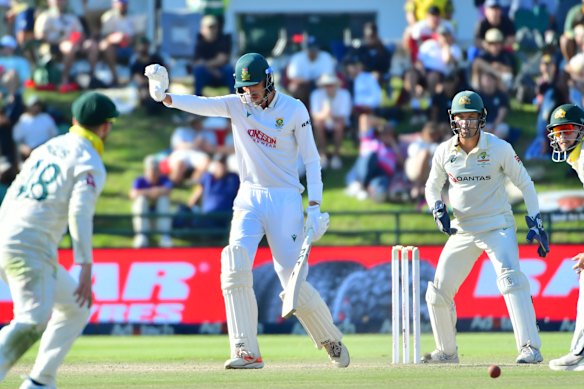
Skipper Pat Cummins and coach Andrew McDonald pawed over the Newlands pitch before the toss, fondling, caressing, squinting and listening to the living 6mm couch resting on the Bulli beneath (yep, same name as the SCG soil from North Wollongong), searching for moisture.
Apparently, they found a trace, and decided to bowl. Were they protecting a frail batting group from exposure to the first, fresh, day-one new ball, and giving their own fabled bowlers a head start?
There’s nothing wrong with that theory if your judgment of the pitch is spot on. Judging pitch behaviour is more art and experience than science.
Throw in Mitchell Starc, Josh Hazlewood, Cummins and Marco Jansen’s size umpteen boots with javelins for spikes, and you have the perfect recipe for impact craters around a good length as the match wears on.
Newlands was an excellent Test match surface. Batsmen had to work hard for runs against quality fast and slow bowling. Errors leading to dismissals have outweighed the role the pitch has played.
South Africa’s batsmen fought bravely and skilfully on day four with the series on the line.
Australia toiled and schemed just as manfully. Getting the game into day five meant more wear and tear on the pitch, just as it should be.
It has been a real Test: complicated, complex, skilful, physically draining, mentally taxing.
I’m not an advocate of batting first every time you win the toss. Conditions change and judgment from the greybeards is counselled.
Cricket is an organic, outdoor game where “the elements are the presiding geniuses” (Sir Neville Cardus). Flexibility and adaptability are keys.
When this final day is done, the judgment will be made on the team winning the toss and deciding to bowl, thus being forced into batting last – a situation historically littered with losses. Then again, it’s always nice to leave a legacy by creating history yourself.
From our partners
Disclaimer : This story is auto aggregated by a computer programme and has not been created or edited by DOWNTHENEWS. Publisher: www.smh.com.au