Melbourne unit rents are at a record high, jumping $25 a week over the past year and adding more pressure to tenants desperate to find an affordable home.
The median asking rent for a Melbourne unit was $600 a week in the September quarter, and the typical house costs the same after rising $20 a week over the past year, Domain’s latest Rent Report, released on Thursday, showed.
Rents were steady over the past three months, while the vacancy rate was also flat, but still tight, at 1.4 per cent.
Although September is a quiet time of year for the rental market in Melbourne, experts say a lack of available properties is fuelling competition and keeping rents high.
By region, the largest rent rises this quarter were in the unit market, showing tenants are looking for cheaper rentals.
Unit rents rose 3.3 per cent in the inner east to $620 per week, 2 per cent in the north-east and 1.1 per cent in the west. The only region where house rents rose was the inner south.
Domain chief of research and economics Dr Nicola Powell said Melbourne was still a landlords’ market, even though rents remained unchanged in September, as the vacancy rate remained below levels considered a balanced market.
She said the September quarter was a seasonally weak time for the rental market.
Tax changes for property investors in the May budget are yet to hit Melbourne’s rental market, Powell said, but she believed it would not be as affected as other capitals.
“Investors left the market in Melbourne a while ago because of weak capital growth and higher land taxes at a state level, so the exposure to further changes is going to be less so than other capital cities,” she said.
Grattan Institute senior associate Matthew Bowes agreed the federal tax changes would not have a significant impact.
Melbourne’s market was in better shape than other capitals given more houses had been built, which would help lower competition for rentals.
“The federal tax changes won’t significantly change housing demand,” Bowes said. “Lots of new owner-occupiers will take up housing and that will balance the market.”
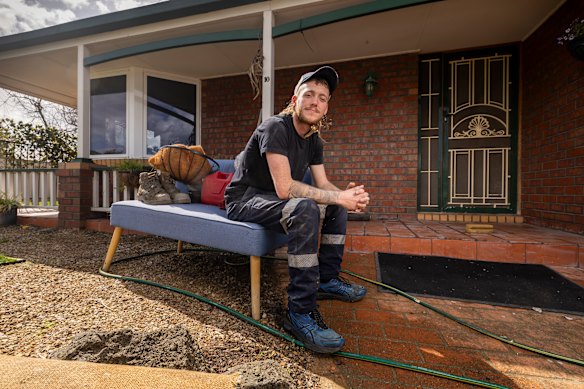
The difficulty in finding a rental is a reality for many tenants like Declan Kelly who is looking for a home in Melbourne’s west.
The 22-year-old qualified carpenter, renting a house in Hoppers Crossing, needs to fast track his move after it was listed for sale by the owner – his mum. His family has moved interstate and no longer needs the home.
Kelly is looking to rent with his girlfriend and said he had inspected at least 15 properties over the past month from Lara to Melton, applying for them all, but has had no luck.
“I’ve been looking at three-bedroom houses, one-bedroom granny flats … I don’t care what it is, I’ve just been applying for everything,” Kelly said.
If he cannot find a rental, Kelly and his girlfriend face a grim reality – living in a broken down campervan left to him by his grandfather.
“If I need to, I’ll just have to park it out the front of someone’s house and live there with my missus and a dog which isn’t ideal.”
Ray White Hoppers Crossing director Fatima Zahra said the rental market was extremely tight, with lots of competition from tenants.
The latest interest rate rise had meant first-time buyers who would normally leave the rental market could no longer afford to buy a home after having their borrowing power cut and higher rents meant saving for a deposit was impossible.
“People choose to rent because they cannot afford to buy properties at the moment … so you find there’s more competition for rentals,” Zahra said.
Tenants Victoria’s director of policy, advocacy and engagement, Damien Patterson, said tenants were finding it extremely tough to find a rental, so much so, that many are scared to push for repairs.
“Vacancy rates remain really low and that has an impact on people,” Patterson said. “It means it’s difficult for renters to feel confident about raising an issue for repairs.”
Closer to the city, competition for a rental property was just as tough.
Jellis Craig Inner North head of department – property management, Nicole Katsivelas, said off-market renting was becoming a growing trend, with property managers offering rentals that are yet to be advertised when there is a lot of interest for similar ones already on the market.
While landlords would normally ready properties for sale in September, the federal tax changes meant they were hanging onto their properties in “decision limbo” unsure of what to do, Katsivelas said.
“They won’t get the same benefits if they sell their property and buy another,” she said.
Property listings
From our partners
Disclaimer : This story is auto aggregated by a computer programme and has not been created or edited by DOWNTHENEWS. Publisher: www.smh.com.au