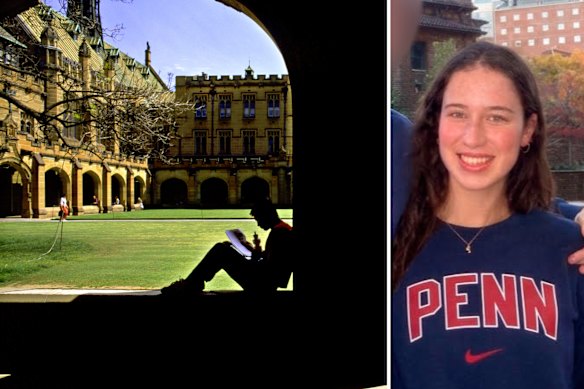
I returned from my exchange at the University of Pennsylvania with no fewer than 10 T-shirts and jumpers, an assortment of posters and pins, a mug, several tote bags and, much to my surprise, Penn-branded socks.
I went to Philadelphia halfway through a five-and-a-half-year degree at the University of Sydney, wanting more than a reprieve from the routine. I returned with something less portable than merchandise: a nagging suspicion that Australian universities are failing to prepare us for life after graduation.
Let me dispel one myth early. The content was not harder. My subjects were pitched at roughly the same level as their USyd equivalents and assessed in much the same way, with a similar weekly workload. If you were hoping for a tale of Ivy League rigour flattening a hapless Australian, I can’t oblige.
What differed was the delivery. My professors wrote everything by hand on a blackboard, working through each problem in real time. At home, lecturers often display pre-typed solutions and narrate over them, which is efficient but, I find, ultimately detrimental to the learning experience. Penn’s lectures weren’t compulsory, but they weren’t recorded either. Miss one and your sole recourse was a friend’s notes, so attendance became self-enforcing. Small weekly homework tasks, worth only a few per cent of the grade, obliged me to consolidate each week’s material instead of exhuming it in the final fortnight.
Then there was the cold calling. In classes small enough to allow it, everyone was called on once or twice a session. At USyd, a participation mark can usually be secured with one perfunctory comment, after which you are free to drift off. For someone who had never voluntarily raised a hand in an Australian lecture, this was petrifying. It was also where I learnt the most because I spent every minute knowing I might be next on the chopping block.
By the end of semester, my professors knew almost every student by name. At USyd, that relationship is largely outsourced to tutors, usually postgraduate students and, in my early years, undergraduates barely older than me.
The biggest difference of all were the students. Every American I met could articulate precisely why they were doing their degree and where it would take them. Second-year students outlined career trajectories that ran, without apparent irony, all the way to retirement.
They also asked questions. Constantly. They volunteered answers with no fear of being wrong and posed silly questions without a flicker of embarrassment. Australian lecture theatres, in my experience, are very different. They typically play out as follows: the lecturer pleads for a response, endures a long silence, then supplies the answer themselves. Tall poppy syndrome, as far as I could tell, had not been granted a visa.
This was the part that unsettled me. Three years into a dual degree, I was not sure where it was leading, and neither are most of my Australian university friends. I don’t think my American classmates are any more intelligent than us. They had simply been asked, much earlier and much more insistently, what they wanted to do with their lives.
For high-demand courses, an Australian teenager’s future hinges on a few weeks of exams in Year 12, distilled into a single number. American students carry that pressure across years of grades, testing, sport and side projects, and are nudged from the start of high school to work out what genuinely interests them.
I am a case study in what happens without that nudge. My ATAR, not my ambition, chose my degree. Like many of my friends, I was backed into a corner by a number.
The American approach, to be clear, is no utopia. It favours families who can pay for private tutoring and admissions consultants. Still, it makes teenagers confront a question that we put off for half a decade.
Another difference is how American universities compete for enrolments. The top universities chase the same students by focusing on the experience. Some campuses have gone as far as building lazy rivers; at Penn, faculties hosted dinners, the Dean threw a formal, and societies handed out doughnuts and sodas by the armful. My sock drawer, I now realise, was a line item in a marketing budget.
Australia’s roughly 40 universities are almost all public, large and broadly comparable, and with domestic fees regulated, their fiercest contest is for international students. The domestic student experience is largely overlooked. The 2025 Student Experience Survey found that only 37.3 per cent of domestic undergraduates enrolled on campus attended all their classes in person. Of those, 54.4 per cent felt a sense of belonging, compared with 45.5 per cent of students who mixed online and in-person classes.
I’m not suggesting Australia import the American system, price tag and inequity included. But much of what made Penn’s classrooms work would cost very little here. Lecturers could work through problems by hand and cold call in classes small enough to allow it. The people who set the exam could learn the names of the people sitting it.
If high school is too late to fix, universities must pick up the slack. In Australia, the name on your testamur rarely sets you apart. What distinguishes a graduate is what they did beyond the syllabus: the project they built, the team they played in, the society they ran. Universities should push students towards these from first year. Most of us, after all, are here to land a career and an income that can support the life we want to live.
Penn won me over with socks. Australian universities, I’m asking you for something worth far more: graduates who walk out knowing what they want to do next and how to achieve it.
Allegra Schubert is studying Commerce/Engineering at the University of Sydney.
From our partners
Disclaimer : This story is auto aggregated by a computer programme and has not been created or edited by DOWNTHENEWS. Publisher: www.smh.com.au