
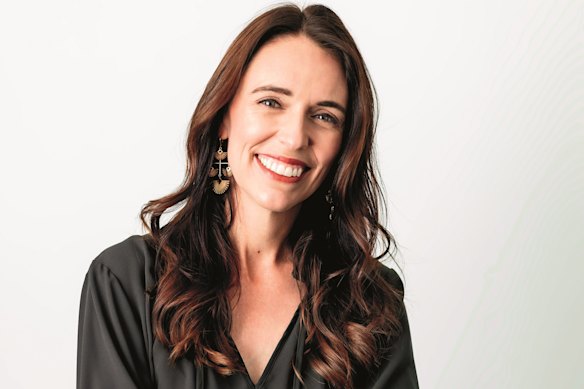
Jacinda Ardern is a former NZ prime minister who has just moved with her family to Sydney’s Northern Beaches.
Fitz: Jacinda Ardern! Thank you for your time, and for giving moi your first extensive interview on Australian soil. To what do we owe the pleasure of you and your family moving to our sunny shores?
JA: [Brightly] Just part of the adventure that we’ve been having since I left office, really. We had a period of time in the United States, and then the UK and then we thought, why not spend a little bit of time in Australia?
Fitz: What do you think “a little bit of time” might boil down to? Will we see you here for years or months?
JA: To be honest, we don’t know. I mean, one of the main attractions for us was the proximity to home. We’d been far away for a while, and we wanted to be closer to friends and family, but also wanted to get back to a life that was, you know, a bit like what we might have in New Zealand. But we don’t have a set time frame. We’ve never been much for five-year plans. We’re just taking life as it comes and really enjoying ourselves.
Fitz: And why Sydney, specifically, apart from us being the most beautiful city on Earth?
JA: [Laughing] You’re undoubtedly a beautiful city, and I say that all with the asterisks *** which is that New Zealand will always be the best place on Earth in my eyes. But, yes, every time I am coming in for a landing at Sydney Airport, I do say, “That’s a beautiful city.” But, why specifically, Sydney? Living beside the ocean is one thing, as that’s where my husband Clark’s happiest. Our daughter also gets great joy from being near the ocean and being a little closer to some wildlife. We particularly love your birds. We have lots of birds in New Zealand, but our birds are just much quieter than yours!
Fitz: Have you heard the expression that “Auckland is just ‘Sydney for learners’?”
JA: [Laughing uproariously.] No, I haven’t! And I’m not sure I would agree with that. Though I do note that in New Zealand, we think that “Auckland is Sydney, and Wellington is Melbourne”.
Fitz: When you’re flying into Sydney, and you have to mark on the arrival card what your occupation is, what do you say?
JA: It’s funny you ask this because every time I pause and I think, “What am I?” You know, “former PM”, is not really an occupation, and yet, so much of what I do is guided by having had that role. But sometimes I write “speaker”, sometimes I write “writer”. If there was more space I would put, “Washed-up politician”!
Fitz: As to your memoir, A Different Kind of Power, why did you call it specifically that?
JA: Yeah, I actually went through a few iterations. I wanted something short and punchy, and for a long time I was stuck on the idea of Run and my editor said to me, “It sounds like you’re running away from responsibility or running away from office” and I said, “Well, actually, it’s the evolution of the idea. I want people who fear something to actually move towards it, and I want people to run for office.” But in the end, the Americans thought it sounded like a jogging manual, and so we went for something a little longer. I liked A Different Kind of Power because the book ultimately seeks to promote an alternative form of political leadership entirely.
Fitz: Speaking of which, I would name you being up on one end of the spectrum of political leadership in terms of kindness and empathy and Donald Trump at the other end. Was it difficult for you, when you were living in Trump’s America, when you stand for everything that he does not?
JA: Yes, but not because of where I was living. Regardless of where in the world I am, I’m finding this particular time in politics to be very painful.
Fitz: I could have a good guess at what you might think of Trump’s politics. But do you ever feel you need to tailor your words about him – like now when I’m recording – given I presume you often head to the USA?
JA: [Flatly.] No. I strongly I disagree with his politics, and I disagree with his style of leadership, and I have no qualms saying that.
Fitz: STOP PRESS. In the wee hours of Thursday morning, I watched the Netflix doco on you, in the first two hours of it dropping. Loved it. In the first minutes, there’s footage of you lecturing Harvard students, where you warn of the dangers of “hyper-partisanship”, of treating politics as a binary choice between good and evil, right and wrong. I take that point, but in the case of Trump, does it not behove everyone who cares about the survival of liberal democracy to condemn him in the strongest of terms?
JA: I rarely speak solely about one leader – that implies we only have one problem. What we have in front of us is a failure of political leadership that we’re seeing around the globe. I want to challenge an entire style and way of doing politics, not just one politician.
Fitz: Julia Gillard told me a fortnight ago that the bulk of her own memoir – 120,000 words – poured out of her in six weeks, and she found it cathartic. Was your writing process like that?
JA: Yes and no. I mean, she told me that as well before I started writing. And there were indeed certain subject areas where I just sat down and I just wrote and I wrote and I wrote. The issue was the quality of that stream-of-consciousness writing was not always strong! The better stuff was when I took my time, and learnt how to write in long form. But I am very glad I did it, and it was good to get my thoughts down.
Fitz: Your husband Clarke recently told me a fabulous story of how, when the possibility of you becoming leader of the NZ Labour Party was first raised, you had said to him, “I don’t want this to affect our relationship if I do it, so are you OK with it?” He replied, “It won’t. Go for your life,” whereupon he went on a scuba diving fishing trip to Australia. A week later he comes up from a dive off the NSW south coast, to see an Australian bloke with a big head leaning down to him in the water, and he says: “Mate, you better phone home. Your missus says she’s got a new job.” And 53 days later you were prime minister!
JA: Yes, it was an absolute whirlwind, and it wasn’t something I expected. I certainly never saw myself running to be prime minister, let alone becoming prime minister. So it was a whirlwind. And then you throw into the mix: me becoming pregnant [during the campaign]. It was an amazing time.
Fitz: Amazing! In seven weeks, you go from being 20 points behind to – bang, bang, bang – winning the whole shebang! You must have been putting something out there that the people wanted. What did you bring?
JA: I’d like to think I just brought myself. There was no time to rebrand or be anything that I wasn’t, and I was determined to bring positivity to that campaign, and also what I’ve always called “pragmatic idealism”. You know, I always want to talk about the destination that we should be on, the place that New Zealand can and should be, but be really pragmatic about the steps it’ll take us to get there. Now, Peter, for instance, I believe in free education all the way through to tertiary education, but I couldn’t deliver that in one term – but we could do one year free. And so that was an example of the trajectory we pursued. We wanted to be big and visionary, but also honest about what it would take.
Fitz: On this side of the Tasman, you were most famous for two things. The first was your very strong stance on shutting New Zealand borders when COVID came, and vigorously pursuing lockdowns. Both moves no doubt saved thousands of lives, and yet, would I be right in saying that you take a lot of flak for those decisions to this very day?
JA: [Wearily] There are some who disagree to this day with our approach on COVID. But not the majority.
Fitz: Looking back, would you do anything differently in the first 100 days of COVID?
JA: Actually, it’s the last 100 days I think about even more – the exit – things like how the new tool for protection, which was vaccines, were deployed. When we were in office, we instigated a royal commission to go away and independently tell us what we should have done differently, and there’s now actually been two, and I’ve always said I accept those findings.
Fitz: What were they?
JA: They found that actually we did the best we could with what we knew. There were some things around the margins that they suggested doing differently, but the margins matter. I don’t want to diminish their importance.
Fitz: You were also highly lauded for your approach after the Christchurch massacre, including immediately turning up wearing a hijab. Where were you when you heard of our own massacre at Bondi, and what did you make of Australia’s response?
JA: I was visiting the Northern Beaches. One of the things that stood out to me at the time was that we are increasingly experiencing these horrific levels of violence and extremism towards communities in our part of the world – and just how hard it is to be a political leader in those moments. So I don’t sit and critique those who are in positions of power during difficult moments like that. Instead, I just sent a message of support to Albo.
Fitz: Was there a reform you abandoned because the political cost was simply too high?
JA: There was a policy I abandoned because the numbers wouldn’t deliver for me. We put up a proposal for a capital gains tax, but [the political party] New Zealand First did not support it and so I made a political decision to take it off the table. But I think that’s a reform that New Zealand has long needed.
Fitz: When you resigned, you said you “no longer had enough in the tank”. Was that about exhaustion, political headwinds, or something deeper?
JA: A bit deeper than that. I could have kept going. So it wasn’t an indication of burnout. I wasn’t in the foetal position in the corner. But I did not believe I could keep going and perform the job to the standard that I had set for myself, and I recognised that I needed to have that sense of responsibility to hand over to someone else.
Fitz: Do you think the style of politics that you champion – collaborative, displaying empathy, kindness – can survive in an increasingly polarised world?
JA: I think it’s key to … the survival of democracy. We’ve been on a trajectory where citizens around the world increasingly feel a sense of grievance to political institutions. They’ve lost trust in them. And now we see laid on top of polarisation, a sense of insularity, a lack of trust of others. These are all things that certain styles of politics have contributed to, [advanced] by politicians who choose to use polarisation and insularity as tools, and it is causing us to be fractured. It’s weakening people’s trust in democracy and politics and politicians. So in my view, rebuilding that trust, rebuilding those institutions, actually requires a different approach to politics, and I know there are politicians out there who believe that, too, who are quietly building consensus, you know, working with integrity and transparency and doing their best in very fraught situations. They just don’t get spotlighted as much as those who are operating on the edges.
Fitz: OK. Last question. Can you give me a percentage chance between 0 and 100 – please – that 25 years from now, your daughter. Neve Te Aroha Ardern Gayford, will be at a Bledisloe Cup match and cry out, “Carn the Wallabies!”
JA: [Laughing] Zero! Absolutely, ZERO!
Fitz: Thank you for your time. Carn the Wallabies.
 Peter FitzSimons is a journalist and columnist with The Sydney Morning Herald.Connect via X.
From our partners
Disclaimer : This story is auto aggregated by a computer programme and has not been created or edited by DOWNTHENEWS. Publisher: www.smh.com.au


