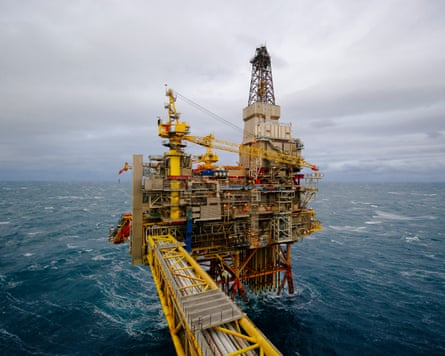
More people can fit on to the top deck of a standard London bus than will be directly employed on the new Jackdaw gasfield in the North Sea, industry documents show.
Only 27 direct full-time jobs would be created by Jackdaw, one of the biggest gasfields remaining in the North Sea, according to an environmental impact assessment filed publicly by its owner, Adura, a joint venture between Shell and Norway’s Equinor.
The document states: “Over the lifetime of the field there would be a consistent level of employment averaging at nearly 500 jobs a year in direct, indirect and induced employment – this includes 273 direct jobs which exist on the Shearwater host installation and [an] additional 27 Jackdaw-specific jobs.”
The fossil fuel industry, along with the Conservatives, Reform UK and sections of the Labour party, is lobbying Andy Burnham, the incoming prime minister, for Jackdaw and Rosebank, an oilfield west of Shetland, to be given the go-ahead.
On Thursday some media reports suggested Burnham was preparing to announce new drilling. Advocates say the sites would support thousands of jobs.
But green campaigners said the impact on the UK economy of exploiting the fields would be minimal. Angharad Hopkinson, a political campaigner at Greenpeace, which uncovered the Jackdaw jobs figure, said: “Fossil fuel cheerleaders have repeatedly defended new oil and gas developments by claiming they are vital for employment. Those claims look increasingly difficult to justify when the developer’s own documents tell a very different story.”
Tessa Khan, the executive director of Uplift, a campaign group, said: “It would be a mistake if the first thing Andy Burnham does as prime minister is cave into the demands of the profiteering oil and gas industry.
“These are companies that have made obscene profits, while our energy costs have skyrocketed. New North Sea drilling will not take a penny off our bills, it will just make a handful of executives and their shareholders even richer.”
The platform for drilling Jackdaw will be unstaffed for most of its operating life. Much of the construction has already taken place in Norway, with limited scope for UK workers.
Hopkinson said: “[This] confirms it’s never been workers who stand to gain most from projects like Jackdaw – it’s fossil fuel companies and their shareholders. If this is the best case they can make for more oil and gas under a collapsing climate, it’s a case that’s run out of road.”
Adura said Jackdaw would support additional jobs in the supply chain. A spokesperson said: “Jackdaw and Rosebank will support 3,500 jobs at peak construction with 880 high-quality, well-paid jobs sustained throughout production in communities across the UK.
“The projects will generate a combined gross value added of over £28bn across their lifetimes and generate immediate tax revenues of £1.4bn before the end of this parliament.”
Jobs in the North Sea have been in decline for two decades as more than 90% of the resources have been extracted.
Uplift has cast doubt on industry claims of tax revenues from the projects, because the tax reliefs offered on developments are so high that they will largely outweigh any returns. The British public would carry almost all of the costs of the development of Rosebank in the form of tax breaks, the group argues.
Labour made a manifesto promise that no new oil or gas licences would be issued. However, both fields were in the licensing system at the last general election, so proponents argue they can go ahead without breaching the commitment.
Green campaigners have attacked the loophole as against the spirit of the pledge. Fatih Birol, the world’s leading energy economist, told the Guardian opening the fields would do little for the UK’s energy security.
A consultation on Jackdaw will finish on 8 August. Adura set out its environmental impact assessment for Rosebank on Thursday before further consultation on that field, claiming the resulting greenhouse gas emissions would be small.
Khan said the assessment underestimated the impact on the climate crisis from the greenhouse gas emissions resulting from the field. Rosebank would create carbon dioxide equivalent to 70% of the UK’s annual emissions, which was “undeniably significant”. She added that it would not meaningfully boost UK energy supplies, saying: “It’s overwhelmingly oil for export.”
Adura said: “Jackdaw and Rosebank will be among the lowest emissions developments in the UK continental shelf [UKCS], itself one of the most highly regulated and lowest emissions oil and gas basins anywhere in the world.
“Across Adura’s portfolio of new developments – including Rosebank and Jackdaw – average production emissions intensity could be as much as half the UKCS average and around eight times lower than emissions intensity associated with imported liquefied natural gas.”
Disclaimer : This story is auto aggregated by a computer programme and has not been created or edited by DOWNTHENEWS. Publisher: theguardian.com