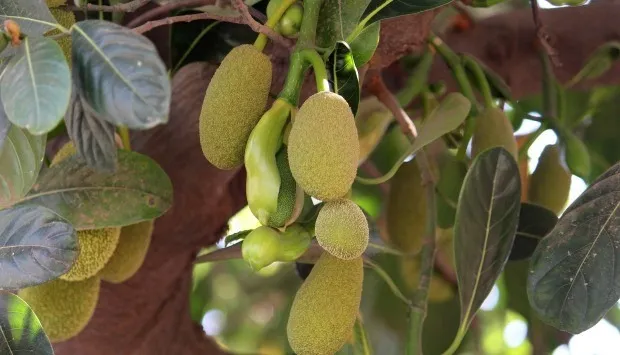
Cut open a ripe jackfruit, and you are greeted by its golden-yellow flesh, sweet aroma and sticky, fibrous peel. While the juicy fruit often finds its way into curries, chips and desserts, its thick outer covering usually ends up in the bin.
Researchers at the National Institute of Technology (NIT) Rourkela, however, have found another use for this often-discarded part of the fruit. They have turned jackfruit peel into a material that removed more than 90% of fluoride from contaminated water in laboratory tests, in about 10 minutes.
The idea brings together two things that rarely make it into the same conversation: fruit waste and safer drinking water. For families whose groundwater contains too much fluoride, which can damage teeth and bones over time, this innovation could eventually offer a more affordable way to make drinking water safer.
How does jackfruit peel help clean water?
The secret lies in what researchers have made from the peel. The team converted discarded jackfruit peel into activated carbon and modified it with zirconium, a metal that helps the material capture fluoride from water.
Prof. Susmita Mishra, Professor in the Department of Chemical Engineering at NIT Rourkela, explains the thinking behind the innovation.
“The key idea behind this technology is to use an agricultural waste material as a resource for water purification. We prepared activated carbon from discarded jackfruit peel and modified it with zirconium to improve its ability to capture fluoride from water,” she adds.
The material showed promising results in laboratory tests, removing over 90% of fluoride within approximately 10 minutes under the tested conditions.
Fluoride occurs naturally in water, but drinking water containing too much of it over a long period can damage teeth and bones. This condition, known as fluorosis, can affect both children and adults.
Removing excess fluoride, however, is not always straightforward. Reverse osmosis, a widely used water treatment method, can waste considerable amounts of water and remove minerals such as calcium and magnesium. Other methods, including ion exchange and activated alumina, also come with limitations, including the use of chemicals that can raise environmental concerns.
The NIT Rourkela team’s approach explores whether an agricultural by-product can help make fluoride removal more accessible.
What did the researchers find?
In laboratory experiments, the jackfruit-peel-based material removed more than 90% of fluoride from water containing around 1–5 milligrams per litre. Under the tested conditions, the team recorded removal efficiencies of over 90–97% within 10–20 minutes.

The researchers have also secured a patent for the technology. The team comprises Prof. Mishra and Dr. Pratima Minz, Research Graduate at NIT Rourkela.
They estimate that preparing the material costs approximately Rs 37 per gram, based on the electricity and chemicals used in its synthesis.
These are promising early findings, but there is still some way to go before the material can be used to treat drinking water outside the laboratory. The research has reached Technology Readiness Level 4 (TRL 4), meaning the material and its underlying concept have been validated in a laboratory environment.
What happens next?
For families in rural and semi-urban areas where groundwater contains excess fluoride, an affordable treatment option could make a meaningful difference. The researchers hope their material could eventually be used in decentralised water treatment systems, bringing purification closer to the communities that need it.
Prof. Mishra says, “The potential of this technology lies in its use of an easily available agricultural by-product to develop a cost-effective material for fluoride removal. In the long term, the technology could contribute to water treatment solutions for communities in fluoride-affected regions, subject to further testing and validation.”

The next step is to develop a physical prototype and test how the material performs in practical conditions. The team will also study its long-term performance and operating costs to understand whether it can be deployed on a larger scale.
A discarded jackfruit peel is not yet ready to make drinking water safer on its own. But this research offers an interesting possibility: something routinely thrown away could, with further development, become part of a solution to a problem that affects communities across India.
Disclaimer : This story is auto aggregated by a computer programme and has not been created or edited by DOWNTHENEWS. Publisher: thebetterindia.com