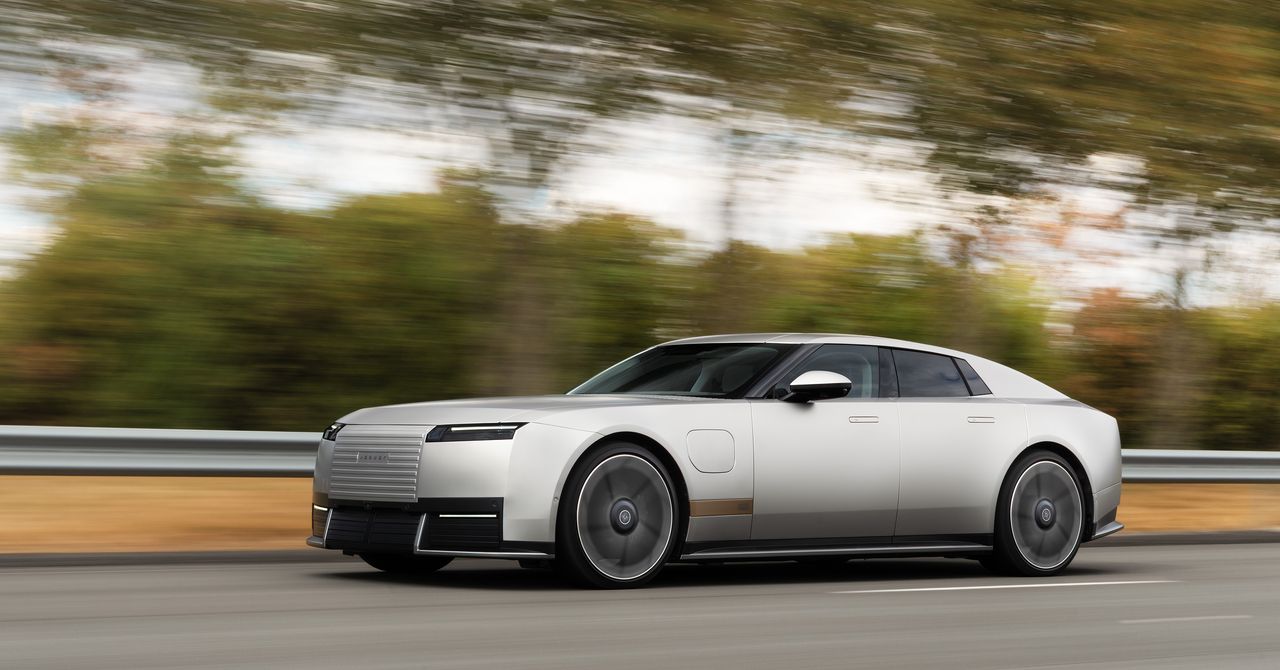
The day has finally arrived. Jaguar began its long road to electric reinvention in November 2024 with a firestorm of a rebrand featuring no cars. Just a month later, it revealed a prototype: the Type 00—a car so polarizing it practically broke the internet’s automotive enclave. Some loved it; others hated it so much that Jaguar’s own staff were targeted for supposedly betraying the company’s 90-year history.
Since this chaotic but undoubtedly viral launch, major departures have followed, including Jaguar Land Rover’s (JLR) chief creative officer Gerry McGovern, the notable car designer who signed off on Jaguar’s divisive all-electric design and the no-car ad campaign.
Jaguar’s managing director, Rawdon Glover, is a brave man. Through this shitstorm, and a frighteningly long period of selling no new cars whatsoever, he’s remained unflappable; utterly confident that, when people see the final car—the finished version of the luxury four-door GT that is “like no other”—everything will make sense. That moment is here. The company finally revealed the Jaguar Type 01 at an event in New York City on Tuesday—the finished version of the Type 00. (Jaguar Land Rover paid a portion of WIRED’s travel expenses so we could attend the launch.)
“A bold grand tourer that never arrives unnoticed, like all the best Jaguars of the past,” Jaguar’s press material says. This is most certainly true: you will see this thing coming. The low roofline, short front and extended rear overhangs, long hood, and huge 23-inch wheels all remain from the prototype, just as promised. The cab-rear design hides a 50–50 weight distribution, and the huge surfaces make it hard to square the fact that this is the most aerodynamic Jag ever, with active vanes, a deployable spoiler, and airflow trickery delivering a drag coefficient of 0.23 Cd.
Crucially, the production model’s extra doors make more sense of the design, shifting the Type 01’s look away from Thunderbirds territory to more familiar ground. The front has been softened ever so slightly as well, which again is preferable to the prototype’s exceedingly bluff nose. The rear, however, is where the exterior design really shines with hidden-until-lit, full-width lights embedded in horizontal strikethroughs.
Let’s get the specs out of the way: the Type 01 is the most powerful Jaguar road car, with up to 1,030 Pferdestärke (PS) and 1,365 Newton-meters. It goes from standstill to 62 mph in 3.2 seconds. Justifying the tagline of “power in reserve,” the car can rocket from 62 to 112 mph in a further 4 seconds. I’ve been driven in it, and it feels like the acceleration never ends thanks to the tri-motor setup of a 260-kilowatt (kW) front motor paired with twin 310-kW rear motors.
It stands 5,235 mm long and 1,403 mm tall, but all-wheel steering makes it feel much smaller on the road. The 850-volt bespoke Jaguar architecture and 118-kilowatt-hour usable battery supposedly deliver an EPA range of up to 400 miles (450 miles on WLTP), with a “sustained highway speed” range of up to 320 miles. Drivers can add up to 200 miles of range in 13 minutes using 350 kW rapid DC charging. So the TL;DR? It’s huge, fast, aerodynamic, powerful, and, most definitely, unique.
Inside, a dramatic central spine runs the full length of the cabin, creating a zone for each occupant. Lots of “brass-inspired” finishes are intended to underline the luxury message. A panoramic glass roof with adjustable virtual blinds brings in the light, but there’s no rear windscreen. Instead, a digital “ClearSight” rearview display is embedded centrally in the full-width panoramic soundbar at the base of the windscreen to show what’s behind. Cleverly, the feed from this rear-facing camera is positioned at the same height as the door mirrors, supposedly reducing the annoying focal adjustment these systems usually demand.
Ahead of the driver is a 24-inch OLED screen that extends toward the center of the car. A central 7-inch smartphone-style display sits between the driver and front passenger for common controls such as climate and audio, operated entirely by touchscreen with (sadly) no physical switchgear in sight. “Hot stone massage effect” seats, whatever those are, are also electrically adjustable in 12 different ways. Cabin air purification removes allergens, toxins, and particulates, and a fragrance diffuser offers a choice of scents—which seems to be the pinnacle of what Western auto companies think a luxury car interior needs these days.
As a grand tourer, luggage space is important. The Type 01 offers 450 liters of load space, expanding to 1,000 liters with rear seats folded. And then there are the production stories: Jaguar built more than 150 prototypes, drove 700,000 miles, and filed more than 360 patents while developing the car.
Jaguar is most proud, and rightly so, of its “impossible panel.” It’s a single, unbroken panel that runs more than 3 meters from the A-pillar to the rear of the Type 01. Pressing this huge piece with five different acute angles in it was deemed not possible by Jaguar’s modeling system. After roughly 22 weeks and 1,500 hours of development (supposedly requiring someone to come out of retirement), Jaguar realized this “impossible” panel.
Pricing of the Type 01 is possibly the most important thing Jaguar has to nail. Starting at around $170,000 (or £130,000—no confirmed pricing yet), this puts the Jag well below Ferrari Luces, electric Merc G-Wagens and Lamborghinis, and even the new Bentley Torcal, exactly where Glover wants to sit. Jaguar thinks it has a sweet spot in luxury EVs, a Goldilocks zone where buyers are eager to part with cash for electric cars that aren’t astronomical but priced high enough above the premium sector to be legitimately highfalutin.
No one has really succeeded with the luxury EV market. Porsche has tried. So has Lamborghini. Mercedes has had a very tough time. Now Bentley is having a crack at it. Glover thinks that the Type 01 has a shot.
“One of us is going to break through the glass ceiling and make a success of EVs at elevated price points,” Glover tells me. “The best way to do that is not to play into the tropes of EVs. You’re not going to get there because it’s an electric car. You’re going to get there because the car itself looks a certain way, feels a certain way, drives a certain way. If you can do all of those things, [it doesn’t matter] whether it’s combustion or electric. Just being an electric car was enough for such a short period. Cars have got to earn their right in somebody’s garage.”
Disclaimer : This story is auto aggregated by a computer programme and has not been created or edited by DOWNTHENEWS. Publisher: wired.com